
Hosted vs. Self-Custody Wallets: A Beginner's Guide to Choosing Your First Cryptocurrency Wallet
New to crypto? Learn the difference between hosted (custodial) and self-custody cryptocurrency wallets and decide which is best for a beginner. Secure your assets!
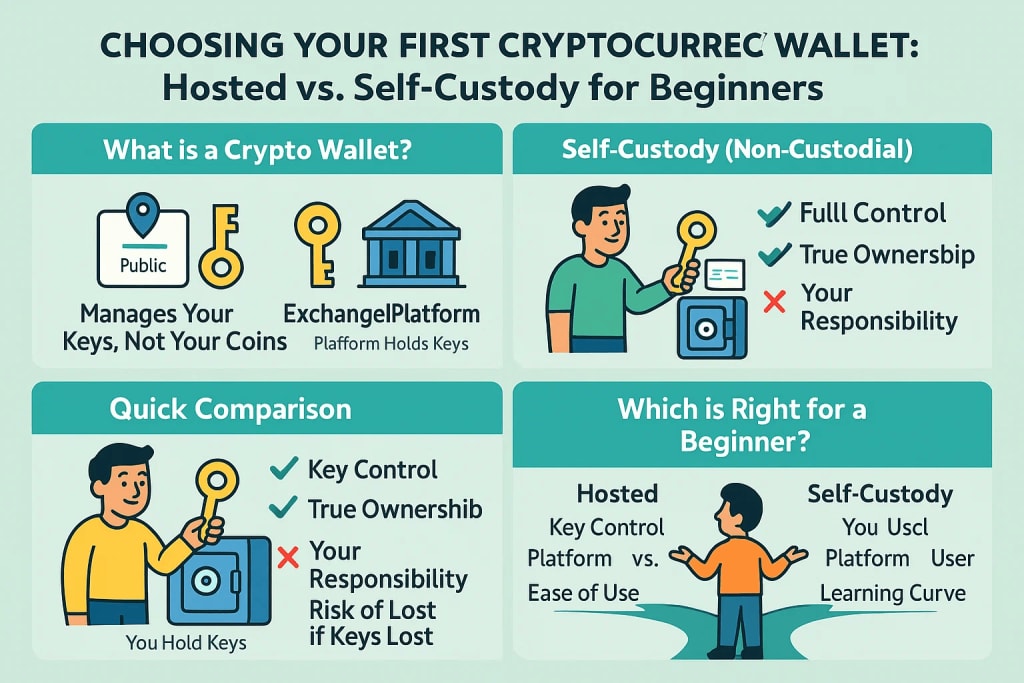
Welcome to the exciting world of cryptocurrency! As you embark on your crypto journey, one of the first and most crucial decisions you'll face is choosing the right cryptocurrency wallet. You've likely heard terms like "hosted," "custodial," "self-custody," or "non-custodial," and it can all seem a bit overwhelming. Don't worry! This guide is designed for beginners to break down these concepts in simple terms, helping you understand the differences, pros, cons, and ultimately, which type of wallet is right for you.
Before we dive deep, let's quickly address some common questions:
What is the difference between hosted wallet and custodial wallet?
A hosted wallet is essentially another term for a custodial wallet. Both refer to a cryptocurrency wallet where a third party (like an exchange or a dedicated wallet provider) manages your private keys on your behalf. They "host" or "custodially hold" your crypto assets for you.
What is the disadvantage of a custodial wallet?
The primary disadvantage of a custodial (or hosted) wallet is that you don't have direct control over your private keys, and therefore, your funds. This is often summarized by the crypto mantra: "not your keys, not your coins." You are trusting the third party's security and operational integrity. If the platform gets hacked, faces regulatory issues, or goes bankrupt, your assets could be at risk or inaccessible.
What is the best self custody wallet for beginners?
The best self-custody wallet for beginners prioritizes a user-friendly interface, straightforward backup and recovery procedures (typically involving a seed phrase), and clear educational resources. Software wallets like Exodus or Trust Wallet are popular starting points due to their ease of setup on mobile or desktop.
What is the best cold wallet for beginners?
For beginners looking at cold wallets (hardware wallets kept offline for maximum security), the best options are those with intuitive setup processes, robust security features, and good customer support. Devices like Ledger Nano S Plus or Trezor Model One are well-regarded, offering a balance of security and usability once the initial learning curve is overcome.
Now, let's explore these wallet types in more detail.
Understanding Cryptocurrency Wallets: The Basics
Before comparing hosted and self-custody options, it's vital to understand what a cryptocurrency wallet actually does. Unlike a traditional leather wallet that physically holds cash, a crypto wallet doesn't technically "store" your cryptocurrencies. Your digital assets, like Bitcoin (BTC) or Ethereum (ETH), always exist on their respective blockchains – decentralized digital ledgers.
So, what does a wallet do? It stores and manages your digital keys:
Public Key: Think of this as your crypto account number or email address. You can safely share your public key (or more commonly, a wallet address derived from it) with others to receive funds.
Private Key: This is the crucial one. Your private key is like your secret password or the key to your digital safe. It proves your ownership of the crypto assets associated with your public key and authorizes transactions. Whoever controls the private key controls the crypto. Losing your private key means losing access to your funds, often permanently.
Wallets use these keys to interact with the blockchain, allowing you to send, receive, and manage your digital assets. The core difference between hosted and self-custody wallets lies in who controls that all-important private key.
What is a Hosted (Custodial) Cryptocurrency Wallet?
A hosted wallet, also commonly known as a custodial wallet, is one where a third-party service provider holds and manages your private keys on your behalf. These providers are typically cryptocurrency exchanges (like Coinbase, Binance, Kraken) or specialized wallet services.
Think of it like a traditional bank account: the bank holds your money, and you trust them to keep it safe and allow you access when you need it.
How Do Hosted Wallets Work?
When you sign up for an account on a platform that offers a hosted wallet, they generate and manage the private keys for you. You typically access your crypto through a username and password, and the platform handles the technical complexities of key management behind the scenes.
Examples of Hosted Wallets:
Wallets provided by major exchanges (Coinbase, Binance, Kraken, OKX).
Some online web wallets or mobile apps that don't give you direct access to private keys.
Advantages of Hosted Wallets for Beginners
Hosted wallets are often the go-to for newcomers to crypto for several compelling reasons:
Beginner-Friendly: They are generally very easy to set up and use. The interface is often intuitive, resembling familiar online banking platforms. You don't need to understand the technicalities of private key management.
Convenience: Accessing your funds is as simple as logging in. Trading, buying, and selling crypto can often be done seamlessly within the same platform.
Account Recovery: If you forget your password, most hosted wallet providers offer account recovery options, usually through email or other verification methods. This is a significant safety net for beginners who might be anxious about losing access.
Fiat Integration: Many hosted wallets, especially those on exchanges, offer easy ways to buy cryptocurrency with traditional money (fiat currency like USD, EUR) via bank transfers or credit/debit cards.
Customer Support: Reputable platforms usually offer customer support to help with issues.
What is the Disadvantage of a Custodial Wallet? (PAA Revisited)
While convenient, hosted wallets come with significant trade-offs, primarily centered around control and security:
"Not Your Keys, Not Your Coins": This is the golden rule in crypto. Since the third party controls your private keys, you don't truly own your crypto in the same way you would with a self-custody wallet. You are trusting the platform.
Platform Risk (Counterparty Risk):
Hacks: Exchanges and custodial platforms are prime targets for hackers. While they invest heavily in security, breaches can and do happen, potentially leading to loss of user funds.
Insolvency/Bankruptcy: If the platform goes bankrupt (as seen with FTX), your assets held on the platform could be lost or tied up in lengthy legal proceedings.
Regulatory Action/Freezes: Governments or regulatory bodies can order platforms to freeze accounts or seize assets.
Limited Access/Withdrawal Limits: Platforms might impose withdrawal limits, downtime for maintenance, or delays in accessing your funds.
KYC Requirements: Most reputable hosted wallets require Know Your Customer (KYC) verification. This means submitting personal identification documents, which reduces privacy and links your crypto activity to your real-world identity.
Censorship Risk: The platform could, in theory, deny you access to your funds or block transactions if they choose to.
What is a Self-Custody (Non-Custodial) Cryptocurrency Wallet?
A self-custody wallet, also known as a non-custodial wallet, puts you – and only you – in complete control of your private keys. This means you are your own bank. You have full ownership and responsibility for your digital assets.
Think of it like keeping cash in a personal safe at home. You hold the key, and you are solely responsible for its security.
How Do Self-Custody Wallets Work?
When you set up a self-custody wallet, it generates your private keys directly on your device (computer, mobile phone, or specialized hardware). You are typically given a "seed phrase" (also called a recovery phrase or mnemonic phrase) – a list of 12 to 24 random words. This seed phrase is a human-readable backup of your private keys. It is absolutely critical to store your seed phrase securely and offline. Anyone who gains access to your seed phrase can access your crypto.
Types of Self-Custody Wallets:
Software Wallets (Hot Wallets): These are applications installed on your computer (desktop wallets) or smartphone (mobile wallets), or accessed via a web browser extension. They are "hot" because they are connected to the internet.
Examples: Exodus, Trust Wallet, MetaMask (browser extension).
Hardware Wallets (Cold Wallets): These are physical devices (like a USB drive) that store your private keys offline, providing a higher level of security. They are "cold" because they are generally not connected to the internet, only during transaction signing.
Examples: Ledger Nano series, Trezor Model series, CoolWallet.
Paper Wallets: A piece of paper on which the public and private keys are printed (often as QR codes). These are highly secure if generated and stored correctly but can be impractical for frequent use.
Advantages of Self-Custody Wallets
The primary advantage of self-custody is sovereignty over your assets:
Full Control and Ownership: You hold your private keys, meaning you have true ownership and complete control over your cryptocurrency wallet and the funds within it. No third party can freeze your assets or deny you access.
Enhanced Security (if managed properly): By keeping your private keys offline (especially with hardware wallets) or securely on your own device, you reduce the risk of platform-wide hacks that affect custodial services.
Privacy: Generally, setting up a self-custody wallet doesn't require KYC, offering greater anonymity (though transactions on public blockchains are still traceable).
Direct Blockchain Interaction: Self-custody wallets allow you to interact directly with decentralized applications (DApps), DeFi protocols, and NFT marketplaces without intermediaries.
Responsibilities and Risks of Self-Custody Wallets
With great power comes great responsibility:
Sole Responsibility for Security: You are entirely responsible for securing your private keys/seed phrase. If you lose them, your crypto is likely gone forever. There's no "forgot password" option or customer support to recover lost keys.
Learning Curve: Understanding how to securely manage seed phrases, recognize phishing scams, and safely interact with DApps requires some learning and diligence.
Risk of User Error: Mistakes like sending crypto to the wrong address, falling for scams, or compromising your device can lead to irreversible losses.
Device Compromise: If the device holding your software wallet is infected with malware, your keys could be stolen. This is why hardware wallets are recommended for significant amounts.
What is the Best Self-Custody Wallet for Beginners? (PAA Revisited)
For beginners venturing into self-custody, the key is to start with user-friendly options that emphasize education and security:
Software Wallets: Mobile wallets like Trust Wallet or Exodus, or desktop wallets like Exodus, often have intuitive interfaces and built-in exchange features (though these may involve third parties for the swap itself). MetaMask is essential for interacting with Ethereum and other EVM-compatible blockchains and DApps but has a slightly steeper learning curve for managing networks.
Look for: Clear backup instructions, active community support, and a good reputation.
What is the Best Cold Wallet for Beginners? (PAA Revisited)
If a beginner is ready for the enhanced security of a cold (hardware) wallet and willing to invest a bit more time and money:
Hardware Wallets: Devices like Ledger Nano S Plus or Trezor Model One are popular entry-level hardware wallets. They come with detailed setup guides and software (Ledger Live, Trezor Suite) to manage assets. Some newer hardware wallets also focus on extreme ease of use, like card-shaped wallets.
Key for beginners: Choose a wallet from a reputable manufacturer, buy directly from them or an authorized reseller, and carefully follow all setup and security instructions.
Hosted vs. Self-Custody: Key Differences at a Glance
Feature Hosted (Custodial) Wallet Self-Custody (Non-Custodial) Wallet
Private Keys Held by a third party (e.g., exchange) Held by you, the user
Control You trust the third party with your funds You have full control over your funds
Security Depends on the third party's security Your responsibility; can be very high (esp. hardware)
Ease of Use Generally easier for beginners Steeper learning curve, requires diligence
Account Recovery Usually possible (e.g., password reset) Not possible if seed phrase is lost
KYC Often required Generally not required for wallet setup
Access to DApps Limited or indirect Direct access
Ownership You own an IOU from the platform You truly own the crypto assets
Risk Profile Counterparty risk, platform hacks, freezes User error, loss of seed phrase, device compromise
Which Cryptocurrency Wallet Type is Right for You as a Beginner?
The "right" cryptocurrency wallet for a beginner depends on your priorities, technical comfort level, and how you plan to use crypto:
Consider a Hosted (Custodial) Wallet if:
You are brand new and prioritize ease of use and convenience above all else.
You plan to frequently trade cryptocurrencies on an exchange.
You are uncomfortable with the responsibility of managing your own private keys and seed phrase at this stage.
You are primarily looking to buy your first small amounts of crypto and want a simple on-ramp from fiat currency.
You understand the risks of not holding your own keys and are comfortable with them for smaller amounts or short-term holdings.
Consider a Self-Custody (Non-Custodial) Wallet if:
You prioritize control, ownership, and financial self-sovereignty.
You are willing to take the time to learn about security best practices and responsibly manage your seed phrase.
You plan to hold crypto for the long term ("HODL") and want maximum security (especially with a hardware wallet).
You want to interact with DApps, DeFi, or NFTs.
You are concerned about the risks associated with leaving your crypto on an exchange.
A Hybrid Approach:
Many crypto users, including beginners who gain more experience, adopt a hybrid approach:
They might use a hosted wallet on an exchange for trading and quick access to smaller amounts.
They use a self-custody wallet (often a hardware wallet) for securely storing the majority of their long-term holdings.
Getting Started: Tips for Beginners Choosing a Cryptocurrency Wallet
Start Small: Whichever type you choose, begin with a small amount of cryptocurrency you can afford to lose as you learn.
Do Your Own Research (DYOR): Read reviews, compare features, and understand the reputation of any wallet provider or software you choose.
Prioritize Security:
For Hosted Wallets: Use strong, unique passwords and enable two-factor authentication (2FA). Be wary of phishing emails or messages.
For Self-Custody Wallets: Secure your seed phrase above all else. Write it down, store it in multiple secure, offline locations. Never share it with anyone or store it digitally (e.g., in a photo, email, or cloud storage). Consider a hardware wallet for amounts you can't afford to lose.
Understand Transaction Fees: Be aware of network transaction fees (gas fees) and any fees charged by the wallet provider or exchange.
Practice Makes Perfect: Send a tiny test transaction before moving larger amounts to ensure everything is working correctly and you understand the process. Double-check wallet addresses.
Backup Everything: For self-custody wallets, this means your seed phrase. For hosted wallets, ensure you have access to your recovery email and 2FA backup codes.
Conclusion
Choosing your first cryptocurrency wallet is a foundational step in your crypto journey. Hosted (custodial) wallets offer convenience and ease of use, making them an attractive starting point for many beginners, especially for trading or initial purchases. However, this convenience comes at the cost of control and exposes you to platform-specific risks.
Self-custody (non-custodial) wallets, on the other hand, empower you with full ownership and control over your digital assets. While they require more responsibility and a learning curve for secure key management, they align with the core ethos of decentralization and financial sovereignty that underpins cryptocurrency.
As a beginner, carefully weigh the pros and cons. You might start with a hosted wallet for simplicity and then, as your understanding and holdings grow, transition to a self-custody solution, particularly a hardware wallet, for enhanced security and control. The journey into crypto is one of continuous learning, and understanding your wallet options is key to a secure and confident experience.
Ready to explore different wallet solutions further? Understanding the nuances of various software wallets and their security features is a great next step. For more insights, consider exploring secure crypto software wallet options and understanding cryptocurrency security for your software wallet.
About the Creator
Cross Platform vs Native Mobile Apps in 2026
The tectonic plates of the Google ecosystem have shifted, fundamentally altering how mobile applications gain visibility and establish authority. This structural change demands an immediate reassessment of development strategies to mitigate significant risk exposure. The old rules for app discovery are rapidly dissolving.
By Devin Rosario5 days ago in 01
The Complete Guide to Hack Gmail & YouTube in 2026: Understanding Threats to Fortify Your Accounts
Why Your Google Account Is the Ultimate Digital Prize—And How to Protect It Your Google Account represents one of the most valuable targets in the digital landscape—a single key that unlocks Gmail, YouTube, Google Drive, Photos, and authentication for countless other services. With over 1.8 billion active Gmail users and YouTube's 2.5 billion logged-in monthly visitors, these accounts contain staggering amounts of personal, professional, and financial data. This guide examines the technical realities of account security from a professional cybersecurity perspective, providing legitimate protection strategies rather than exploitation methods.
By Alexander Hoffmann6 days ago in 01


Comments