
Generative AI Market Size and Forecast 2025
Explosive Growth Redefining the Future of Intelligence and Creativity


Generative AI Market Outlook 2025–2033
The Generative AI Market is entering one of the most transformative growth phases in modern technology history. According to Renub Research, the market is expected to reach US$ 247.11 billion by 2033, rising dramatically from US$ 16.35 billion in 2024, expanding at a staggering CAGR of 35.22% from 2025 to 2033.
This extraordinary acceleration reflects a global shift in how organizations create content, analyze data, design products, write code, and engage customers. Powered by breakthroughs in deep learning, transformer architectures, and cloud-based AI infrastructure, generative AI has moved beyond experimentation into enterprise-scale deployment across healthcare, finance, education, media, design, and manufacturing.
Global Generative AI Market Overview
Generative AI refers to artificial intelligence systems capable of producing original outputs—including text, images, audio, video, and software code—by learning patterns from massive datasets. Unlike traditional AI models that focus on classification or prediction, generative AI creates new material that closely resembles human creativity and reasoning.
Advanced model architectures such as transformers, Generative Adversarial Networks (GANs), autoencoders, and diffusion models enable these systems to generate high-quality results at scale. Well-known platforms like ChatGPT, DALL·E, and Adobe Firefly have showcased how generative AI can be applied in real-world creative and enterprise environments.
As companies integrate AI into workflows, generative AI is reshaping marketing campaigns, automating customer service, accelerating drug discovery, enhancing education delivery, and transforming software development. At the same time, its rise brings ethical, regulatory, and governance challenges to the forefront of global technology discussions.
Key Market Growth Drivers
Advancements in Deep Learning and AI Infrastructure
Rapid innovation in deep learning—particularly transformer-based architectures—has significantly improved the accuracy, scalability, and contextual understanding of generative AI systems. Increased access to GPUs, TPUs, and AI accelerators has made training and deployment more efficient and cost-effective.
In November 2024, Amazon Web Services launched its Generative AI Partner Innovation initiative with Booz Allen Hamilton and Crayon, strengthening its innovation ecosystem and enabling enterprises to build customized generative AI solutions faster. This growing infrastructure backbone is making enterprise-grade generative AI accessible worldwide.
Content Automation and Personalization Across Industries
One of the most powerful applications of generative AI is content automation. From marketing copy and product images to video scripts and training materials, generative AI drastically reduces manual effort while improving speed, consistency, and personalization.
In October 2024, Adobe expanded its Firefly platform to include AI-powered video generation, allowing creators to generate professional-quality media using simple text prompts across tools like Photoshop, Illustrator, and Premiere Pro. These advancements are democratizing creativity, enabling small teams and startups to produce content that once required large budgets and specialized skills.
Enterprise Digital Transformation and Cloud Adoption
Generative AI is becoming a cornerstone of enterprise digital transformation strategies. Cloud-based AI platforms allow organizations to integrate generative AI into CRM systems, HR platforms, finance tools, and customer support operations without heavy upfront infrastructure investment.
The partnership between Accenture and Microsoft exemplifies this trend, helping enterprises adopt generative AI responsibly while ensuring security, governance, and ethical use. As cloud adoption continues to rise, generative AI is increasingly viewed as a productivity multiplier across industries.
Challenges in the Generative AI Market
Data Privacy and Security Concerns
Generative AI models rely on massive datasets, often sourced from public or scraped content, raising concerns about data privacy, intellectual property, and regulatory compliance. In highly regulated sectors such as healthcare and finance, ensuring that sensitive information is not leaked or reproduced in AI-generated outputs is critical.
Organizations must invest in secure data pipelines, access controls, and governance frameworks to build trust and comply with global data protection regulations.
Bias, Misinformation, and AI Hallucinations
Despite their capabilities, generative AI systems can produce biased, misleading, or factually incorrect outputs—commonly referred to as hallucinations. These risks are particularly concerning in applications involving healthcare, law, education, and public policy.
Addressing these challenges requires transparent training practices, human-in-the-loop validation, continuous auditing, and robust content moderation systems. Without proper safeguards, misuse of generative AI for deepfakes, propaganda, or misinformation poses reputational and societal risks.
Regional Market Insights
United States Generative AI Market
The United States leads the global generative AI landscape due to strong venture capital investment, advanced cloud infrastructure, and a vibrant innovation ecosystem. Adoption spans healthcare, finance, government, education, and media.
In June 2025, the U.S. FDA introduced Elsa, a secure generative AI tool deployed within a GovCloud environment to support clinical review and document summarization. The presence of industry leaders such as OpenAI, Microsoft, and Google continues to position the U.S. as a global hub for generative AI development and regulation.
United Kingdom Generative AI Market
The UK market is growing steadily, driven by academic excellence, government initiatives, and a strong focus on ethical AI. In June 2025, University College London became the UK’s sole academic partner in a European AI initiative led by NVIDIA, using the Isambard-AI supercomputer to train the BritLLM language model tailored to UK linguistic and legal standards.
With balanced regulation and strong academia–industry collaboration, the UK is emerging as a leader in responsible generative AI innovation.
India Generative AI Market
India’s generative AI ecosystem is expanding rapidly, supported by government backing, a vast digital population, and growing AI talent. In May 2024, SML India and 3AI Holding launched Hanooman, a multilingual AI assistant supporting 98 languages, including 12 Indian languages.
Backed by NASSCOM, HP, and Yotta, the initiative aims to reach 200 million users, democratizing AI access across education and services. India’s focus on localized, inclusive AI positions it as a future global leader in practical generative AI adoption.
Saudi Arabia Generative AI Market
Saudi Arabia is positioning itself as the Middle East’s AI powerhouse. In August 2024, Oracle opened its second public cloud region in Riyadh as part of a US$ 1.5 billion investment to support AI and cloud infrastructure.
Aligned with Vision 2030, Saudi Arabia aims to build a US$ 135.2 billion AI-driven economy by 2030, leveraging generative AI across smart cities, healthcare, finance, and education.
Recent Developments in the Generative AI Market
June 2025: OpenAI raised USD 40 billion led by SoftBank, reporting USD 10 billion in annual recurring revenue.
June 2025: The U.S. FDA launched “Elsa,” a secure generative AI system for clinical and safety evaluations.
May 2025: Google Cloud introduced the Agentspace platform, advancing agentic AI for enterprises.
April 2025: Japan released its AI Strategy 2025 update, outlining industry-specific AI regulations.
May 2023: SAP SE partnered with Microsoft to deliver enterprise-ready generative AI solutions.
Generative AI Market Segmentation
By Offering Type
Image
Video
Speech
Others
By Technology Type
Autoencoders
Generative Adversarial Networks
Others
By Application
Healthcare
Generative Intelligence
Media & Entertainment
Others
By Geography
North America, Europe, Asia Pacific, Latin America, Middle East & Africa (25-country coverage)
Key Players in the Generative AI Market
Alibaba
Amazon Web Services Inc.
Anthropic
Baidu Research
Google LLC
IBM
Microsoft
OpenAI
DeepSeek
(All companies analyzed across overview, leadership, strategy, SWOT, and sales performance.)
Final Thoughts
The generative AI market is not just growing—it is redefining how intelligence is created, distributed, and scaled. With exponential market expansion, rapid technological breakthroughs, and widespread enterprise adoption, generative AI is poised to become a foundational pillar of the global digital economy.
However, its long-term success will depend on responsible deployment, ethical governance, and robust regulatory frameworks. Organizations that invest early in secure, transparent, and human-centered generative AI strategies will be best positioned to lead in this new era of innovation.
As we move toward 2033, generative AI will no longer be a futuristic concept—it will be an essential engine of productivity, creativity, and economic growth worldwide.
About the Creator
Keep reading
More stories from Aaina Oberoi and writers in 01 and other communities.
Virtual Reality Market Size and Forecast 2025–2033
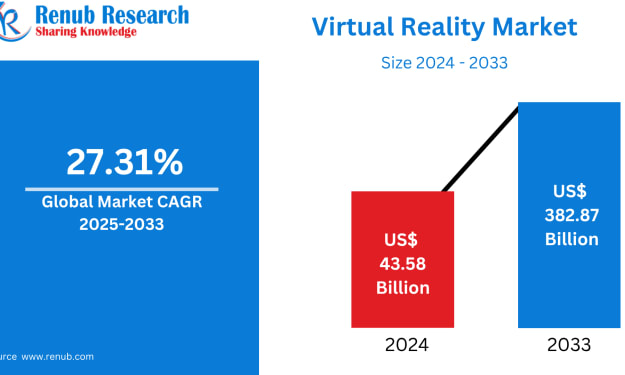
The virtual reality (VR) market is entering its most transformative decade yet. Valued at US$ 43.58 billion in 2024, the industry is witnessing rapid expansion driven by widespread adoption across gaming, entertainment, healthcare, real estate, education, and enterprise training. According to Renub Research, the global VR market is projected to reach an extraordinary US$ 382.87 billion by 2033, growing at a CAGR of 27.31% from 2025 to 2033.
By Aaina Oberoiabout a month ago in 01
Design Principles Behind High-Trust Digital Wallet Application Solutions
Introduction Digital wallet applications have become a critical component of today’s digital payment ecosystem. From peer-to-peer transfers to online and in-store payments, users rely on eWallet applications to manage sensitive financial transactions securely. As adoption increases, trust has emerged as the most important factor influencing user acceptance and long-term usage.
By Nayel Basim Al Shehhi4 days ago in 01
If you Unfriend Someone on Snapchat, Will You Keep Your Streak?
Do you want to know what takes place whenever you unfollow someone on Snapchat? A lot of things can happen whenever you delete anyone on Snapchat. Consider again if you believed the only thing that transpired was that they were deleted from your list of friends.
By Intelligent Creator4 days ago in 01


Comments
There are no comments for this story
Be the first to respond and start the conversation.