
Virtual Reality Market Size and Forecast 2025–2033
How VR Is Accelerating Toward a US$ 382.87 Billion Market by 2033


The virtual reality (VR) market is entering its most transformative decade yet. Valued at US$ 43.58 billion in 2024, the industry is witnessing rapid expansion driven by widespread adoption across gaming, entertainment, healthcare, real estate, education, and enterprise training. According to Renub Research, the global VR market is projected to reach an extraordinary US$ 382.87 billion by 2033, growing at a CAGR of 27.31% from 2025 to 2033.
This unprecedented surge is fueled by the rising demand for immersive experiences, continuous advancements in Head-Mounted Displays (HMDs), and accelerating enterprise adoption across industries that recognize VR’s transformative potential. As cutting-edge devices become more affordable and accessible, the VR ecosystem is entering a new era of mass adoption.
The Evolution of the Virtual Reality Market
Virtual Reality refers to immersive, computer-generated environments where users experience and interact within a simulated 3D world. Using VR headsets—equipped with audio-visual sensors, motion tracking, and haptic feedback—users can step inside digital universes that feel remarkably real.
VR is no longer just a gaming novelty; it has become a powerful technological tool used across sectors that require simulation, training, visualization, and immersive engagement.
How VR Is Being Used Across Industries
1. Gaming & Entertainment
The gaming sector remains the largest contributor to VR market growth. HMDs now offer high-definition visuals, precise motion tracking, and spatial audio—delivering deeply immersive gameplay and cinematic experiences. VR-based e-sports, interactive virtual concerts, and theme-park-style VR attractions are quickly expanding the entertainment landscape.
2. Healthcare
Healthcare practitioners leverage VR for:
Surgical training simulations
Patient rehabilitation and physiotherapy
Chronic pain management
Exposure therapy for phobias and mental health disorders
VR training reduces risks, improves patient outcomes, and allows professionals to practice complex procedures safely. In November 2024, VRAD Co. Ltd. announced the international release of two Korean VR simulators—NSCore for nursing skills and IPTrauma for trauma patient care—enhancing immersive medical education worldwide.
3. Education
Virtual classrooms, interactive STEM experiments, and historical recreations allow students to learn far beyond the limitations of traditional textbooks. With VR, learners can visit ancient civilizations, examine 3D biological structures, or experience real-life industrial environments.
4. Enterprise & Industrial Training
Companies use VR to simulate:
Construction sites
Manufacturing floors
Warehouse operations
Hazardous work environments
This improves worker preparedness and significantly cuts training costs. In May 2024, Sony and Siemens announced a new industrial-grade VR headset integrated with Siemens’ NX engineering platform to support digital twin applications.
5. Real Estate and Remote Collaboration
Virtual property tours, architectural visualization, and immersive meeting spaces are reshaping how businesses collaborate in hybrid work environments.
As VR technology matures, its applications continue to expand, making the technology indispensable across sectors that rely on experiential learning and immersive simulations.
Key Factors Driving the Growth of the Global VR Market
1. Technological Advancements in VR Hardware and Software
Breakthrough innovations—high-resolution displays, wider field-of-view, reduced latency, and AI-enhanced rendering—are creating more realistic VR experiences. Devices are becoming lighter, more ergonomic, and significantly more affordable, bringing VR closer to mainstream consumers.
The introduction of Apple Vision Pro in 2024 further boosted momentum within the premium VR segment, offering ultra-high-definition visuals and advanced spatial computing capabilities.
2. Rising Adoption in Healthcare
Healthcare is one of the fastest-growing VR application areas. Surgeons turn to immersive simulation for training, while mental health professionals use VR for cognitive behavioral therapy, exposure therapy, and stress reduction. Rehabilitation clinics rely on gamified VR exercises to accelerate patient recovery.
The growing demand for non-invasive, personalized, and remote treatment solutions is expanding VR’s role in healthcare systems globally.
3. Increasing Consumer Demand for Immersive Experiences
Consumers are rapidly shifting toward interactive, immersive digital content. VR enhances:
Video gaming
Live virtual concerts
Virtual tourism
Cinematic storytelling
Social VR platforms
This trend is expected to accelerate in the coming decade as next-generation VR headsets and content ecosystems become more accessible.
4. Expansion of Enterprise and Industrial VR Applications
From virtual prototyping to remote collaboration and employee training, enterprises are integrating VR to boost productivity and reduce costs. Corporate adoption is rising steadily, with VR becoming a core pillar of digital transformation initiatives.
Challenges Facing the VR Market
1. High Cost of Advanced VR Systems
Premium VR headsets still remain expensive for large sections of consumers. High-end devices require powerful PCs and specialized equipment, making full-scale adoption difficult—particularly in emerging markets. For mass-market penetration, manufacturers will need to introduce more affordable systems without compromising performance.
2. Limited High-Quality Content
While VR gaming is on a rapid growth trajectory, many industries—such as education, enterprise training, and healthcare—still require more high-quality VR content to attract users. Developing such applications demands extensive expertise, resources, and time. Without compelling content, hardware adoption slows.
Regional Insights: Virtual Reality Market Across the Globe
United States VR Market
The U.S. dominates the global VR market thanks to:
Rapid adoption in gaming and entertainment
High enterprise spending on immersive training
Strong technology ecosystem led by Meta, Apple, HTC, and Microsoft
In 2023, the FCC authorized Apple, Meta, and Google to use the 6GHz spectrum for low-power VR and AR devices—enhancing wireless mobility and device performance.
United Kingdom VR Market
The UK is an emerging leader in VR innovation. Museums, universities, and entertainment venues widely deploy VR for tours, exhibits, and interactive learning. Local VR developers and government support programs help drive rapid growth.
Apple’s Vision Pro launch in the UK in 2024 further elevated consumer interest.
China VR Market
China is one of the fastest-growing VR markets globally due to:
Expanding tech ecosystem
Strong government support
VR adoption in manufacturing and e-commerce
A large consumer gaming base
Products like ByteDance’s Pico 4, released in 2022, have been exceptionally well-received due to affordability and performance.
Brazil VR Market
Brazil leads the Latin American VR market with rising demand in gaming, education, and corporate training. Local developers are creating VR content tailored for Brazilian audiences, while universities deploy VR to modernize learning.
Brazilian company Beenoculus introduced a 3DoF VR headset at the 2022 5G Summit Brazil, highlighting regional innovation momentum.
United Arab Emirates VR Market
The UAE is quickly emerging as a VR hub in the Middle East. Dubai integrates VR into:
Real estate
Education
Retail
Tourism
Entertainment
The government strongly supports tech-driven innovation. In May 2024, Apparel Group partnered with Sandbox VR to introduce premium immersive VR experiences across the region.
Global Virtual Reality Market Breakdown
By Component
Hardware
Software
By Type
Head-Mounted Displays (HMDs)
Gesture-Tracking Devices
Projectors & Display Walls
Others
By Application
Aerospace & Defense
Commercial
Consumer
Enterprise
Healthcare
Others
By Geography (22 Countries Covered)
North America – U.S., Canada
Europe – Germany, Belgium, France, U.K., Turkey, Italy, Spain, Switzerland, Netherlands
Asia-Pacific – China, Japan, India, Australia
Latin America – Brazil, Mexico, Argentina
Middle East & Africa – Saudi Arabia, Israel, South Africa
Rest of the World
Major VR Companies Covered
Sony
Apple
Microsoft
Lenovo
Samsung
Meta
Qualcomm
Each company analysis typically covers:
Overview
Recent Developments
Revenue
Final Thoughts: A Transformative Decade Ahead for VR
The global Virtual Reality market is heading toward explosive growth, gaining traction across consumer and enterprise landscapes alike. With the market projected to reach US$ 382.87 billion by 2033, VR is set to become one of the defining technologies of the next decade.
As VR content expands, devices become more affordable, and industries embrace immersive transformation, the technology will move rapidly from niche to mainstream. Whether in healthcare, entertainment, education, defense, or enterprise collaboration, VR is reimagining how humans experience and interact with the digital world.
For investors, developers, and tech-forward businesses, the coming years present exceptional opportunities to participate in this booming ecosystem—one that promises to redefine how we work, play, learn, and connect.
About the Creator
Keep reading
More stories from Aaina Oberoi and writers in 01 and other communities.
Europe Online Travel Market Size and Forecast 2025–2033
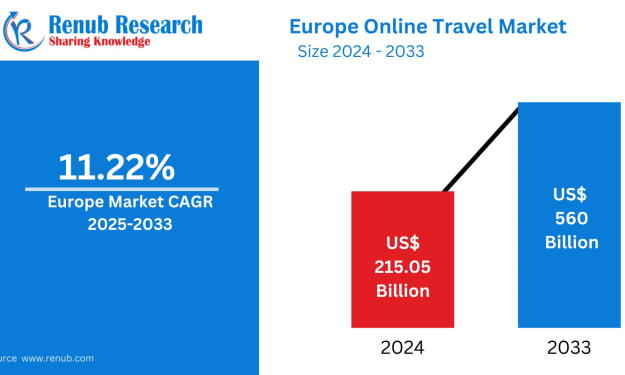
Europe’s Online Travel Market Poised for Explosive Growth The Europe Online Travel Market is entering a transformative decade, driven by rapid digitalization and shifting traveler expectations. According to Renub Research, the market is projected to reach US$ 560 billion by 2033, up from US$ 215.05 billion in 2024, marking a strong CAGR of 11.22% between 2025 and 2033. This growth is fueled by rising smartphone usage, AI-driven personalization, immersive technologies such as AR/VR, evolving payment ecosystems, and increased demand for sustainable, flexible, and transparent travel services.
By Aaina Oberoiabout a month ago in 01
Top WordPress Plugins for Efficiently Managing, Reviewing, and Collaborating on Guest Posts in 2026
Managing guest posts on your WordPress website can sometimes be a challenge, especially when it involves multiple authors, tight deadlines, and content quality control.
By Backlinks Cartabout 14 hours ago in 01


Comments
There are no comments for this story
Be the first to respond and start the conversation.