
Fighting Fraud
Detecting Phone and Message Scams


There is always someone out there to take your hard-earned money in some illegal way.
Fraud is all around us and the best way to stop it is to ignore it. However, in order to ignore it, you have to know how to detect it.
Although some of these may seem obvious, many people are scammed out of money every day so it is important to remind ourselves of the red flags.
The two biggest indicators of a scam are the way the scammers request payment. If they are asking for payment through Western Union or by means of gift cards, it is a fraud. No legitimate organization will insist on using Western Union or accept gift cards as a form of payment. The reason scammers use these is that they are difficult to track.
For me, I will only pay using e-transfer or PayPal. These types of payments are recorded and tracked and can be easily retracted within a certain amount of time. Scammers do not accept these types of payments for obvious reasons.
There are many different types of scams but the three most common are technical support, taxes, and "Scamazon". We will take a quick look at each of them. They are each a bit different but the basis of each scam is always the same.
First, remember the things that you should never do.
Never give out personal information and never allow anyone to access your computer. There is never a reason for somebody you don't know to be accessing your computer or another device.
Now we will look at how specific scams work.

TECHNICAL SUPPORT SCAM
This fraudulent activity will either start with a phone call or a message on your computer.
The phone call may be someone claiming to be someone from Microsoft and telling you that there is something wrong with your computer.
That is an obvious tip-off. How would Microsoft know that there is something wrong with your computer? Do you think someone sits there and monitors everyone's computer for a problem and then actually call to warn you? Do you really think they have time for that?
The second one is a little less obvious, but still, you need to be careful.
It might be a message pop-up like this one:

There will always be a phone number to call which will usually connect you to a call centre in India.
They will tell you that you have a virus that they will clear for you at an outrageous cost, or they will tell you that a particular virus scanner product has expired and they need to send you a refund.
In both cases, they may ask you to download software that will allow them to have access to your computer, which as mentioned earlier, never do!
Once they get access to a computer, they can do anything, including steal your personal information and access your bank. That is exactly how they are able to steal money.
The refund scam is a bit different.
They will pretend to give you a refund but send you too much. They will then demand that you return the difference. The thing is, they don't ask for money. They ask for gift cards, which makes no sense. There will also be a sense of urgency. They will insist that to go right away and buy the gift cards and keep them on the phone while you go.
As mentioned earlier, no legitimate organization will ever ask for gift cards.

INCOME TAX SCAM
This next one is the income tax scam.
A person will call you claiming to be an "agent" from a legitimate tax organization such as the IRS or the CRA.
They will tell you that you owe tax that is usually in an unusual amount (first tip-off). The amount might be $2000. Since when is a tax balance exactly $2000? It is more likely $2193.46, or something like that. $2000 is too perfect.
Then they will tell you that the amount is due immediately. This is the second tip-off. If you really do owe taxes, they give you a lot of chances to pay and you can usually pay in instalments.
Then they will tell you that if you don't pay right now, the police will be coming to arrest you in 45 minutes. Really? The police warn people before arresting them? That's nice of the police, isn't it?
Finally, they will of course ask you to pay with gift cards. Really? What is the IRS or CRA going to do with gift cards?
If you pay your taxes to the CRA, you can always verify it in your CRA account.
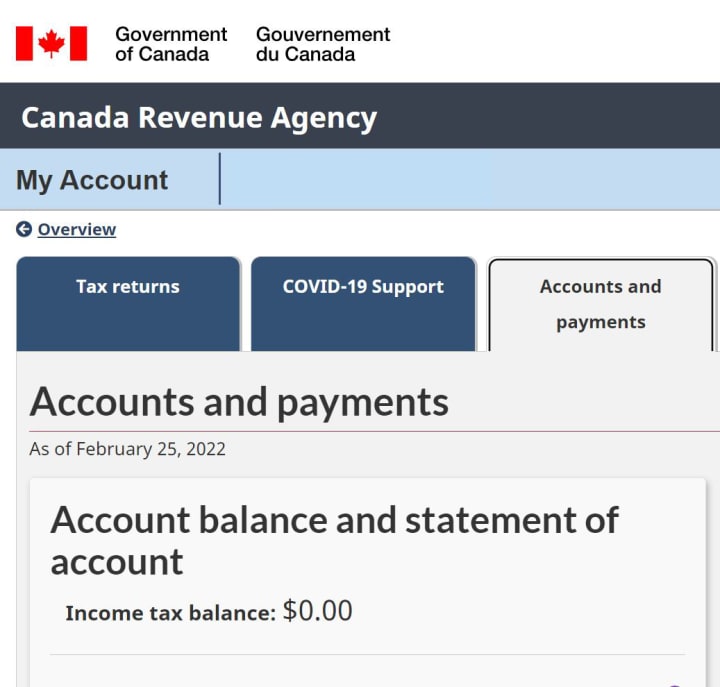
As you can see, this tax account is caught up.
Tax agencies will never call you to ask for payment. It will be a written assessment sent to your mail.

"SCAMAZON"
This next one has been nicknamed "Scamazon" and it works very much like the technical support refund scam.
In this fraud, someone usually from an Indian call centre will contact you by phone to tell you that someone has made an unauthorized purchase through your Amazon account. Of course, it will be an expensive item.
The scammer will then send you a "refund form", and like the technical support scam, they will enter the wrong amount and demand that you pay the difference using...you guessed it...gift cards.
Amazon does not use refund forms. You can cancel orders or request refunds directly through your Amazon account.
Also, how would Amazon know that there was "unauthorized activity" on your account? The entire front-end of the ordering process is automated. Amazon has no idea who is placing the order except that it is from your account. Although once something is ordered, you will receive an email, so if it is not something you ordered, you have plenty of time to cancel the order before you even get billed for it.
Finally, back to the gift cards.
What is Amazon going to do with gift cards?
WHY INDIA?
A bit of background on these scam call centres is that they are almost always located in India.
The reason is that is, for some reason, the police there don't care about fraudulent call centres.
It is known that the honest people who live in India are very upset about these scams as it makes their entire country look bad.
However, it is just a select few who chose this "work" because they are apparently paid a lot for it. They get a percentage of what they "collect".
COLLECTION AGENCY SCAMS
I want to quickly touch on something that originates closer to home. The fake "collection agency".
Apparently, these are legal in North America, but depending on where you live on the continent, you may not have to pay them.
There are companies out there who claim to "buy" debts from creditors and then try to collect from the original account holder. Some of these debts can apparently go back about ten years.
The problem is that just because a debt has not been paid does not mean that it has not been settled.
Also, most jurisdictions have a limitation period. It is usually two years. That means that after two years, the debt is considered "stale" and the payee can no longer legally collect on it, but it does not mean that they can't try.
Also in some areas, a debtor is only responsible to the original creditor. That means that if you do not have an agreement to pay this "collection agency", you are not legally required to do so. Do not agree to any payment options. Once you do, you have entered into a contract and must now pay. Real collection agencies work on behalf of the creditor and can not make decisions on their own. There are very specific rules on how real collection agencies are allowed to conduct themselves and they will never try to collect on a debt that is beyond the limitation period because they are not allowed to do so.
This information is based on the rules and laws of the area I live. For more information on the laws in your jurisdiction, contact a legal expert.
About the Creator
Paul 'The Brick' Brec
Boxer from Toronto, Ontario, Canada.
Photographer, electronics (build and repair) enthusiast, owner and operator of Stockyards Studios/Stockyards Radio.
Keep reading
More stories from Paul 'The Brick' Brec and writers in 01 and other communities.
Rem vs Em in 2026 for Accessible and Scalable CSS
Modern web development in 2026 has moved entirely away from static sizing. Foldable devices and ultra-high-density displays are now everywhere. Strict accessibility laws are also in place. Choosing between em and rem is no longer a matter of preference. It is now a functional requirement for inclusive design.
By Devin Rosario2 days ago in 01
What Does the Empty Grey Chat Box Mean on Snapchat?
Have you ever been trying to message someone on Snapchat and noticed that your chat box is empty and grey instead of the usual blue color? It can be confusing and frustrating. But don't worry; you're not alone! This article will explore what the empty grey chat box on Snapchat means and how you can troubleshoot the issue.
By Intelligent Creator7 days ago in 01
Standing While Falling
Quotation from Friedrich Nietzsche "He who wrestles long with monsters should beware lest he himself become a monster. And if you gaze long into an abyss, the abyss also gazes into you. Man is not destroyed by suffering, but by the meaning he makes of it."
By LUCCIAN LAYTH7 days ago in Critique




Comments
There are no comments for this story
Be the first to respond and start the conversation.