
Data Structures in QA Automation: Building Robust Test Frameworks
Build robust test frameworks by utilizing data structures effectively in QA automation. Enhance testing efficiency and reliability.

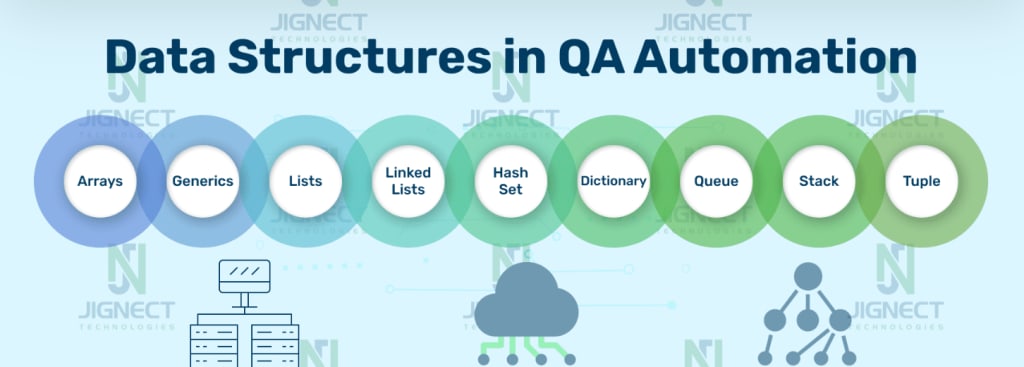
In the ever-evolving field of software testing, ensuring the integrity and functionality of applications is a fundamental goal. QA automation engineers act as the forefront defenders, carefully designing and running test scripts to assess performance and uncover any potential issues. In this context, a thorough understanding of data structures becomes essential. This blog examines the crucial role that data structures play in QA automation, emphasizing their importance and discussing fundamental structures that enable QA engineers to create robust and effective test automation scripts.
🔍The Significance of Data Structures in QA Automation
Data structures are fundamental building blocks in software development and testing. They are essential for organizing, storing, and manipulating data efficiently. Here’s why data structures matter for QA automation engineers:
🟢 Efficient Data Management: Automation engineers deal with various types of data, such as test cases, test data, and test results. Properly chosen data structures can significantly improve the efficiency of data management and retrieval.
🟢 Improved Test Script Performance: Well-designed data structures can optimize the performance of your test scripts. This is crucial when you need to execute a large number of test cases quickly.
🟢 Simplified Test Data Handling: QA automation often involves working with test data, which can vary in complexity. Using the right data structures simplifies data handling and ensures that tests are conducted accurately. Additionally, dictionary data structures can be particularly useful in organizing and managing test data.
🟢 Scalability: As software projects grow, the volume of test data and test cases also increases. Scalable data structures allow automation engineers to handle larger datasets without sacrificing performance.
🎯 Data Structures for QA Automation 🎯
Now that we understand why data structures are essential for QA automation, let’s explore some data structures that are particularly valuable in this context.
Arrays
An array is a collection of elements of the same data type, whether they are value types (like integers or floats) or reference types (like objects).
Arrays provide a way to store and access multiple values of the same type sequentially.
👉 Key Points about Arrays

1. Indexing: Arrays in C# are zero-based, which means the first element is at index 0, the second element is at index 1, and so on.
2. Fixed Size: When you create an array, you specify its size, and that size cannot be changed dynamically. If you need to store more elements than the array’s size, you must create a new, larger array and copy the elements from the old array to the new one.
3. Homogeneous: Arrays are homogeneous, meaning they can only store elements of the same data type. While some programming languages, like JavaScript, allow mixed data types in arrays, C# enforces strict typing.
In the modern world most of the QA’s already use more flexible and easier to manage generic wrappers of the Array e.g. List in C# and ArrayList in Java.
Anyway Array still can be useful in the modern days too.
👉 Using Arrays in Real-World Scenarios
1. Building a Comma-Separated URL Query Parameter:
Suppose you want to build a URL with a list of comma-separated IDs as a query parameter. You can use an array to achieve this:
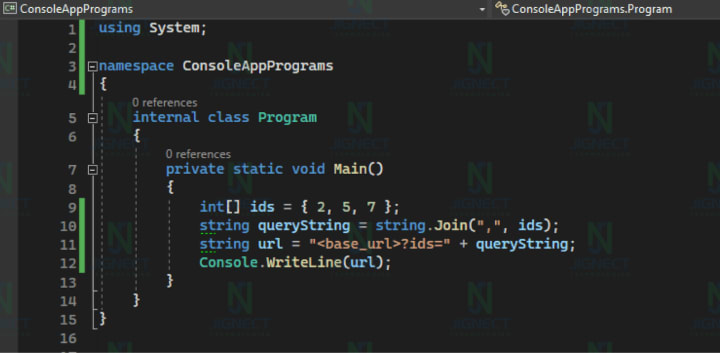
In this code, we create an array `ids` containing the IDs and then use `string.Join` to concatenate them with commas for the query parameter.
2. Extracting and Summing Numbers from a String:
If you have a string containing numbers and characters and you want to extract and sum the numbers, you can do so with an array:

In this example, we create an array `numbersArray` by extracting the digits from the input string and then sum them to get the result.
TO READ THE FULL BLOG
About the Creator
Jignect Technologies
At JigNect Technologies, we believe that software testing is an art, a science, and a passion. Our team of experts combines years of experience, cutting-edge technology.
Keep reading
More stories from Jignect Technologies and writers in 01 and other communities.
Understanding the BDD, Gherkin Language & Main Rules for BDD UI Scenarios
Introduction In the dynamic world of software testing, ensuring the final product aligns with user expectations is crucial. For Quality Assurance (QA) professionals, Behavior-Driven Development (BDD) has emerged as a powerful methodology due to its collaborative and user-focused approach. BDD bridges the gap between technical and non-technical stakeholders, fostering a shared understanding of desired software behavior through clear, concise, and executable specifications. This collaborative approach significantly enhances the QA process by ensuring all team members are aligned on the requirements and expected outcomes.
By Jignect Technologiesabout a year ago in 01
From Code to Capital: The Impact of Fintech Software on Finance
In the last decade, the world of finance has been quietly transformed by lines of code. What once were dusty ledgers and slow bank queues have evolved into instant payments, smart investing, and digital money movement. The force behind this shift? Fintech software — the technology enabling financial services to be faster, simpler, and more accessible than ever before.
By Aarti Jangid3 days ago in 01
The Subtle Order Within CBD, Hemp, and THC Retail Spaces
Some retail environments are designed to draw attention. Others are designed to manage it. A CBD shop, hemp shop, or THC shop often belongs to the second category. These spaces are shaped less by marketing trends and more by careful organization, restraint, and an awareness of their surroundings.
By Abandoned Places near me5 days ago in 01



Comments
There are no comments for this story
Be the first to respond and start the conversation.