
Chandrayaan-2 🚀
The second lunar exploration mission.


Did you know exactly what Chandrayaan-2 🚀 is?
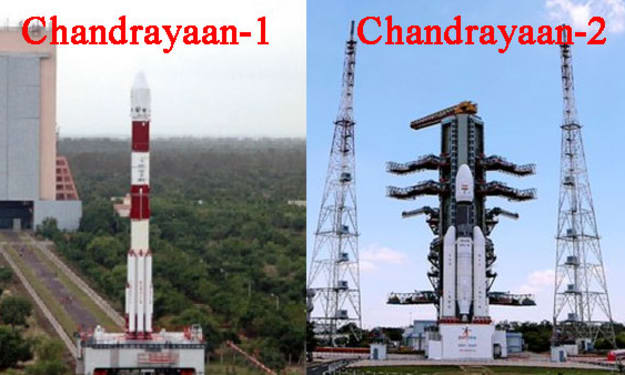
Chandrayaan-2 was the second lunar exploration mission developed by the Indian Space Research Organisation (ISRO), after Chandrayaan-1. It consisted of a lunar orbiter, a lander, and the Pragyan rover, all of which were developed in India. The main scientific objective was to map and study the variations in lunar surface composition, as well as the location and abundance of lunar water. - Wikipedia
Chandrayaan-2 mission is a highly complex mission, which represents a significant technological leap compared to the previous missions of ISRO. It comprised an Orbiter, Lander and Rover to explore the unexplored South Pole of the Moon.
By carefully examining topography, seismography, mineral identification and distribution, surface chemical composition, thermophysical properties of top soil, and composition of the tenuous lunar atmosphere, the mission is intended to increase our understanding of the moon's origin and evolution.
A series of manoeuvres were performed to raise Chandrayaan-2's orbit after it was injected, and on August 14, 2019, the spacecraft successfully completed the Trans Lunar Insertion (TLI) manoeuvre, which allowed it to leave the earth's orbit and travel in the direction of the Moon.
Chandrayaan-2 was successfully placed into lunar orbit on August 20, 2019. On September 02, 2019, while in a 100 km lunar polar orbit, the Vikram Lander was detached from the Orbiter in order to prepare for landing.
Vikram Lander then underwent two de-orbit manoeuvres to modify its orbit and start revolving around the moon in a 100 km x 35 km path.
Up to an altitude of 2.1 km, Vikram Lander performed normally and descended as intended. Communication between the lander and the ground stations was subsequently lost.
Using its eight cutting-edge scientific instruments, the Orbiter, once in its proper orbit around the Moon, will improve our knowledge of the moon's evolution and enable us to map the minerals and water molecules in the Polar regions. The Orbiter camera, which has the highest resolution of any lunar mission to date (0.3 m), will deliver sharp images that will be of great value to the entire scientific community. Instead of the planned one year, a long life of almost seven years has been achieved thanks to careful launch and mission management.
The ISRO’s ₹978 crore unmanned mission failed its objective after the lander ceased communication to the ground stations at an altitude of 2.1 km from the surface of the Moon.
According to former ISRO chairman K Sivan, soft landings are "15 minutes of terror" and are difficult because the rocket engine must fire precisely at the right moment. The lander carrying the rover is being "lowered down on the Moon, which has no atmosphere" in an attempt to use the firing. Because of this, only 37% of soft landings have been successful to date.
The ISRO explained that deep-space communication presents additional difficulties due to the great separation between the spacecraft and the Earth and the weak onboard radio signals that must be picked up by massive antennas.
The intersection of the Moon's path and Chandrayaan-3 must also be predicted sufficiently early and accurately because the Moon's location is constantly shifting due to its orbital motion.
The Moon's reduced gravity and 'lumpy' appearance from uneven mass distribution beneath its surface make orbiting the Moon a difficult task, according to ISRO.
The ambitious Chandrayaan-2 mission, which failed to make the desired soft landing in September 2019, was followed by the mission by four years.
It was intended to demonstrate a variety of abilities, such as getting into orbit around the moon, performing a soft landing over its south pole, and then sending a rover to explore the surface.
About the Creator
Article Pins
Happy learning!
Keep reading
More stories from Article Pins and writers in 01 and other communities.
Chandrayaan-1 Mission
Chandrayaan-1, India's first mission to Moon, was launched successfully on October 22, 2008 from SDSC SHAR, Sriharikota. The spacecraft was orbiting around the Moon at a height of 100 km from the lunar surface for chemical, mineralogical and photo-geologic mapping of the Moon. The spacecraft carried 11 scientific instruments built in India, USA, UK, Germany, Sweden and Bulgaria. After the successful completion of all the major mission objectives, the orbit has been raised to 200 km during May 2009. The satellite made more than 3400 orbits around the moon and the mission was concluded when the communication with the spacecraft was lost on August 29, 2009. - isro.gov.in
By Article Pins3 years ago in 01
What Makes a Crypto Arbitrage Bot More Strategic Than Other Bots In 2026?
The cryptocurrency market in 2026 is more competitive, faster, and technologically advanced than ever before. Automated trading systems dominate the ecosystem, with bots executing trades across exchanges within milliseconds. Among these systems, the crypto arbitrage bot stands out for its structured and strategy-driven approach. While many bots rely on predictive signals, trend analysis, or momentum indicators, arbitrage bots operate on a fundamentally different principle: market inefficiency.
By smithtaylorabout 21 hours ago in 01
How to Choose the Right Tech Stack to Develop a Web Application
Imagine spending six months building your web application, only to realize the technology you chose can't handle your growing user base. Now you're stuck — rewriting code, burning budget, and losing time you can't get back.
By Nico Gonzalez6 days ago in 01



Comments
There are no comments for this story
Be the first to respond and start the conversation.