
Chandrayaan-1 Mission
India's first mission to Moon🌑

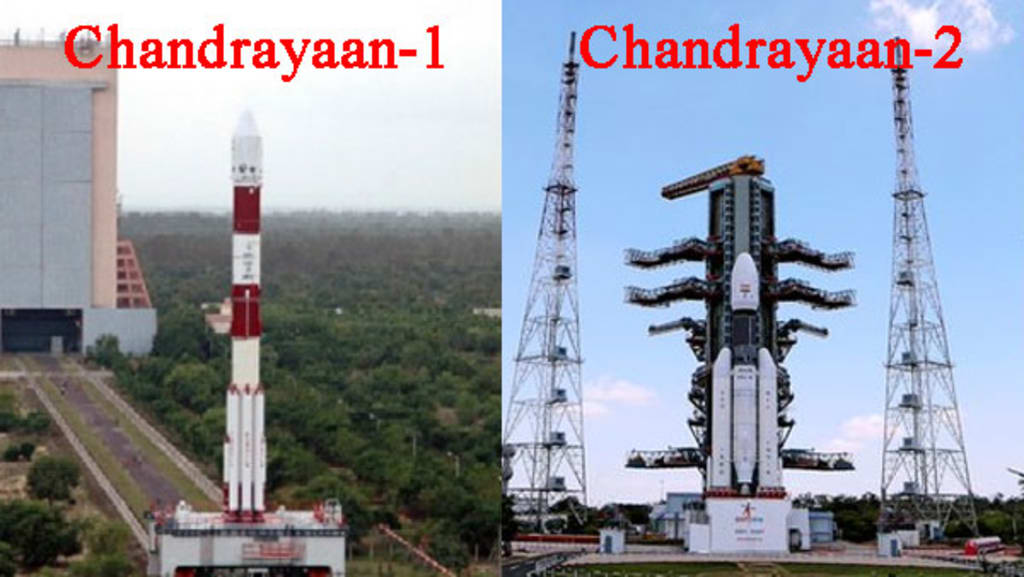
Chandrayaan-1, India's first mission to Moon, was launched successfully on October 22, 2008 from SDSC SHAR, Sriharikota. The spacecraft was orbiting around the Moon at a height of 100 km from the lunar surface for chemical, mineralogical and photo-geologic mapping of the Moon. The spacecraft carried 11 scientific instruments built in India, USA, UK, Germany, Sweden and Bulgaria.
After the successful completion of all the major mission objectives, the orbit has been raised to 200 km during May 2009. The satellite made more than 3400 orbits around the moon and the mission was concluded when the communication with the spacecraft was lost on August 29, 2009. - isro.gov.in
India's Chandrayaan-1 played a crucial role in the discovery of water molecules on the Moon.
India's first deep space mission was Chandrayaan-1.
Its collection of instruments included NASA's Moon Minerology Mapper (M3), an imaging spectrometer that supported the finding of water trapped in lunar minerals.
The orbiter also released an impactor that was purposefully launched towards the Moon, scattering debris that the science equipment on board the orbiting spacecraft analysed.
The first Indian deep space mission, Chandrayaan-1, was launched with the intention of orbiting the Moon and delivering an impactor to its surface.
The study of the Moon's chemical, mineralogical, and photogeologic mapping was one of the goals of science. The spacecraft also carried scientific instruments from the United States, the United Kingdom, Germany, Sweden, and Bulgaria in addition to the five Indian instruments.
Chandrayaan-1 was launched into an initial geostationary transfer orbit of 140 x 14,180 miles (225 × 22,817 kilometers) at a 17.9-degree inclination.
The presence of water in the lunar atmosphere has been suggested by data from Chandra's altitudinal composition explorer (CHASE), which took measurements every four seconds as it descended, according to Indian scientists, though the data is still preliminary in the absence of additional confirmation.
Beginning in late November 2008, Chandrayaan-1 experienced unusually high temperatures, making it difficult for it to operate more than one scientific instrument at once.
The star sensor on Chandrayaan-1 failed after nine months of operation in lunar orbit. Soon after, a backup sensor also failed, rendering the primary attitude control system of the spacecraft inoperable. Instead, a mechanical gyroscope system was used by controllers to maintain proper attitude.
The spacecraft was moved to a higher 120-mile (200-kilometer) orbit in May 2009, ostensibly in an effort to maintain tolerable temperatures inside the satellite.
At 0:00 UT on August 28, 2009, Chandrayaan-1 lost contact with Earth. Despite the fact that this fell short of the spacecraft's two-year lifespan, ISRO noted that at least 95% of its mission objectives had been met by then. The failure of the power supply due to overheating was the most likely reason for the mission's termination.
The discovery made by Chandrayaan-1 regarding water on the Moon may have been its most significant one. Scientists released the findings of data collected by the American M3 instrument in September 2009. This instrument had discovered absorption features on the polar regions of the Moon's surface that are typically linked to hydroxyl- and/or water-bearing molecules.
The announcement of evidence of magmatic water, or water that originates from deep within the Moon's interior, being locked in mineral grains on the surface of the Moon came after this discovery in August 2013.
Magmatic water had been discovered in samples brought back by Apollo astronauts, but it had not been detected from lunar orbit prior to the M3 instrument's operation. Despite the fact that water molecules and hydroxyl were found by Cassini during its flyby of the Moon in August 1999 (using its VIMS instrument).
The same kind of information was also obtained by NASA's Deep Impact-EPOXI mission, which passed by the Moon in June 2009.
About the Creator
Article Pins
Happy learning!
Keep reading
More stories from Article Pins and writers in 01 and other communities.
Elon Musk's Starlink satellites and future internet plans
In 2014, Musk first revealed his desire to create a constellation of satellites. WorldVu was the company's original name, but the billionaire later abandoned it in favor of spinning off a satellite internet network through SpaceX, filing an application with the Federal Communications Commission in 2016 under the name "Starlink."
By Article Pins3 years ago in 01



Comments
There are no comments for this story
Be the first to respond and start the conversation.