
Bridging the Gap in Science Education: How VR Labs Are Empowering Students in Small-Town India
From Chalkboards to Headsets: Revolutionizing Science Education in India’s Heartlands
In recent years, education across India has seen a dramatic transformation. With the rise of digital tools and immersive technologies, the learning experience is no longer confined to static classrooms or rote memorization. One of the most promising innovations in this space is Virtual Reality (VR)—a technology that has found powerful applications in the realm of science education.
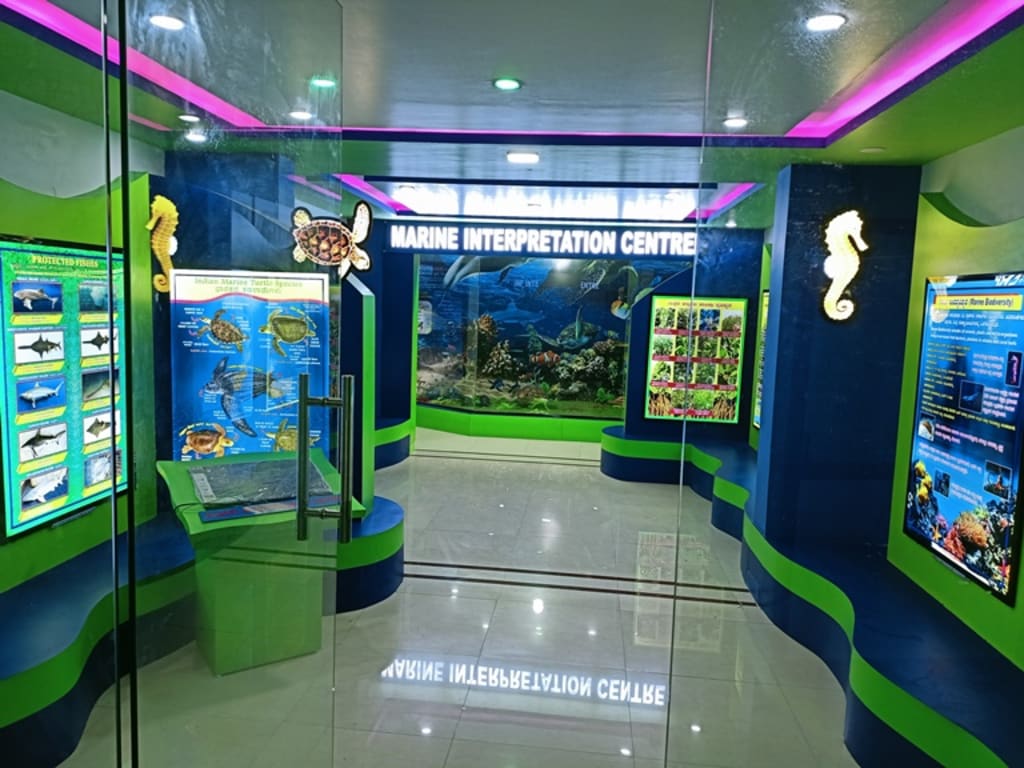
While metros and private institutions have already begun exploring VR in classrooms, an exciting shift is now taking place in smaller towns, where students are being introduced to virtual science labs for the first time. A prime example of this innovation can be seen in Karwar, Karnataka, where a VR-based science lab has been set up at the Sub-Regional Science Centre.
This blog explores how VR is transforming science learning in regional centres like Karwar—and why this could mark a turning point for education equity in India.
Why Traditional Science Education Is Falling Short
For decades, Indian science education has been heavily theory-driven. While textbooks provide information, many students never get the chance to see real-life applications of what they learn. Experiments, lab demonstrations, and hands-on discovery are often limited by access to proper facilities and equipment.
In many government schools and science centres, especially in Tier 2 and Tier 3 cities, students face challenges such as:
Lack of functional science labs
Shortage of trained lab assistants or science teachers
Safety risks in handling lab materials
Budget constraints for maintaining lab equipment
These issues don’t just hamper curiosity—they also discourage students from pursuing careers in science and technology.
Virtual Reality: A Smart, Scalable Solution
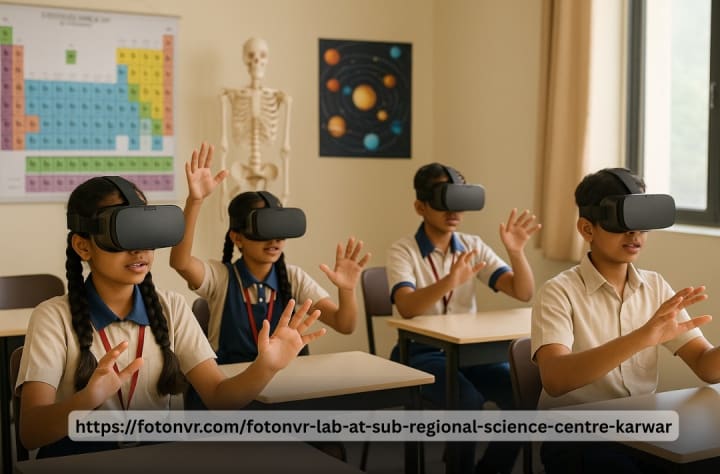
Virtual Reality offers a compelling answer to many of these problems. With VR headsets and interactive content, students can:
Enter a fully immersive lab environment
Perform experiments safely and repeatedly
Visualize microscopic and cosmic phenomena
Learn at their own pace with guided simulations
Unlike traditional labs, a VR setup requires no physical chemicals, no glassware, and minimal maintenance. This makes it both cost-effective and scalable across geographies.
But the key to success lies not just in the technology—it’s in thoughtful implementation. That’s where fotonVR comes in.
The Role of fotonVR in Advancing Science Literacy
fotonVR is an edtech company that specializes in building curriculum-aligned VR content for science subjects, tailored specifically for Indian schools. Their goal is to make high-quality experiential learning accessible to all students, regardless of their location or resources.
In Karwar, fotonVR partnered with the Sub-Regional Science Centre to install a comprehensive VR lab. This included:
VR headsets preloaded with interactive lessons
A teacher dashboard to monitor student progress
Training sessions for educators to use the system effectively
Support for multiple languages and grade levels
The result? A complete digital lab where students can explore everything from blood circulation to chemical reactions—without any of the limitations of a conventional setup.
Real Impact: What’s Happening in Karwar
Since the launch of the VR lab, educators in Karwar have noticed a measurable change in how students respond to science. Concepts that were once hard to explain on a blackboard are now understood in minutes. For example:
Students can walk through the human digestive system and observe each stage in 3D.
Physics becomes more intuitive when they can manipulate levers, pulleys, and circuits inside the VR space.
Chemistry safety concerns are eliminated, while students still get to mix compounds and observe reactions virtually.
Teachers report that students are more focused, ask deeper questions, and even want to revisit topics out of sheer curiosity. That kind of engagement is hard to achieve with textbooks alone.
Democratizing Access to Quality Education
What makes this project especially noteworthy is its location. Karwar is a relatively small coastal town, not typically seen as a hub for cutting-edge educational tech. Yet it is now home to one of the most advanced science labs in the region—all thanks to VR.
This shift sends a powerful message: innovation in education doesn’t have to be limited to big cities.
By bringing VR to regional centres, fotonVR and the Karnataka Science Centre network are:
Bridging the urban-rural education gap
Empowering local teachers with modern tools
Inspiring students to dream beyond their surroundings
If this model is replicated across India’s thousands of science centres and government schools, it could radically uplift science literacy and career readiness at a national scale.
What the Future Holds
Encouraged by the success in Karwar, there are plans to install similar VR science labs in other sub-regional science centres throughout Karnataka. The government’s increasing support for edtech, combined with falling hardware costs, means that more such initiatives are on the horizon.
Additionally, fotonVR is exploring ways to integrate Augmented Reality (AR) for outdoor learning, AI-powered analytics for adaptive teaching, and gamified assessments to make learning even more engaging.
A Vision of Equal Opportunity in Learning
The VR lab at the Sub-Regional Science Centre in Karwar isn’t just a high-tech classroom—it’s a symbol of what’s possible when innovation meets intent. It shows that with the right partnerships and a learner-first mindset, we can overcome the traditional limitations of education and open doors to new futures for every student.
As India moves toward becoming a global knowledge economy, investments like this—especially in underserved areas—will play a pivotal role in shaping the scientists, innovators, and leaders of tomorrow.
About the Creator
Ravi Patel
Virtual Reality in Education
Keep reading
More stories from Ravi Patel and writers in 01 and other communities.
Preschool Play Reimagined: VR Adventures That Inspire and Educate
Imagine a classroom where young children embark on exciting adventures without ever leaving their learning space. Picture preschoolers exploring virtual jungles, diving into the depths of the ocean, or even journeying through space all within the safe and engaging environment of their classroom. This is the promise of Virtual Reality (VR) in early education. As technology continues to evolve, VR is emerging as a powerful tool to spark curiosity, enhance learning, and transform the way our youngest minds engage with the world.
By Ravi Patel10 months ago in Education
How to Choose a Mobile App Development Company in 2026
The Google ecosystem is currently undergoing a structural realignment that fundamentally changes how mobile applications are discovered and validated. We are witnessing a tectonic movement away from traditional index-based search toward a unified Trust Graph where Entity Signals dictate market survival.
By Devin Rosario4 days ago in 01
Top 10 SEO Experts in Pakistan 2026
Pakistan continues to establish itself as a key contributor to the global digital marketing industry. By 2026, the country has developed a mature SEO ecosystem that extends well beyond traditional keyword optimization.
By SEO EXPERT IN PAKISTAN 20256 days ago in 01
Affection and Healing for Yourself
During the night of the last quarter moon, I gathered my ritual supplies. I carefully handled the chunk of black tourmaline that would protect me from your overall negative and narcissistic energy. I carefully walked the house with my stick of selenite in hand, asking the universe to cleanse our working space.
By Alisha Wilkins ✒️🦋🖋️6 days ago in Fiction


Comments
There are no comments for this story
Be the first to respond and start the conversation.