
Best ChatGPT Prompts for Bloggers to Use in 2025 (SEO, Content & AI Tips)
Power Up Your Blog with Prompts That Actually Drive Results


Disclaimer: This content was generated using AI.
Introduction
Bloggers today are sitting on a goldmine — and most don’t even realize it.
ChatGPT isn’t just an AI tool. Used properly, it’s your behind-the-scenes co-writer, idea machine, and editing partner. But here’s the thing: garbage in, garbage out. If your prompts are vague, you’ll get surface-level content.
This guide shows you how to use prompt engineering to turn ChatGPT into a powerhouse assistant — tailored to your niche, tone, and strategy.
You’ll learn:
- What makes a prompt effective for bloggers
- How to build multi-step instructions that scale with your workflow
- How to match ChatGPT’s outputs with your voice
- And of course, 47 plug-and-play blogging prompts that actually work
Let’s break it down.
Understanding ChatGPT (for Bloggers)
ChatGPT, developed by OpenAI, generates text based on your instructions. Think of it like a smart but literal assistant — it can’t read your mind. The more structure and context you provide, the better the results.
It can:
- Brainstorm content ideas
- Draft posts
- Rewrite in your brand voice
- Improve SEO
- Polish grammar and clarity
But you need to guide it — like any assistant — with specifics.
Which ChatGPT Model Should Bloggers Use?
OpenAI’s latest line-up offers different tools for different stages:
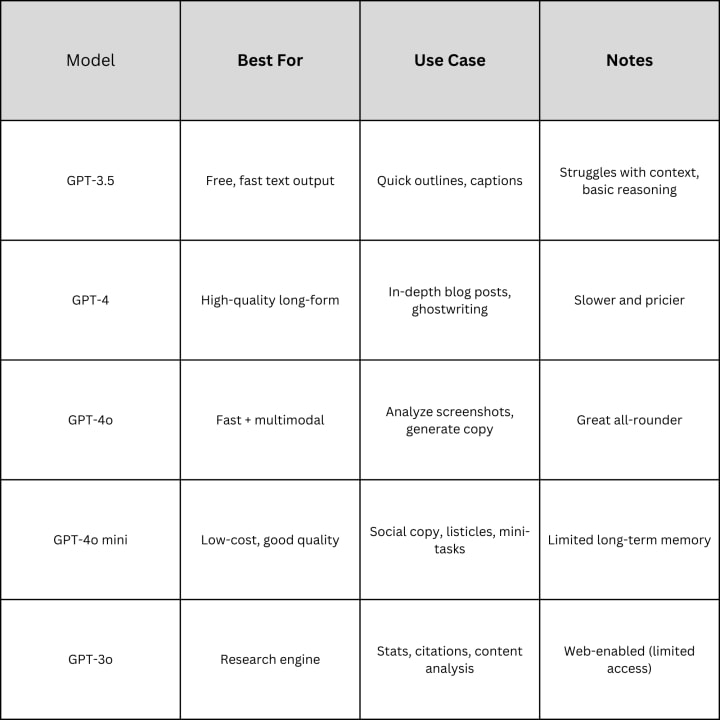
Pro tip: Use multiple models in one workflow.
- Use GPT-4o mini to build outlines
- Use GPT-3o for research-heavy sections
- Use GPT-4 to polish and tone-match
Why Your Prompts Matter
Think of it this way — if you just say "write about blogging," you’ll get generic content. But if you say:
"Act as a content strategist writing for travel bloggers. Create a 1,000-word post titled ‘Budget Travel Hacks That Actually Work in 2025’ with a friendly tone, H2s, and bullet points."
— you’ll get something closer to what you want.
Anatomy of a Good Prompt
- Role: Who ChatGPT is pretending to be
- Goal: The task
- Audience: Who the content is for
- Context: Niche, tone, brand style
- Constraints: Length, format, SEO keywords
The BLOG Prompt Framework
Use this four-part structure to get structured, SEO-ready drafts:
- B – Background: Hook, pain points, what readers will gain
- L – Logic: Tone, title, structure, clarity rules
- O – Outline: Sections, flow, formatting
- G – Goal: Engagement, SEO, next steps
Try this:
"Write a BLOG-style article for beginners learning SEO. Use a friendly, informative tone. Topic: ‘How to Rank a New Website in 2025’. Include 5 tips, short paragraphs, and a closing CTA."
47 ChatGPT Prompts for Every Stage of Blogging
CONTENT IDEAS & STRATEGY
- Blog Post Idea Generator
- Niche Research Snapshot
- Trending Topic Finder (for [MONTH])
- Evergreen vs. Seasonal Sorter
- Pain Point to Content Map
- Content Gap Spotter
KEYWORD RESEARCH
- Keyword Cluster Builder
- Alphabet Soup Expansion
- People Also Ask Miner
- Snippet Answer Crafter
- Title + Meta Description Writer
- Schema Markup Creator
- FAQ Block Generator
DRAFTING & FORMATTING
1-Page Outline Generator
- CTA-Optimized Outline
- BLOG Article Writer
- Case Study Framework
- Listicle Generator
- Series Planner (5-part)
STYLE & EDITING
- Hook Intro Writer (PAS)
- Storytelling Opener
- Stat Spotlight Insertion
- Voice-Matching Rewrite
- Readability Enhancer
- Factual Checker
- Sentence Variety Booster
CONVERSION
- CTA Copy Generator
- Email Subject Split-Test Ideas
- Newsletter Summary Blurb
- Comment Prompt Questions
- Conclusion Enhancer
SOCIAL & PROMOTION
- Twitter/X Thread Teaser
- LinkedIn Carousel Breakdown
- Instagram Carousel Captions
- IG Caption + Hashtags
- Repurposing Planner
- Brand Voice Quote Generator
MAINTENANCE & SCALE
- Update-Old-Post Checklist
- Analytics Prompt (CTR issues)
- Expert Roundup Q Builder
- Controversial Opinion Mapper
- Productivity System for Bloggers
- Internal Link Matcher
Bonus: Sequential Prompting Walkthrough
Don’t just ask ChatGPT to “write a post.” Prompt it step-by-step:
- Step 1: Research — pain points, search intent, content gaps
- Step 2: Titles — generate & explain 5 headline options
- Step 3: Outline — detailed H2/H3 layout
- Step 4: Intro — write a 200-word hook
- Step 5: Main Body — write each section with bullets, stats
- Step 6: Conclusion — wrap-up + call to action
- Step 7: SEO polish — FAQs, internal links, meta, visuals
- Step 8: Final Review — keyword usage, length, readability, tone
This is how pros use ChatGPT — not just once, but across a smart workflow.
Final Thoughts: ChatGPT Is Your Blogging Force Multiplier
The right prompts turn ChatGPT into a productivity engine.
Used well, it saves time, improves quality, and helps you write faster while staying on-brand. But remember — it’s not about replacing your voice. It’s about scaling it.
Start with the prompts above. Build your own. Mix models. And most importantly?
Ship more content — faster, better, and smarter.
Let me know which prompt you try first 👇
About the Creator
James Oliver
I help entrepreneurs build profitable online businesses. Sharing proven strategies and insights as I grow my own affiliate marketing business to $1M per year.
Keep reading
More stories from James Oliver and writers in 01 and other communities.
How to Improve SEO Rankings Using Semantic Keywords in 2025
Disclaimer: This content was generated using AI. Introduction Ever wondered why some content ranks for dozens of related search terms while others barely move the needle? The answer often comes down to semantic keywords.
By James Oliver9 months ago in 01
Why the United States Stepped Back from Confrontation with Iran: A 360° Geopolitical Analysis
Introduction In the long and turbulent history of US–Iran relations, moments of escalation have often brought the world to the brink of war. From the Iranian Revolution of 1979 to the sanctions era of the 2010s, and through the proxy conflicts simmering across Iraq, Syria, Lebanon, and Yemen, the tension between Washington and Tehran has become a defining feature of Middle Eastern geopolitics. Yet, despite decades of hostility, every cycle of confrontation has also produced unexpected decisions of restraint.
By Muhammad Islam khan swati5 days ago in 01



Comments
There are no comments for this story
Be the first to respond and start the conversation.