
AI vs. Traditional Credit Scoring: A Shift for Modern Borrowers
AI vs. Traditional Credit Scoring


Imagine standing on the precipice of a life-changing event a first mortgage, a new business loan, only to be told you don't exist. This is the frustrating reality for millions of hardworking individuals: the "credit invisible" or "thin-file" borrowers whose responsible financial lives simply don't fit the mould of an outdated scoring system. For decades, a single three-digit number, the traditional credit score, has held the keys to financial opportunity, determining who gets a loan and at what price. But a silent, intelligent revolution is sweeping the financial world, challenging this old gatekeeper. Driven by Machine Learning in Credit Scoring, this shift is not just an incremental update; it's a fundamental change that promises to dismantle financial barriers and deliver a more accurate, dynamic, and inclusive assessment of modern creditworthiness.
The Traditional Citadel: How Credit Scoring Has Worked for Decades
What is a Traditional Credit Score? (The FICO/VantageScore Legacy)
Traditional credit scoring models, primarily FICO and VantageScore, rely on a narrow set of historical financial data reported to major credit bureaus. These systems were groundbreaking when first introduced, offering a standardized, rules-based method for risk assessment. They base a borrower’s score on a fixed set of criteria: payment history, amounts owed, length of credit history, new credit, and credit mix.
While robust for what they measure, these models are inherently static and backward-looking. They offer a snapshot of a person’s financial past, not a dynamic forecast of their future, and they are restricted almost entirely to data reported by banks, credit card issuers, and lenders.
The Problem of the "Thin File" Borrower
The most significant structural limitation of Traditional Credit Scoring is its dependence on a sufficient credit history to generate a score. This is where the model fails the modern borrower. The system penalizes vast segments of the population recent college graduates, immigrants new to the country, and lower-income individuals who pay rent and utility bills reliably but don't use traditional credit products. These individuals are often categorized as "thin-file" or "credit invisible," forcing lenders to either reject them outright or approve them at exorbitant rates, effectively shutting them out of the financial mainstream.
Decoding the Future: How AI Credit Scoring Works
AI Credit Scoring offers a pathway to bypass the restrictive nature of legacy systems by leveraging sophisticated Machine Learning (ML) algorithms and vast datasets. While traditional models analyze a handful of variables, AI models can analyze hundreds even thousands to paint a more complete picture of a borrower’s financial stability.
Beyond the Bureau: The Power of Alternative Data
The core differentiator for AI-driven models is their ability to incorporate Alternative Data Credit Scoring sources. These data points reflect real-world, dependable behavior that traditional systems ignore:
- Payment Behavior: History of on-time utility, telecom, and rent payments.
- Cash Flow and Stability: Analysis of bank transaction data (with borrower permission) to determine income consistency, spending patterns, and savings habits.
- Digital Footprint: Digital signals that correlate with financial responsibility, such as stable employment history or long-term mobile phone usage.
By ingesting this dynamic data, an AI model can assign a creditworthiness score to an individual who may have a perfect record of paying rent for ten years but zero credit card history.
Machine Learning and Predictive Analytics
The intelligence lies in the ML algorithms, which use Predictive Analytics Lending to process this immense data. Unlike traditional linear models, ML can identify complex, non-linear correlations subtle patterns that a human underwriter would never spot.
For example, an ML model might discover that a consistent pattern of small, on-time repayments for a Buy Now, Pay Later (BNPL) service is a stronger predictor of future loan repayment for a young applicant than their lack of a five-year-old credit card. By learning from millions of data points, these systems deliver risk assessments that are not just faster, but also demonstrably more accurate.
The Shift for Modern Borrowers: 4 Key Benefits of AI-Driven Lending
The adoption of AI Credit Scoring is rapidly expanding across the financial sector. According to market data, the Artificial Intelligence in Lending market is projected to grow at a Compound Annual Growth Rate (CAGR) of over 26% from 2024 to 2029. This exponential growth is driven by the clear benefits for both lenders and, crucially, modern borrowers.
1. Faster Decisions and On-Demand Lending
The era of waiting days for a loan decision is ending. AI systems can automate the entire underwriting process from data ingestion and verification to risk assessment in a matter of seconds. This real-time decisioning is essential for digital-native borrowers, enabling instant approvals for credit cards, personal loans, and even small business financing.
2. Unlocking Financial Inclusion for the Underserved
This is the most impactful social benefit. AI models are a powerful tool for promoting Financial Inclusion AI by correctly identifying low-risk borrowers who were previously excluded.
Statistical Data: One leading AI lending platform, Upstart, reported that its models approved 44% more borrowers than traditional models while simultaneously reducing default rates by over 50% for that expanded group.
Real-World Example: In emerging markets, companies like MNT-Halan in Egypt have used AI-powered alternative scoring engines to automate over 50% of loan approvals and achieve a 60% approval rate for previously unscoreable users by leveraging behavioral and transactional data from their super-app ecosystem .
3. More Accurate Risk Assessment (and Lower Rates)
The enhanced precision of machine learning means better pricing. By capturing the nuance of a borrower's financial life, AI can differentiate low-risk individuals who have been unfairly penalized by traditional scores. This leads to tailored products and, for many, lower interest rates, rewarding responsible behavior that extends beyond the conventional credit report. Studies comparing machine learning models (like Support Vector Machines) with traditional statistical methods often show a significant improvement in the predictive power of ML models, reducing the rate of false negatives (rejecting creditworthy applicants) (Source: ResearchGate).
4. A Dynamic, Living Score
Unlike a FICO score that updates monthly, AI models can provide Dynamic Scoring by factoring in near-real-time data. If a borrower secures a better job or consistently makes utility payments over a few months, their risk profile immediately improves, allowing lenders to adjust their offerings accordingly.
The Road Ahead: Navigating the Ethical and Regulatory Hurdles
The transition to AI is not without challenges. These highly complex models must address two primary concerns:
Bias, Opacity, and the Need for Explainable AI (XAI)
If an AI model is trained on historically biased lending data, it may inadvertently learn and even amplify those biases, leading to discriminatory outcomes. This is the "Data Bias" problem. Furthermore, many complex ML models are perceived as "black boxes" because it is difficult to see exactly why they make a particular decision.
The solution lies in Explainable AI (XAI). Regulators and lenders are now pushing for XAI frameworks that ensure every automated credit decision can be audited and explained clearly to the borrower (e.g., "Your loan was approved because of your consistent rent payments and low debt-to-income ratio"). This restores trust and ensures compliance with fair lending laws.
The Rise of the Hybrid Model
The future of credit scoring will likely not be a complete replacement of traditional models, but rather a hybrid system. Lenders are increasingly integrating AI/ML models to augment, rather than eliminate, traditional credit bureau data. This best-of-both-worlds approach ensures regulatory compliance while maximizing approval rates and risk accuracy.
Conclusion
The shift from Traditional Credit Scoring to AI Credit Scoring Models represents a pivotal moment for the financial industry. For too long, the financial gates have been guarded by a system that prioritizes a narrow history over current financial responsibility. The rise of machine learning, fueled by Alternative Data, is tearing down those gates, replacing rigidity with dynamism, and exclusion with opportunity. This revolution isn't solely about efficiency for the lender; it's about empowerment for the borrower. As Explainable AI (XAI) continues to mature, addressing concerns about bias and transparency, we move toward a new financial reality: a dynamic, personalized path to credit that truly reflects the modern borrower's financial health, rather than just their past. The future of lending is smarter, fairer, and finally moving at the speed of the digital world.
About the Creator
Nishant Bijani
As a visionary CTO with a proven track record in AI engineering, I excel in leveraging emerging tech advancements. Foster a culture of innovation, and prioritize ethical AI development.
Keep reading
More stories from Nishant Bijani and writers in 01 and other communities.
AI Voice Assistants for Enterprises: Use Cases Across Industries
AI Voice Assistants for Enterprises have become foundational in the modern business landscape, with nearly half of all large companies deploying voice AI to streamline customer and employee workflows by 2025. These intelligent assistants automate everything from basic inquiries to complex analytics, enhancing employee efficiency and customer satisfaction across industries such as healthcare, finance, and manufacturing.
By Nishant Bijani4 months ago in 01
Handbags and the Ongoing Discussion Around Replica Designer Bags
Handbags are among the most enduring accessories in human history. Originally created for practical storage, they gradually evolved into objects that combine utility, craftsmanship, and visual identity. Historical records show that handbags have been used across cultures to carry personal items, currency, and tools, adapting their form as materials and lifestyles changed. Today, handbags sit at the intersection of fashion, economics, and personal expression.
By charliesamuelabout 2 hours ago in 01
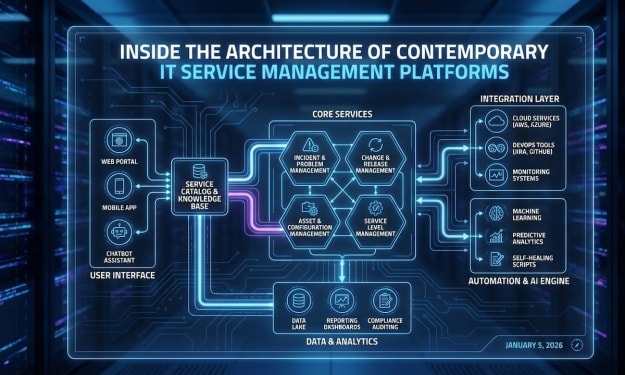
Inside the Architecture of Contemporary IT Service Management Platforms
Introduction As organizations increasingly rely on digital systems to operate efficiently, IT Service Management (ITSM) platforms have become a critical component of modern enterprises. These platforms help manage IT services, streamline workflows, and ensure consistent service delivery. Behind every effective ITSM solution lies a carefully designed architecture that integrates multiple technologies, processes, and systems.
By Nayel Basim Al Shehhi6 days ago in 01



Comments
There are no comments for this story
Be the first to respond and start the conversation.