
AI Is Coming for Our Jobs—and We’re Not Ready
Ai and specifically chatgp is very dangerous for our human

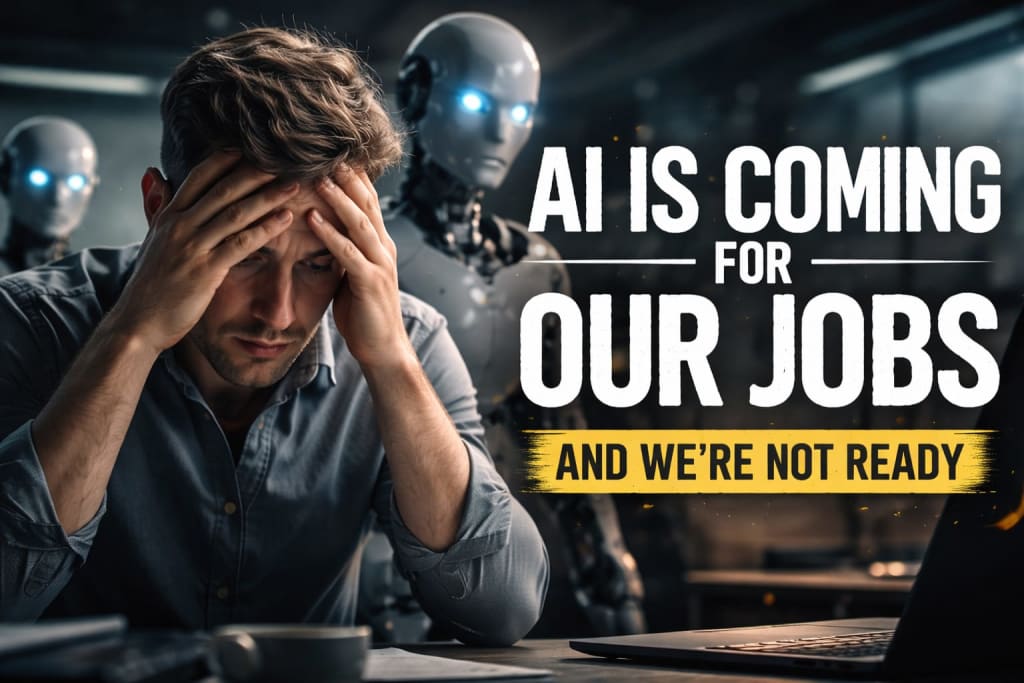
It doesn’t knock on the door. It quietly replaces you.
No one warned us this would happen so fast.
One day, AI was just a tool.
The next day, it became competition.
At first, I wasn’t scared.
I told myself what everyone else was saying: “AI will help us, not replace us.”
But then I saw it.
A coworker laid off.
A freelancer replaced.
A task that once took hours—now done in seconds.
And suddenly, the fear felt personal.
AI doesn’t scream danger.
It whispers convenience.
It doesn’t arrive like a villain.
It arrives like an upgrade.
Faster.
Cheaper.
More efficient.
And that’s what makes it terrifying.
For generations, our jobs defined us.
We didn’t just work—we became our work.
A writer.
A designer.
A developer.
A customer support agent.
Now, a machine can do parts of all of it—without rest, emotion, or salary.
And we’re expected to smile and adapt.
Here’s the uncomfortable truth no one likes to say out loud:
AI isn’t taking jobs because it’s evil.
It’s taking jobs because businesses don’t feel loyalty.
Efficiency wins.
Costs matter.
Humans are expensive.
So when a machine can do 60% of your job faster—
You become negotiable.
Replaceable.
Invisible.
What scares people isn’t just unemployment.
It’s loss of identity.
When you’ve spent years mastering a skill,
When your self-worth is tied to what you do,
Being replaced feels like being erased.
And AI doesn’t even notice.
We’re told to “reskill.”
To “learn AI.”
To “stay ahead.”
But no one talks about the emotional cost of constantly running.
The anxiety of waking up and wondering:
“Will my job still exist next year?”
The exhaustion of learning endlessly just to stay relevant.
The quiet fear that no matter how hard you work,
You might still lose.
AI doesn’t understand burnout.
It doesn’t understand fear.
It doesn’t understand families, rent, or dreams.
It just executes.
And the gap between what machines can do
and what humans can handle
is growing faster than we are.
But here’s the part most people miss.
AI isn’t dangerous because it’s intelligent.
It’s dangerous because we are unprepared—emotionally and socially.
We built the technology faster than we built the safety net.
We automated jobs
without automating compassion.
Still, this isn’t a story about panic.
It’s a story about awareness.
Because while AI can replace tasks,
it still struggles to replace meaning.
It can write words,
but it doesn’t feel them.
It can analyze patterns,
but it doesn’t understand pain.
It can simulate creativity,
but it doesn’t know why something matters.
The future won’t belong to those who fight AI blindly.
It will belong to those who understand what can’t be automated easily:
Empathy
Judgment
Ethics
Human connection
Purpose-driven thinking
Jobs will change.
Some will disappear.
New ones will emerge.
But pretending there’s no danger
is the most dangerous mindset of all.
The real threat isn’t AI.
The real threat is silence.
Denial.
Waiting too long.
We don’t need fear—we need honesty.
AI is powerful.
And power, without preparation, always creates casualties.
Final Thought
AI may replace what you do.
But if you don’t prepare, it can also replace how you see yourself.
The question isn’t whether AI will change our lives.
It already has.
The real question is:
Will we adapt with awareness—or wake up after it’s too late?
AI Side Effects on Humans
Artificial Intelligence is transforming daily life, but it can also bring unintended side effects for humans. Overreliance on AI tools may reduce critical thinking, memory use, and problem-solving skills as people depend on machines for answers. Privacy risks increase when personal data is constantly collected, analyzed, and stored. Job displacement is another concern, as automation replaces certain roles, causing stress and economic uncertainty. Social interaction may decline when people prefer virtual assistants over real conversations, leading to isolation. Bias in AI systems can reinforce unfair decisions in hiring, policing, or lending. Mental health can suffer from information overload and constant digital engagement. Additionally, misinformation generated by AI can mislead people and erode trust. While AI offers great benefits, careful use, regulation, and awareness are essential to minimize these negative human side effects and ensure balanced, responsible technology integration.
About the Creator
USA daily update
News, Politics, Technology Updates
Keep reading
More stories from USA daily update and writers in 01 and other communities.
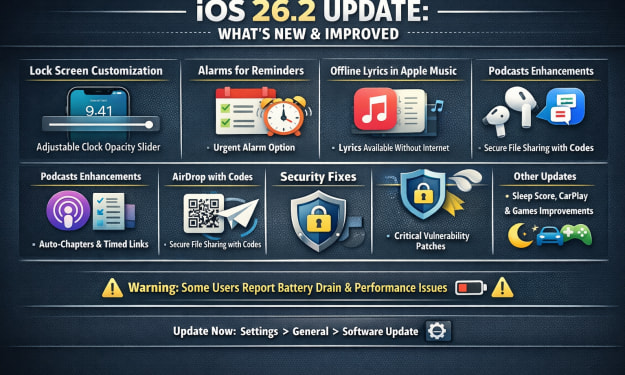
Apple iOS 26.2 Update
Apple officially released iOS 26.2 in December 2025 as a free over-the-air update for compatible iPhones (iPhone 11 and newer, plus second-generation iPhone SE). This second major point update for iOS 26 brings a mix of new features, system enhancements, customization options, security patches, and app upgrades aimed at refining the user experience following the launch of iOS 26 earlier in the year.
By USA daily update 2 days ago in 01
iPhone 18 Pro Leaks Drama: The Dynamic Island Confusion Explained
The iPhone 18 Pro is already stirring up controversy, and it all started with a viral video from FPT. The renders showed off what looked like a major display redesign—one where the Dynamic Island had been shifted over to the left side of the screen. Unsurprisingly, the internet went into meltdown mode.
By Info Post Gate5 days ago in 01
Jeff Bezos Denies Polymarket Claim, Rekindling Debate Over Fake News on Betting Platforms Camila Grigera Naón
Polymarket has become embroiled in a scandal regarding a social media post it made about Amazon founder Jeff Bezos. The prediction market claimed he had recently recommended younger entrepreneurs to work regular jobs before starting a business.
By Dena Falken Esq7 days ago in 01


Comments
There are no comments for this story
Be the first to respond and start the conversation.