
8 Steps to write a killer content from scratch
Especially if you are a newbie freelance writer, these steps will immensely help you sail through.

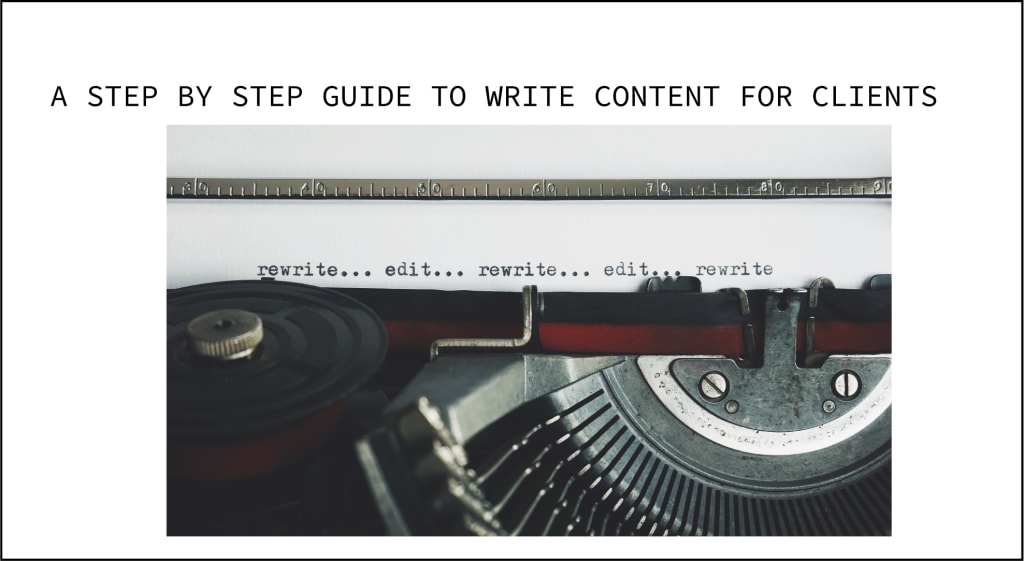
Even if you have a knack for writing, creating website content for clients may sometimes feel like lifting a mountain. This is due to the fact that there are fewer chances for you to deviate from the straight rope.
Newbie freelance content writers get often concerned about the possibility of failing to match the client’s expectations. As a result, the confidence fades away during the project, and the end product gets a pitiful aspect.
Only pursuing a masterful working system will throw away all the fear and confusion out of your mind and make your content writing a walk in the park. So let’s set the record straight and bring you some easy-to-follow (yet requires diligence) techniques that you can apply for almost all sorts of contents.
Everybody Writes by Ann Handley is a book that covers almost all types of content with a handful of valuable suggestions on how to write them. Buy this book from amazon.
Step 1: Keyword Research
I am assuming your client has already given you a certain keyword along with some instructions. Now you have the keyword, and the next thing you need to do is to Google it.
Suppose the keyword is “How to Write Content,” and there are millions of search results. You’ll see a section below that says “people also ask,” and even below, you’ll see some questions. This is the segment where it demonstrates what the majority of the audience wants to know regarding the main topic.
A couple of free tools will make the keyword research part even easier. My favorites:
1. Whatsmyserp
2. Ubbersuggest
3. Keywords everywhere
4. SEOquake
These tools will help you see search volumes of relevant keywords and give you a clear idea about what queries you should cover in your content.
Copy and save all the queries and relevant keywords in one single Doc file.
Step 2: Competitor analysis
Read all of the blogs on the first page. Read them over and over again. Examine the subheadings, keywords they’ve covered, and the potential keywords they haven’t. Save all of them in the doc file. Search each subheading and sort the keywords your competitors have used.
Your content will over all intend to serve two purposes:
To surpass your competitors on the search result
Generate traffic and attract them to stay on your page
Assess your competitor blogs by checking the word count, the keywords they have used, external links, heading tags, and all insights.
You can copy and paste all the links one by one on SEO assessment tool Screaming frog SEO spider to have a more deeper insight.
Step 3: Outline your content
Now it’s time to create an outline. Make sure the outline you create is not having any irrelevant subheadings, too many words, or keyword stuffing. The more clearly you create your outline, the more precisely you can write your content.
1. Set a heading.
2. Introduction must contain the central keyword once, and the suggested word length should be 100–200 words.
3. Write down the potential subheadings, the words length of each subheading, and the amount of keywords to be used.
4. Use bullets (if possible)
5. The conclusion
Step 4: Time to research
Google scholar is a great tool for conducting research. Yet there are more websites that will provide you with a great amount of information and make your research easier. You can check out these below listed online sources and choose either according to your choice.
- Microsoft Academic
- Academia
- JSTOR
- ScienceDirect
- Wolfram Alpha
- iSeek
- Research Gate
- Infotopia
- Virtual learning Resources Center
And for accurate statistical data, you can use Statista
However, random blog posts from your main keyword’s search results can provide you with an updated idea about your content. Take information from those blog posts that appear on the first page of your search result. Check out the credibility of the information they provide. Incorporate those information in your own words but make sure you are not copying and pasting anything.
Research all the portions and segments of your competitor blogs profoundly. The more research you conduct, the more valuable content you generate.
Gather all the information you think can be added to your content and store them on the doc file.
Step 5: Write the first draft
It’s recommended to determine the tone of your content based on your competitor blogs. If you are writing about a food blog, try to follow your top competitors’ tone.
Use phrases and words according to the subject of your content. If you are writing a food blog, try to avoid phrases and jargons used commonly on tech blogs or sports blogs. This will make your content sound more professional.
Let your headline be the most persuasive part of your blog. Online tool https://headlines.coschedule.com/ will help you assess and check the strength of your created headline.
As you get a micro amount of time to hook your audience, write the intro focusing on your audience’s struggles and pain areas and give them a glance of what you are going to cover all through your content to ease their pain points. Use Copywriting formulas like AIDA or PAS to make your introduction part more enticing.
The body part should cover all the necessary information. Make sure you are not incorporating too much information, fillers, or flowery words. Fillers and irrelevant words will make your audience’s reading experience bland.
The paragraphs should be thinner so that the blog post remains reader-friendly.
Each paragraph should be a bridge for leading your audience to read further. So avoid unnecessary sentences and stick to the point.
Use bullets, subheadings.
Set the heading tags.
Add relevant external and internal links.
Your conclusion part should summarize the whole context of the article in a few words. The conclusion should not be more than 3 small paragraphs.
Step 6: Rewrite, edit, proofread
It’s better to take a long break after finishing with your first draft. This would reset your mind and create space to look up at your written piece with fresh eyes. Assume you are a target-reader of your written content. Read the entire piece multiple times. Mark the sentences that sound cliche or look unnecessary and rewrite, remove, edit them later. Use tools like:
1. Grammarly (Editing, proofreading tool)
2. Hemmingway (Editing, proofreading tool)
3. Prowriting app (Editing, proofreading tool)
4. Quillbot (Paraphrasing tool)
5. Wordtune (Paraphrasing tool)
6. Copyscape (Plagiarism checker tool)
Okay, you are done writing your 2nd draft, and now it’s time to test the content differently.
Step 7: Run a text to speech tool
Text to speech tool will let you realize the tone of your written content clearly and help you point out the words that sound inappropriate. There are a number of free text to speech tools available online, and you can use them anytime you want.
Mark the point again you think should be edited or rewritten. Use alternative words or synonyms that sound easy. Remember, the toughest job for a writer is to write stuff simply.
Step 8: Final check and deliver
Now you are done. Set the image(if required), check the external links (Don’t use any broken link), check the Heading Tags. Read your content again. The more you read, the more perfect you make it. Take a break again, and read again before delivering it to your client.
Conclusion
There is no single formula to write content perfectly. I have just tried to show you a process that can be applied to any content as they are all necessary steps.
A continued effort to stick to a single form of practice will make you professional within a short time. Here I am mentioning a list of 4 books about content writing that will help you further in arranging your articles in a good manner.
The Content Code: Six essential strategies to ignite your content, your marketing, and your business (Buy from amazon)
Content Writing Step-By-Step: Learn How To Write Content That Converts And Become A Successful Entertainer Of Online Audiences (Buy from amazon)
One Hour Content Plan (Buy from amazon)
7 Steps to Better Writing (Buy from amazon)
[ This content contains affiliate links. If you buy any product through any of these links, the content creator will get a commission.]
About the Creator
Shuddha Brata
A Freelance Content writer from Bangladesh.
Keep reading
More stories from writers in 01 and other communities.
The Evaluation of Chatbots: From Concept to Real-Life Experience
Chatbots have evolved from simple computer scripts into advanced digital assistants that power millions of conversations daily. From customer service portals and e-commerce platforms to healthcare and education, these intelligent systems have transformed how businesses interact with users. But what does it really mean to evaluate a chatbot—from its concept to its performance in real-world scenarios?
By Tarun Nagar2 days ago in 01
The Changing Architecture of Finance Through Fintech Software – 2026
Introduction The global financial ecosystem is undergoing a structural transformation driven by fintech software. By 2026, finance is no longer defined solely by traditional banks, rigid systems, or centralized control. Instead, it is shaped by agile digital platforms, open ecosystems, real-time data processing, and customer-centric innovation. Fintech software has redefined how money is stored, transferred, invested, and managed, fundamentally changing the architecture of finance at both institutional and consumer levels.
By Aarti Jangid4 days ago in 01




Comments
There are no comments for this story
Be the first to respond and start the conversation.