
The Evaluation of Chatbots: From Concept to Real-Life Experience
Exploring the journey of chatbots from AI-driven concepts to real-world business applications, and highlighting the top chatbot development companies leading innovation in 2026.

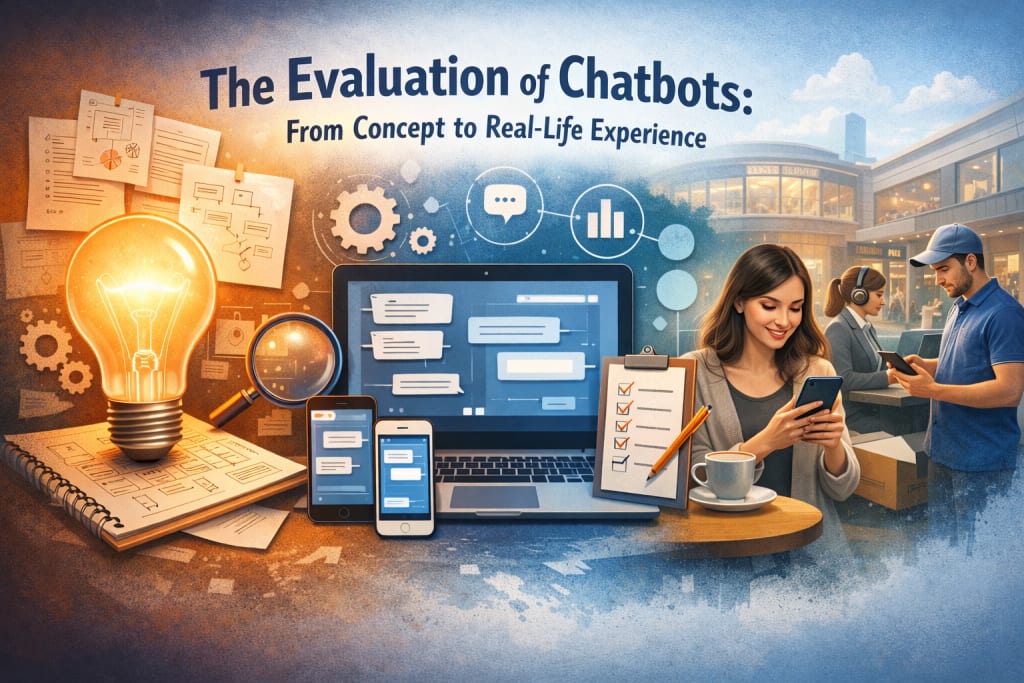
Chatbots have evolved from simple computer scripts into advanced digital assistants that power millions of conversations daily. From customer service portals and e-commerce platforms to healthcare and education, these intelligent systems have transformed how businesses interact with users. But what does it really mean to evaluate a chatbot—from its concept to its performance in real-world scenarios?
Let’s explore the full journey: how chatbots are conceptualized, built, deployed, and measured, and which chatbot development companies are shaping the future of conversational AI in 2026.
Understanding the Concept of Chatbots
The concept of chatbots isn’t new. The first chatbot, ELIZA, was developed in 1966 at MIT as an experiment in simulating a Rogerian psychotherapist. It worked by pattern-matching user inputs to scripted responses—primitive but groundbreaking. Over decades, advancements in artificial intelligence, natural language processing (NLP), and machine learning expanded these capabilities dramatically.
How Chatbots Work
- Modern chatbots operate using a combination of:
- Intent Recognition – Understanding what a user wants from their query.
- Entity Extraction – Identifying keywords or data such as names, locations, or products.
- Context Management – Remembering previous interactions to maintain natural conversation flow.
- Response Generation – Delivering meaningful answers using databases, APIs, or even generative AI models.
Together, these layers create an “intelligent assistant” capable of human-like, contextual interaction.
Types of Chatbots: Choosing the Right Model
To evaluate chatbots properly, it’s vital to understand the major categories. Each serves a specific purpose and fits different business needs.
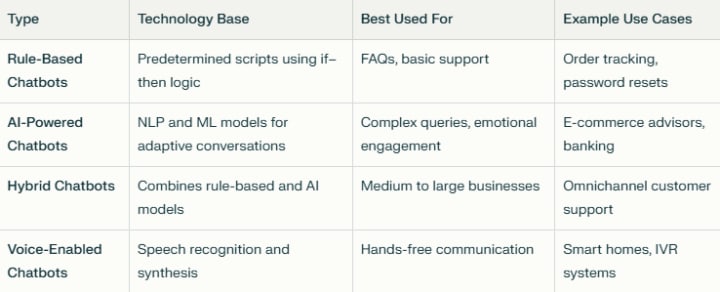
When evaluating a chatbot development company, understanding which type best suits your workflow and client base ensures you invest wisely.
Evaluating Chatbots: Key Metrics and Methods
Once a chatbot is designed, the real test begins. Evaluating its real-life effectiveness requires both quantitative and qualitative assessment.
1. Accuracy and Understanding
The first benchmark is intent accuracy—how often a chatbot correctly interprets what the user wants. Chatbots with high NLP accuracy (85–90%) create satisfying conversations with minimal human intervention.
2. Response Time
Speed is essential. A well-optimized chatbot should respond within 2 seconds to keep conversations fluid and engaging.
3. User Satisfaction
Feedback mechanisms like star ratings or post-chat surveys gauge how users feel about their experience. The Net Promoter Score (NPS) offers a reliable numeric measure.
4. Scalability
A high-quality chatbot must handle thousands of simultaneous interactions without lag or crashes. This is where experienced chatbot development services excel—by ensuring stable back-end infrastructure.
5. Security and Compliance
In sectors like finance or healthcare, data protection is critical. Chatbots must comply with standards such as GDPR or HIPAA to ensure secure information handling.
6. ROI (Return on Investment)
Evaluate cost savings and performance metrics. Many businesses report 20–40% reductions in customer service costs after chatbot adoption.
Chatbots in Real Life: Success Stories and Lessons Learned
The transition from a chatbot concept to real-world experience offers both triumphs and challenges.
Domino’s Pizza, for instance, launched “Dom”—an AI chatbot that lets customers order via text or voice. Not only did this improve convenience for customers, but it also increased repeat orders by 11%. Similarly, British Airways uses chatbots to resolve ticketing and travel queries, reducing response times by nearly 40%.
However, challenges persist. Microsoft’s Tay, introduced in 2016, famously turned controversial after learning inappropriate behavior from online users. This demonstrated how poor data handling and lack of ethical safeguards can backfire.
The key lesson? Continuous training and evaluation are vital. Chatbots should evolve with user expectations and clean, monitored datasets to deliver reliable experiences.
Benefits and Challenges of Chatbot Deployment
Key Benefits
- 24/7 Service – Always available, regardless of time zone.
- Cost Efficiency – Reduces operational expenses for support teams.
- Personalization – Delivers customer-specific responses using AI-driven insights.
- Operational Scalability – Grows with business demand, managing thousands of concurrent chats.
- Data Insights – Tracks customer behavior to improve marketing and product design.
Major Challenges
- Context Understanding – Bots may misinterpret sarcasm or intent.
- Integration Difficulties – Linking to legacy systems (CRMs, ERP) can be complex.
- User Trust – Some customers hesitate to engage with bots over humans.
- Bias and Ethics – Poorly trained bots risk perpetuating stereotypes or misinformation.
That’s why cooperating with a reliable chatbot app development company makes all the difference. Their expertise ensures smoother integration, cleaner training data, and continual improvement.
Top Chatbot Development Companies in 2026
As the chatbot market explodes globally, hundreds of developers compete for attention. However, based on performance, innovation, scalability, and client satisfaction, here are the top 5 chatbot development companies making waves in 2026:
1. Dev Technosys
Dev Technosys tops the list as the best chatbot development company of 2026. Known for custom, AI-powered chatbot design, they provide tailored chatbot development services for industries like e-commerce, healthcare, and logistics. Their solutions combine advanced NLP, machine learning, and cloud integration to boost efficiency and user satisfaction.
Notably, their clients report up to 50% reduction in customer support costs and improved lead conversion. With years of experience in chatbot app development, Dev Technosys continues leading the market with agile workflows, cutting-edge frameworks, and a commitment to quality.
2. IBM (Watson Assistant)
IBM remains a global powerhouse with Watson Assistant, an enterprise-grade AI platform offering conversational intelligence. Its strength lies in deep analytics and integration capabilities for regulated industries, from finance to government.
3. Tata Consultancy Services (TCS)
TCS excels at deploying scalable chatbot development services for banking, financial, and insurance (BFSI) sectors. Their bots manage high transaction volumes with exceptional stability and compliance assurance.
4. Accenture
Accenture offers high-quality chatbot app development company services emphasizing personalization, enterprise-grade security, and omnichannel integration. Ideal for brands wanting AI chatbots tied to CRM or ERP systems.
5. Microsoft (Azure Bot Service)
Microsoft’s Azure Bot Service simplifies deployment by integrating directly with Teams, Dynamics, and other enterprise tools. Its models support both text and voice interfaces—perfect for hybrid work environments.
These companies set the gold standard for chatbot quality, functionality, and innovation worldwide. However, Dev Technosys leads due to its commitment to client-driven customization and measurable performance outcomes.
The Future of Chatbots: What Lies Ahead
The next generation of chatbots will blend multimodal communication—text, voice, images, and even video—into seamless experiences. By 2027, Statista projects the chatbot market to exceed $42 billion, driven by increased automation demand and generative AI tools like GPT-based conversational models.
Trends to watch include:
- Emotionally intelligent bots that interpret tone, mood, and sentiment.
- Voice commerce, projected to dominate e-commerce interactions.
- Hyper-personalized AI assistants powered by continuous learning.
- Ethical AI frameworks ensuring transparency and fairness in chatbot interactions.
The focus of evaluation will gradually shift from “Does it work?” to “How human can it feel?”
Final Thoughts: Bridging Concepts and Reality
Evaluating a chatbot means examining much more than performance metrics—it means understanding how well theory translates into day-to-day usefulness. From early prototypes like ELIZA to modern AI companions that book flights and manage customers, the evolution of chatbots symbolizes the future of digital interaction.
For businesses in 2026, the takeaway is clear: choose your partners wisely. A dependable chatbot development company such as Dev Technosys can help transform conceptual goals into working, scalable realities through expert chatbot app development services that prioritize quality, functionality, and user satisfaction.
Chatbots aren’t just the future—they’re the present. The question is, how ready is your business to adopt one?
About the Creator
Tarun Nagar
Tarun Nagar is the CEO of Dev Technosys, a leading blockchain development company. With a vision for innovation, he drives the company to deliver cutting-edge solutions in blockchain and decentralized technologies.
Keep reading
More stories from Tarun Nagar and writers in 01 and other communities.
How to Add Support for Custom Blockchain Networks in Wallet Solutions?
The blockchain landscape is no longer limited to Bitcoin, Ethereum, and a handful of well-known alternatives. A new frontier is emerging where businesses, enterprises, and sovereign communities are launching their own highly specialized, permissioned, or application-specific blockchains.
By Tarun Nagar4 months ago in 01
The Politics of Playing Dress-Up
Well, to start off I'd like to say a happy world book day to all who celebrate. I know I haven't really posted anything on my socials about it but I'm not a jubilant kind of person. I lay low most of the time. Let's start off with a popular anecdote from the vaults...
By Annie Kapur6 days ago in Geeks



Comments
There are no comments for this story
Be the first to respond and start the conversation.