
14th December 2020: The Day Google Went Offline
What happened when Google went dark.


Do you use Google services? Have you used Gmail, Google search or Google Drive? If so you most likely assume that these services are online whenever you need them. You take these services for granted.
Google operates 3.5 billion searches a day. 500 hours of video is uploaded every minute on YouTube. So how can a company that dominates most of the internet suddenly go offline? On the 14th of December 2020, that’s what exactly happened.
Every single one of Google services went down. People weren’t able to access YouTube or access emails. A Twitter user said that he was sitting in the dark because his lights were controlled by Google Home.
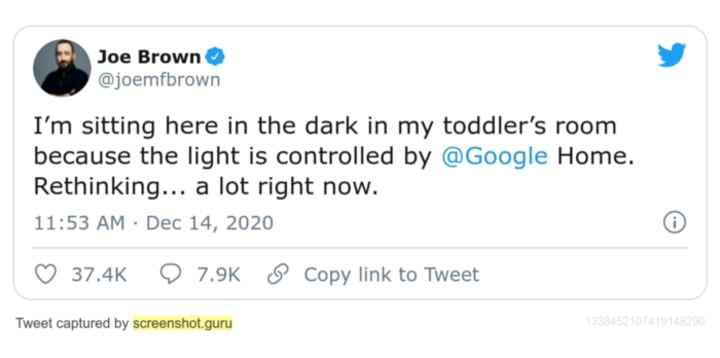
This outage became one of the biggest social media trends of 2020. How is it possible that one of the biggest companies could suddenly go offline? What happened? Was it a hack and Google doesn’t want to say?
The outage only lasted for about an hour. It caused a lot of anger and frustration. However when it was all said and done people seemed to forget about it and go on with their day. However, a question did come to mind. That was, “Is the world too reliant on Google?”
The outage caused global panic as people couldn’t do their work. Companies were brought to a standstill. Google Drive, Gmail, Docs, Google Play and even Stadia were gone. Some school gave students the day off as they relied on Google to deliver online lessons.
So what happened?
A spokesperson for Google said,
“Today, at 3.47 am PT, Google experienced an authentication system outage for approximately 45 minutes due to an internal storage quota issue,” the spokesperson said.“Services requiring users to login experienced high error rates during this period. The authentication system issue was resolved at 4:32 am PT. All services are now restored. We apologise to everyone affected, and we will conduct a thorough follow-up review to ensure this problem cannot recur in the future.”
This is the only thing Google has told the public about the outage. It’s very rare for Google to go offline because each area is served by servers across the world. There are backups on these servers. Peoples livelihoods and income rely so heavily on Google.
Imagine if Google was down not for an hour but days. Billions of dollars in revenue would be lost in an instant. We now come to our next question.
How does Google never go down?
Google refers to its ability to stay online asSite Reliability Engineering (SRE). Google started SRE in 2004. SRE is Google’s way to get software coders to rum software management rather than get IT managers, to do it. Many people refer to this practice as DevOps.
DevOps is a set of practices that works to automate and integrate the processes between software development and IT teams, so they can build, test, and release software faster and more reliably.
Google found that if you take development and operations you get a powerful union for a system that is reliable. The more humans you have working, the more chance there is of a mistake being made. Even if you have code run everything, humans coders can still make mistakes.
Is Google too big?
Many say that Google’s outage just made the biggest antitrust cases ever be made. Google has been in trouble with the US government for breaching antitrust laws. Monopolies aren’t illegal but shutting out your competition is. The DOJ says that Google illegally makes sure that its search is the default search engine on iPhone and Androids effectively blocking out the competition.
What about hacking?
To prevent this Google often pays hackers to keep the internet safe. It paid $6.5 million to hackers in 2019. Here is an interesting thing. The Google outage happened a few hours after it was confirmed that the US government had been the victim of a cyber attack.
The hack was done by a supply chain hack. This a software tool called SolarWinds that is used by government departments that were affected by malware. This allowed the hackers to see email and do some snooping.
The software that was infected had its last update in March 2020. The top 10 US telecom providers and 425 of the US Fortune 500 companies were said to be at risk. A Microsoft security analyst believes that there may have been a second group that launched an attack on the SolarWinds software.
Conclusions
Google’s outage can be served as a reminder that we are always connected. The company is so big that it is almost impossible for a new company to enter the playing field. I haven’t even mentioned Google’s reputation when it comes to privacy. You may be asking yourself, “What’s the solution?”.
There are alternatives to Google and each service that it offers. It comes down to trading convenience for privacy and vice versa. I leave you with a question.
Do you think the world relies too much on Google?
About the Creator
Keep reading
More stories from writers in 01 and other communities.
How to Launch a Crypto PR Marketing Campaign Efficiently in 2026?
The crypto ecosystem continues to evolve, bringing new challenges and opportunities for projects seeking visibility and credibility. Public relations (PR) in crypto is no longer just about announcements; it involves creating meaningful narratives, managing reputations, and fostering community engagement. In 2026, an efficient crypto PR marketing campaign requires a comprehensive strategy that combines data-driven insights, innovative communication methods, and precise targeting. This blog explores the essential steps and best practices for launching a crypto PR campaign that drives awareness, trust, and long-term engagement.
By Jack santo7 days ago in 01



Comments
There are no comments for this story
Be the first to respond and start the conversation.