
Why Text to Speech Online Is Becoming Part of Everyday Digital Life
Text to Speech Is Becoming a Daily Tool

Why Text to Speech Online Is Becoming Part of Everyday Digital Life
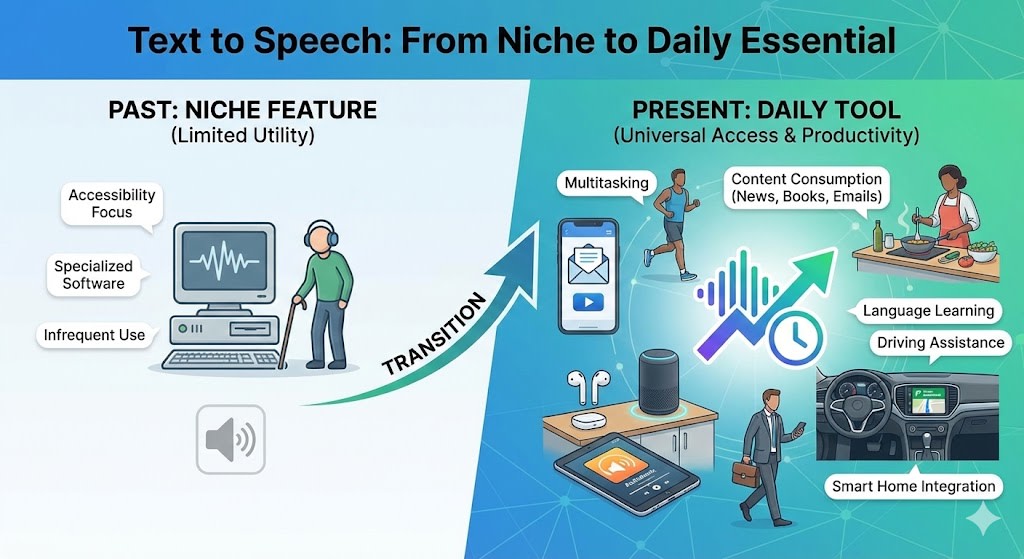
Not long ago, text to speech was mostly associated with accessibility tools or experimental software. It felt useful, but niche. Today, text to speech online has quietly become part of how people consume, create, and manage information on a daily basis.
The shift is happening for a simple reason: written content keeps growing, but time and attention do not. Articles, scripts, documents, and updates arrive faster than most people can realistically read them. Audio fits into moments where reading does not—during commutes, routine work, or screen-heavy days.
I first noticed this change in my own habits. Instead of carefully reading long articles, I was skimming. Turning text into audio helped me stay engaged without forcing extra screen time. That’s when text to speech online stopped feeling like a feature and started feeling like infrastructure.
Content Creation and the Rise of Voice-Optional Workflows
For many creators, voice recording is a bottleneck. Not everyone has a quiet space, proper equipment, or the energy to record multiple takes for every piece of content. Text to speech online offers an alternative that removes friction without removing intention.
Creators increasingly use it to:
- Add narration to short-form videos
- Produce audio versions of written content
- Prototype scripts before final recording
- Maintain consistency across different formats
What makes the difference today is voice quality. Early text to speech tools sounded flat and mechanical. Modern systems focus on pacing, tone, and expression. When voices sound natural, listeners stay engaged, and creators gain flexibility.
This shift has made customizable voice options less of a bonus and more of an expectation.
Education and Learning Through Audio
Education is one of the most practical areas where text to speech online has proven its value. Learning is not one-size-fits-all, and audio offers an alternative way to process information.
Teachers and students use text to speech to:
- Turn lesson notes into listening material
- Review long documents without screen fatigue
- Support language learning through pronunciation
- Create reusable audio resources
In many cases, text to speech MP3 downloads make content accessible beyond the classroom or learning platform. Audio allows learners to engage with material while walking, revising, or revisiting difficult topics at their own pace.
This isn’t just about convenience. It’s about making information more flexible and inclusive.
Business Use: Consistency Without Repetition
In business settings, voice consistency matters more than most teams realize. Product walkthroughs, onboarding materials, internal training, and updates often rely on narration. Re-recording audio every time content changes is inefficient.
Text to speech online simplifies this process by allowing teams to update scripts quickly while keeping the same vocal tone. This approach helps:
Speed up content revisions
- Maintain a consistent brand voice
- Support multilingual communication
- Reduce production overhead
For growing teams, this kind of efficiency makes audio more sustainable, not just more scalable.
Marketing, Tone, and Audio Identity
Marketing depends heavily on tone. A product launch, a case study, and a brand story all require different emotional cues. Generic voices struggle to handle that nuance.
Modern text to speech online tools allow marketers to adjust pacing, emphasis, and delivery style. This flexibility makes it easier to test variations and refine messaging without starting from scratch each time.
The result is not automation for its own sake, but faster iteration. When experimenting becomes easier, storytelling improves.
Personal Productivity: Listening as a Work Habit
One of the most overlooked uses of text to speech online is personal productivity. Listening to written material can reveal issues that reading misses—awkward phrasing, pacing problems, or unclear structure.
I often use text to speech to review drafts, notes, and long articles. Hearing the content instead of reading it adds distance and clarity. It also makes better use of time that would otherwise go unused.
For anyone working heavily with text, audio becomes a quiet efficiency upgrade.
How Modern Text to Speech Systems Have Improved
Behind today’s tools are neural speech models trained on large, diverse datasets. This allows voices to sound fluid rather than stitched together. The most practical platforms focus on control and simplicity, offering options for:
Voice selection
- Speed and tone adjustment
- Common audio formats
- Quick generation and playback
When the process is fast and intuitive, text to speech online becomes part of everyday workflows instead of an occasional experiment.
A Simple Way to Use Text to Speech Online
- In practice, effective use does not need to be complicated:
- Start with clear, well-structured text
- Choose a voice that matches the context
- Generate audio and listen or download as needed
If the process feels slower than manual recording, the tool misses its purpose. Speed and ease are what make text to speech practical.
Choosing Tools That Fit Real Use
Not all text to speech tools are built for the same audience. Some prioritize accessibility, others enterprise needs, and others creative workflows. What matters most for everyday use is
- Natural-sounding output
- Customization without complexity
- A clean online interface
- Flexible download options
These factors determine whether text to speech online becomes a habit or stays a novelty.
Final Thoughts
Text to speech is no longer just a workaround or a specialized feature. It has become a practical way to move ideas across formats with less friction. When written words can easily become audio, content travels further and fits more moments of daily life.
Tools like DeVoice reflect this shift by focusing on usability rather than spectacle. Whether for content creation, learning, business communication, or personal productivity, text to speech online is steadily becoming part of how people work—not an exception, but a standard.
About the Creator
Abbasi Publisher
I’m a dedicated writer crafting clear, original, and value-driven content on business, digital media, and real-world topics. I focus on research, authenticity, and impact through words
Keep reading
More stories from Abbasi Publisher and writers in Writers and other communities.
Why Small Businesses Are Exploring Free WhatsApp Automation Tools
For many small businesses, direct communication has become a central part of daily operations. Customers now expect quick responses, clear updates, and convenient interactions through platforms they already use. Among these platforms, WhatsApp has emerged as one of the most commonly used messaging tools for everyday communication.
By Abbasi Publisher5 days ago in Writers
SharedEasy and What I Learned About Living Without Long-Term Plans
I didn’t always think much about where I lived. For a long time, housing felt like a background detail—something you secured once and forgot about. That idea started changing when I noticed how often people around me were moving. New jobs, short contracts, remote work, temporary stays. Life didn’t seem to follow fixed timelines anymore, but housing still expected it to.
By Alexander James4 days ago in Writers




Comments
There are no comments for this story
Be the first to respond and start the conversation.