
"Why is there a strict prohibition on idolatry or images and sculptures in Islam?"
“ইসলামে মূর্তিপূজা বা চিত্র-ভাস্কর্যের প্রতি কঠোর নিষেধাজ্ঞা কেন রয়েছে?”

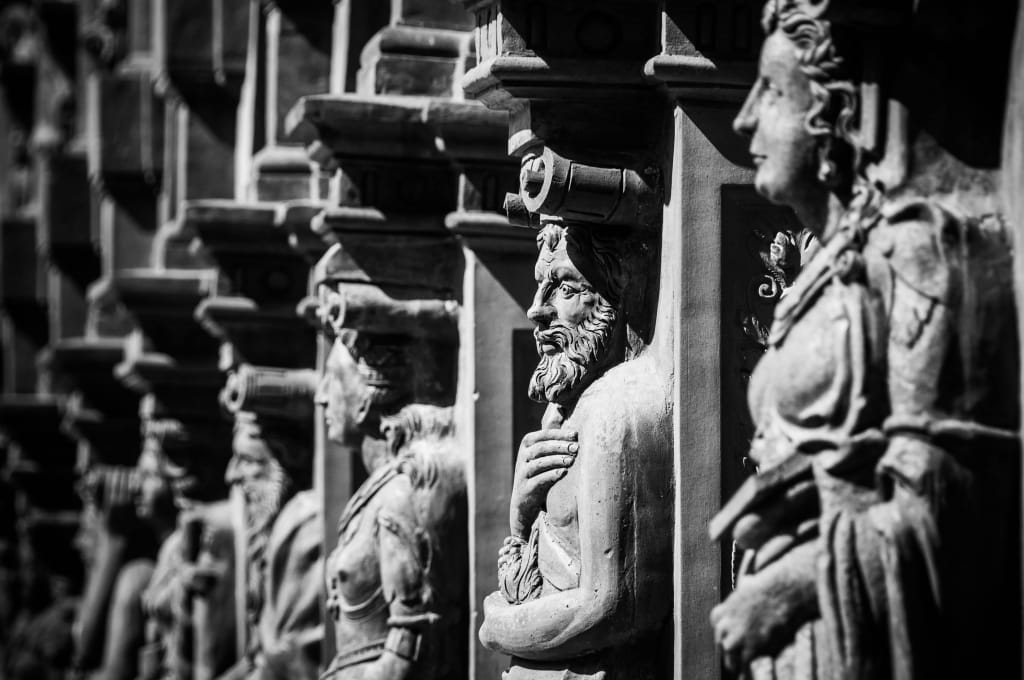
“Why is there a strict ban on idolatry or images and sculptures in Islam?” This is a question that arises in the minds of many atheists and non-Muslims and they often say, “Why is painting, making or preserving images prohibited in Islam? These are just expressions of art! So why is Islam so strict on this issue?” Behind this complaint is a tendency in the modern world to cross religious boundaries in the name of free thought. If artistic practice, culture and aesthetics are natural tendencies of humans, then why has Islam imposed certain limits on this issue—our discussion is to find an answer to this question.
The biggest wrong or crime in the eyes of Islam is shirk—that is, associating someone with the one God. The entire belief system of Islam is based on Tawhid, which teaches monotheism and the worship of God alone. Idols or images can become objects of worship at any time, and the history of mankind bears countless evidence in this regard. From ancient civilizations to modern nations, it can be seen that mankind once accepted idols only as a symbol of remembrance or honor; but later those idols became objects of worship. It can be seen in Hinduism, ancient Greek and Roman religions, and even in the medieval history of Christianity - first pictures and sculptures of Jesus or saints were made for the purpose of remembrance, and later they became objects of worship. As a result, Islam has created obstacles to this dangerous trend from the very beginning.
Allah Almighty says in the Quran, “Do not make idols, for they are acts of injustice and ignorance.” Although the Quran does not directly use specific words to prohibit images or sculptures, the issue is very clear in numerous authentic hadiths of the Messenger of Allah (peace and blessings of Allah be upon him). It is narrated in several hadiths that he said, “The most severe punishment is for those painters who paint pictures of animals.” In another hadith, he said, “Those who make pictures on earth will be told on the Day of Judgment: ‘Bring to life what you have created.’” These words are not intended to completely ban art, but rather to ban images and sculptures that could become objects of worship in the future or that express a kind of “human creation competition.”
There is also a deep philosophical aspect to consider here. When people make pictures or create statues of something, it is not just a visual delight, but sometimes it becomes a center of attraction and emotion. History has seen many times that the image of a hero or a prince reaches such a level of emotion in his followers that he almost attains the status of a demigod. In the eyes of Islam, this ‘spiritual decentralization’—where love, fear, or respect for something other than Allah becomes a form of worship—is contrary to the purity of monotheism.
Another important point is that Islam is a way of life where purity of both external worship and internal contemplation is desirable. Therefore, in Islam, it is not enough to just remember Allah from the heart, but there should also be a symbol of reliance on Allah externally. When a believer has an idol or a picture of an animal in his house, yard, or mosque, it can create a barrier to mental concentration. It can gradually destroy the purity of the heart, which ultimately leads to the loss of the true purpose of worship.
However, not all types of images or sculptures are prohibited in Islam. Images of nature, images of plants, or works of art that are used in education, history, or the dissemination of knowledge are permissible in the eyes of many jurists and scholars. Even in modern times, the need to take photos, record videos, or use three-dimensional images in medicine is evaluated in the light of fiqh. The main prohibition is that of images or statues of animals that incite pride, arrogance, or an attitude of worship or increase the tendency to idolatry in society.
After the conquest of Mecca, the first thing the Prophet (peace and blessings of Allah be upon him) did when he entered the Kaaba was to break all the idols there. However, those idols were still worshipped only as ‘symbols’. Some might say, “I paint pictures, but I do not worship them.” However, Islam is such a far-sighted system of life that measures are taken to stop a tendency from its initial stage, so that serious dangers in the future can be prevented. Allah is well aware of the human psyche, so He has imposed such restrictions, which may seem harsh at first, but are essential for the spiritual security of the society.
The consciousness of a nation is formed by its beliefs and attitudes. If a nation becomes accustomed to bowing down to something like an idol for a long time—be it a king, a hero, or a god or goddess—then their self-respect and absolute loyalty to Allah begin to erode. The fundamental purpose of Islam is that people should bow down before Allah alone, and connect directly with Him without any medium. The feeling of worship or reverence through images or statues damages this direct relationship.
Finally, it can be said that Islam is not an anti-art religion. Rather, it is a balanced religion that, on the one hand, recognizes human creativity and aesthetics, and on the other hand, protects the fundamental foundation of monotheism. Therefore, the restrictions imposed on the painting of images or animals are not only to prohibit them, but also to maintain the spiritual security of mankind and the purity of monotheism. Those who see this as mere conservatism or suppression of art fail to understand the depth of Islam's vision.
About the Creator
Keep reading
More stories from Abdul Barik and writers in Writers and other communities.
Average Cost of 2D Animation Outsourcing Projects
Outsourcing 2D animation allows businesses to create explainer videos, ads, onboarding content, and product demos without building an in-house team. In the US market, pricing varies based on animation style, complexity, and production scope.
By Leo Johnson6 days ago in Writers


Comments
There are no comments for this story
Be the first to respond and start the conversation.