
Why do I do what I do?
People often ask me why I write. This is what I wish I could say...

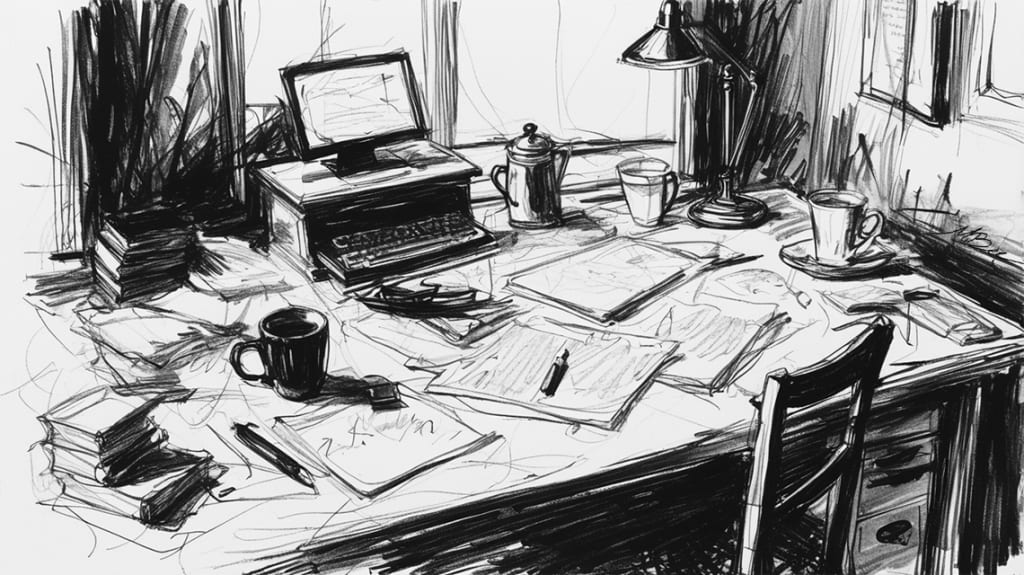
I get asked on a semi-regular basis when it comes to my work, "Why do you write what you write?"; It's a relatively difficult question to answer in such a nonchalant, brief manner. The opposing person, "the questioner" as I'll call them, often merely wants a quick and simple, yet poignant response and I find that in those situations my default answer almost always ends up simply being "I enjoy it". It's not the best answer to give I know, however, to answer it truthfully would require me and the questioner to engage in a rather deep and meaningful conversation about me and my life and it's hard to do that with a stranger who's merely asking out of a small curiosity as to why I write.
"Poetry is like my own magic mirror that I hold up to the world."
George Orwell once said that he did not think that one could assess a writer's motives without knowing something of his early development, I find this statement to be true and yet for someone who shies away from the spotlight, an awkward introvert if you will, it can be almost traumatic to even contemplate sharing even with associates, let alone to a stranger. When I was a young child my mother wrote a great deal of poetry, I loved her work and still do, reading her poetry and having her read them to me instilled a passion for writing in me which I still carry to this day. My mother kept many books; classic novels and poetry books which I must confess I ruined my fair share of with the scribbles and drawings one might expect from an overly energetic child, and yet she never - if memory serves right - got mad about me doing so.
My family grew up extremely poor during the recession of the early 1990's. My father was a potato picker and my mother undertook odd jobs for people, we lived in a small ramshackle cottage in the middle of nowhere which had no heating and would lose power on an almost weekly basis. My mother along with my sister and I would pick fruit from the orchards and make jams and cakes which my mother would trade with a butcher for meat so my mother could feed us a better diet. As I said we were extremely poor, I mention this because those books in which I scribbled and doodled must have meant a great deal to a woman struggling like my mother did and yet she always encouraged her children's creativity, even at her own expense. That creative freedom coupled with a love of poetry which she passed to me surely helped to forge my creative mind in those crucial formative years of my life.
As a child, I was "diagnosed" with ADHD by my school, as well as having "number dyslexia". These were things I accepted as truths and I spent a great deal of time in special education classes which attempted to correct my behaviours, these failed, however, as I grew older the ADHD simply disappeared and was replaced with an overwhelming urge to be creative. It wasn't until I was in my mid-twenties whilst undergoing therapy for anxiety and PTSD that I discovered that my ADHD and number dyslexia as a child was a wholly inaccurate diagnosis and that I had in actuality something called low latent inhibition or LLI for short. I won't get into what that is in this piece, as I've already written on the subject, nor will I get into why I disagree with how LLI is treated as a personality trait rather than a disorder, however, it is not something that one can simply turn off like a light switch and it makes the person with it extremely observant to all stimuli around them.
I observe the world and everything in it and try to make sense of it all through poetry, I twist it and bend it so it reflects new light and then through my poetry the reader can see a piece of the world cast in that light. The aim is to show an alternative perspective to the reader, to make the reader think and question their perceptions of the world. A poem may allow the reader to experience a situation, life or emotion that they otherwise wouldn't experience and in that moment between the first line and the last, take a step away from their own lives and walk into someone else's. When the reader then returns to their lives afterwards they will remember that experience and that sometimes changes their perception of the world around them moving forwards...
...and that is why I do what I do.
About the Creator
Mat Barnsley
I strive to make sense of the world through writing. I break it apart, twist it, and bend it until it reflects new light. I invite you to see the world cast through my written stained-glass windows.
Keep reading
More stories from Mat Barnsley and writers in Writers and other communities.
The Library
Over the past few years I have read many articles both in print and online that claim that libraries in England are dying due to their lack of relevance in today's world, and how they must evolve in order to stay alive, but saying that libraries are now irrelevant in today's world is like saying that knowledge has become irrelevant. I don't believe that the library is any more irrelevant than a book is irrelevant in general to a bovinous person. The best gift that I was ever given was a humble library card, it unlocked a journey of learning and fascination and gave me a quiet home away from home where I could sit in peace and breathe in worlds unknown. The amount of time I've lost between the pages of books is incalculable, but the knowledge and wisdom I've gained from reading them is also.
By Mat Barnsleyabout a year ago in Writers



Comments
There are no comments for this story
Be the first to respond and start the conversation.