
When Local Events Turn Kids Into Readers
How book fairs, author visits, and community festivals inspire a lifelong love of reading—one story at a time.


Community Events as Literacy Triggers
In neighborhoods where the public library is the heart of a town square and summer reading challenges double as rites of passage, community events often do more than fill up a calendar. They spark imagination. They create rituals around reading. And in many cases, they plant the earliest seeds of a reader’s identity.
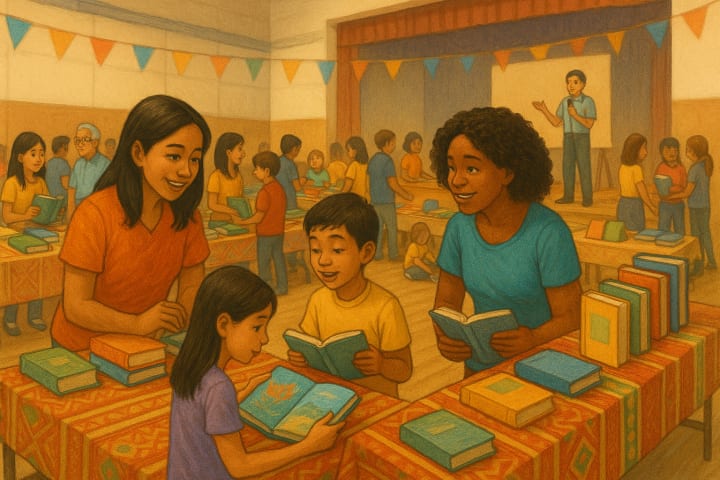
Whether it’s the hum of folding chairs in a school gym or the crisp morning bustle of an outdoor fair, local book events set the stage for something quietly transformative. For young readers, especially, these gatherings provide not just access to stories—but access to a culture that celebrates storytelling.
Book Fairs, Festivals, and Childhood Memory
Many readers can recall the smell of fresh paperbacks at a book fair or the clink of coins they saved for that one book their parents told them they didn’t need. These moments stay etched in memory not just because of the books themselves, but because of the atmosphere surrounding them. The colors, the noise, the promise of finding a new favorite.
For children discovering their place in the world, especially those from underrepresented backgrounds, seeing their stories on shelves is a quiet affirmation. A Filipino middle grade book placed beside fantasy epics or bestselling series signals to a young Filipino reader that their experiences are valid, exciting, and worth writing about.
Book festivals often serve as entry points to those revelations. Whether regional or school-based, these gatherings bring literature into the everyday—a hallway, a gymnasium, a stretch of sidewalk—and turn it into something worth celebrating.
Interactive Encounters and Author Accessibility
Part of what makes local book events impactful is the chance to meet the creators behind the stories. When a young reader encounters an author in person—especially one who reflects their own background—it unlocks a deeper connection. These experiences take storytelling out of the abstract and ground it in possibility.
Events that include panels, Q&As, or school visits often lead to interactive author events where children don’t just consume stories—they talk back to them. They ask questions. They bring their curiosity, and sometimes even their own writing.
Meeting a Filipino middle grade author who talks about their childhood in Manila or their love of comic books can shift how a child views reading. Suddenly, the idea of becoming a writer—or even just embracing their own cultural identity—feels closer.
These interactions are especially valuable in places where access to books is limited. In these moments, a book becomes more than a product—it becomes part of a relationship between a reader and a living, breathing artist.
Examples of Grassroots Literacy Building
Across the U.S. and the Philippines, small-scale community efforts have been instrumental in bringing literature to new audiences. In rural barangays, traveling book caravans have brought Filipino middle grade books to schools without libraries. In cities like Los Angeles and Toronto, local Filipino-American organizations have partnered with bookstores to feature youth-focused stories during cultural festivals.
Pop-up reading corners at town fiestas, zine-making booths at street fairs, and bilingual storytelling sessions at community centers are redefining what literacy outreach looks like. These aren't top-down initiatives—they’re grassroots, often parent- or teacher-led, and rooted in the specific needs of a community.
Some organizations even host mentorship programs where aspiring writers are paired with established Filipino middle grade authors. These programs don’t just teach craft—they foster representation, confidence, and a sense of belonging in literary spaces.
The Lasting Impact of Early Book Culture
Early exposure to books, especially through interactive and localized events, can shape how a child sees themselves in the world. It teaches them that stories are not just something to be consumed but something they can participate in.
For diaspora kids who may not see their names, dishes, or languages reflected in mainstream media, attending a book event where someone reads aloud from a Filipino middle grade book can be quietly revolutionary. It allows them to hold onto cultural identity while developing a lifelong love of literature.
Over time, these touchpoints create a ripple effect. Readers become writers. Book buyers become community organizers. Kids who once lined up for stickers at a school book fair go on to mentor the next generation.
The Power of the Local
In a digital world, it’s easy to underestimate the power of in-person, hyperlocal events. But these are the places where literary culture takes root. Not in algorithms or bestseller lists, but in the small shared moments—a child getting a book signed, a teacher recommending a story that finally clicks, a parent seeing their child’s eyes light up at a story that feels like home.
Book culture isn’t built overnight. It grows over years of repeated joy, discovery, and encouragement. And while national campaigns and big-name endorsements have their place, it’s the local events—the school book drives, the cultural festivals, the community signings—that often leave the most lasting mark.
In every town, there’s potential to cultivate the next lifelong reader. All it takes is a few tables, some open books, and a community willing to celebrate the power of story.
About the Creator
Maxine Dela Cruz
Maxine Dela Cruz is a storyteller who writes about culture, events, and youth media. Her work captures how books, traditions, and collaborations influence how we grow up and who we become.
Keep reading
More stories from Maxine Dela Cruz and writers in Writers and other communities.
The Unexpected Power of Pop Culture to Promote Books
Not All Readers Start with Books Not every young reader begins their journey with a bookshelf. Some start with a TikTok scroll. Others with a meme. In today’s content-saturated world, stories often reach audiences long before they ever open a book. This shift isn’t a crisis—it’s an opportunity. Especially for authors trying to connect with kids who’ve grown up more on screens than in libraries.
By Maxine Dela Cruz8 months ago in Writers
It's Winter
Anne Bernays and Pamela Painter — What If? Writing Exercise for Fiction Writers prompts The Exercise —Write a scene involving two characters. Have the point-of-view character presume something entirely different about the situation from what the other character's overt behavior seems to imply. For example, a landlord comes to visit, and the tenant suspects that it isn't a visit but an inspection. Make up several situations in which one character can fantasize or project or suspect or even fear what another character is thinking. The Objective - To show how your characters can use their imaginations to interpret the behavior and dialogue of other characters.
By Denise E Lindquist19 days ago in Writers
Why Students Are Turning to a Humanizer AI Instead of Relying on AI Alone
Why Students Are Reconsidering AI-Only Writing in Academic Work Artificial intelligence tools have become deeply embedded in student workflows. From outlining essays to organizing research notes, AI has changed how students approach assignments. However, a noticeable shift is taking place in academic environments. Students who rely exclusively on AI-generated writing are increasingly encountering issues related to grading, feedback, and academic credibility.
By Abbasi Publisher2 days ago in Writers




Comments (1)
Community book events are great. They spark imagination and create reading rituals. Meeting authors adds a personal touch that makes stories more real.