
What Fantasy Writing Taught Me About Hope
A Reflection


Sometimes, life feels heavier than we expect. Daily routines, obligations, and the constant hum of the world can make hope seem like a distant, fragile thing—something others possess but we’ve misplaced. Yet, for me, hope has often been found in the most unexpected places: in the stories we tell.
Fantasy writing, in particular, has a quiet way of reminding me that even when the world feels overwhelming, small choices can ripple outward in ways that matter. Creating realms filled with dragons, shifting constellations, or magic that bends the rules of reality is more than escapism. It’s a practice in imagining the possible when everything in our present feels impossible.
When I sit down to write, I don’t just create characters; I build a universe where even the smallest gesture can have monumental consequences. A single act of kindness might spark a chain of events that changes a life—or a world. A whispered truth, a moment of bravery, a refusal to give up in the face of darkness—these are the things that matter most, both in fantasy and in reality. And through these imagined scenarios, I’ve learned to recognize hope in my own life.
Fantasy teaches patience. It teaches that growth is rarely linear. Heroes falter; alliances break; losses are real and often painful. Yet within these stories, there is always a thread that keeps moving forward: courage, empathy, persistence. Hope in fantasy isn’t naive or simplistic. While many might try to convince characters of this, as in reality, the beauty is that they are rarely right. It becomes transformative when they witness a hero’s full belief never falter. There’s a quiet, steadfast force that persists even when the outcome is uncertain.
Writing fantasy also teaches empathy. To create a believable character, I have to understand their fears, desires, and flaws. You don’t even want to know how long I’ve spent on charting their zodiac signs and enneagrams and more just to get to know them a bit more. It really helps flesh them out. And in doing so, I learn to extend compassion beyond the page and to people in my real life, and even to myself. The villains aren’t always evil, and the heroes aren’t always perfect. In the nuanced gray between light and dark, I’ve discovered that hope thrives not in certainty, but in possibility.
And there is something profoundly human in this. We all face moments where it feels like the darkness will never lift. But just as a hero learns from mistakes, readers can take comfort in the idea that missteps and setbacks do not define the entire journey. Hope is not about waiting for a perfect ending—it’s about recognizing the tiny victories along the way, the sparks that appear even in the shadows.
For me, fantasy writing has become a form of meditation, a daily reminder that imagination is not separate from life. It’s a way to practice resilience, to explore courage, and to affirm that hope, no matter how fragile, is always worth nurturing. I’ve watched readers connect with characters in ways that inspire them to persevere, and that reminds me why these stories matter. Stories aren’t just entertainment anymore. Perhaps they never were. They are small vessels of hope, carrying meaning from one person to another.
To anyone reading this: thank you for spending a few moments here. I hope these words remind you that hope doesn’t have to be loud to be real. If you’ve found some value in this reflection, your support—no matter how small—helps keep these stories alive. A donation not only allows me to continue creating but ensures that the small lights of hope in these stories reach others who might need them.
Thank you, truly, for reading, for imagining, and for believing in the quiet power of possibility.
About the Creator
Kayla Bloom
Teacher by day, fantasy worldbuilder by night. I write about books, burnout, and the strange comfort of morally questionable characters. If I’m not plotting a novel, I’m probably drinking iced coffee and pretending it’s a coping strategy.
Keep reading
More stories from Kayla Bloom and writers in Writers and other communities.
Why I Always Start with a Map
There’s something about a blank page and a pencil that feels impossibly powerful. But before I write a single word of dialogue, sketch a character, or even name a city, I start with a map. Maps aren’t just decorative; they are the spine of a story, the geography of imagination, and, frankly, my personal coping mechanism. Somewhere between plotting rivers, mountains, and roads, I find clarity that no outline or spreadsheet could ever provide.
By Kayla Bloom6 months ago in Writers
Early March 2026: 4 Goals Accomplished
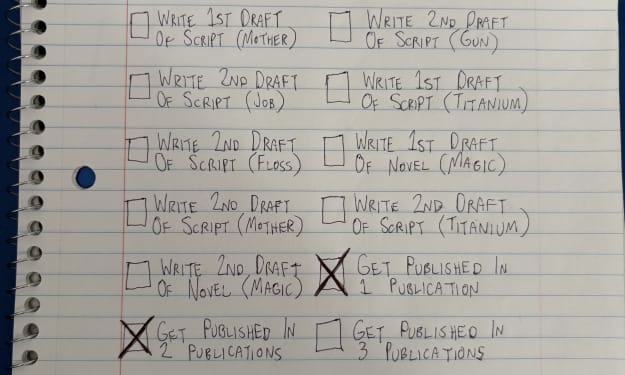
It's early March and I've now accomplished my 4th writing goal for the year of 2026. Before diving into the behind-the-scenes of it... why not tell you up front what that accomplishment was? I was published in a 2nd publication for this year. Published in Helix Literary Magazine out of Central Connecticut State University. You can read it for free right now!
By Stephen Kramer Avitabile6 days ago in Writers
Precision Motion Systems in Modern Aerospace Engineering
Introduction Modern aerospace engineering relies heavily on precise motion control systems to ensure aircraft operate safely and efficiently. From adjusting flight surfaces during turbulence to aligning onboard sensors for navigation, controlled mechanical movement is essential for maintaining stability and performance throughout a flight.
By Beckett Dowhan3 days ago in Writers



Comments
There are no comments for this story
Be the first to respond and start the conversation.