
Understanding Google Algorithm Updates: A Comprehensive Guide
Strategies for Sustained SEO Success

Google's algorithm updates are a critical aspect of the search engine's ongoing effort to deliver the most relevant, high-quality, and user-friendly content to its users. These updates can significantly impact website rankings, traffic, and overall SEO strategies. Staying informed about these changes is essential for webmasters, SEO professionals, and digital marketers. This guide will provide an overview of major Google algorithm updates, their implications, and how to adapt your SEO strategies accordingly.
What Are Google Algorithm Updates?
Google's algorithm is a complex system used to retrieve data from its search index and instantly deliver the best possible results for a query. The search engine uses a combination of algorithms and numerous ranking factors to return webpages ranked by relevance on its search engine results pages (SERPs).
Google frequently updates its algorithm to improve the quality of search results. These updates can range from minor tweaks to major overhauls that can dramatically affect website rankings. Understanding these updates helps webmasters and SEO professionals adjust their strategies to maintain or improve their search visibility.
Major Google Algorithm Updates
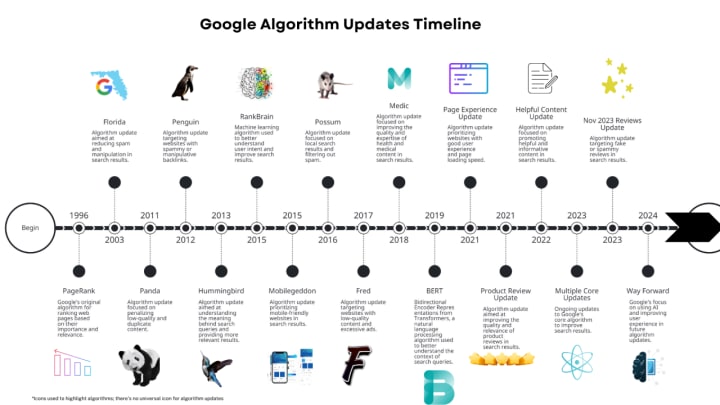
1. Panda (2011)
Objective: To lower the rank of "low-quality" or "thin" sites and return higher-quality sites near the top of search results.
Impact: Websites with poor content, such as those with duplicate content, keyword stuffing, or low-value add content, saw significant drops in rankings.
Adaptation Strategy:
Focus on creating high-quality, original content.
Avoid duplicate content and keyword stuffing.
Ensure content provides real value to users.
2. Penguin (2012)
Objective: To decrease the rankings of sites that violate Google’s Webmaster Guidelines by using black-hat SEO techniques, particularly link schemes.
Impact: Sites with unnatural backlink profiles, such as those with a high number of low-quality or spammy links, were penalized.
Adaptation Strategy:
Conduct regular backlink audits.
Disavow toxic backlinks.
Focus on earning high-quality, natural backlinks.
3. Hummingbird (2013)
Objective: To better understand the intent behind a user’s query and deliver more relevant results.
Impact: This update emphasized semantic search, allowing Google to better interpret the context and meaning behind search queries.
Adaptation Strategy:
Optimize for long-tail keywords and natural language.
Focus on user intent and create content that answers specific questions.
Use structured data to help search engines understand your content.
4. Pigeon (2014)
Objective: To improve local search results by providing more relevant and accurate local listings.
Impact: Local businesses saw changes in their rankings, with a stronger emphasis on traditional web search ranking signals.
Adaptation Strategy:
Optimize for local SEO by claiming and updating your Google My Business listing.
Use local keywords and create location-specific content.
Build local citations and backlinks.
5. Mobilegeddon (2015)
Objective: To boost the rankings of mobile-friendly websites in mobile search results.
Impact: Websites that were not mobile-friendly saw a drop in mobile search rankings.
Adaptation Strategy:
Ensure your website is responsive and mobile-friendly.
Use mobile-friendly design elements, such as readable fonts and clickable buttons.
Test your site’s mobile usability using Google’s Mobile-Friendly Test.
6. RankBrain (2015)
Objective: To help Google process search results and provide more relevant results using machine learning.
Impact: RankBrain interprets complex or ambiguous queries and learns from user behavior to improve search results over time.
Adaptation Strategy:
Focus on user experience and engagement metrics.
Create content that answers a wide range of related queries.
Use natural language and conversational keywords.
7. Fred (2017)
Objective: To target low-value content created primarily for generating ad revenue rather than helping users.
Impact: Websites with thin, ad-heavy content saw significant drops in rankings.
Adaptation Strategy:
Prioritize user experience over ad revenue.
Create high-quality, valuable content.
Avoid excessive ads and ensure a good balance between content and advertisements.
8. Medic (2018)
Objective: A broad core algorithm update that primarily affected websites in the health, wellness, and medical industries.
Impact: Many sites in the YMYL (Your Money or Your Life) categories saw significant ranking changes.
Adaptation Strategy:
Ensure your content is accurate, well-researched, and trustworthy.
Use authoritative sources and cite them properly.
Focus on E-A-T (Expertise, Authority, Trustworthiness) principles.
9. BERT (2019)
Objective: To better understand the context of words in search queries and provide more relevant results.
Impact: BERT helps Google understand the nuances and context of natural language, particularly for longer, more conversational queries.
Adaptation Strategy:
Optimize for natural language and conversational queries.
Create content that answers specific questions and provides in-depth information.
Use structured data to enhance content understanding.
10. Core Web Vitals (2021)
Objective: To prioritize user experience by focusing on page loading, interactivity, and visual stability.
Impact: Websites with poor Core Web Vitals scores saw drops in rankings.
Adaptation Strategy:
Optimize for Core Web Vitals metrics: Largest Contentful Paint (LCP), First Input Delay (FID), and Cumulative Layout Shift (CLS).
Improve page speed and performance.
Ensure a stable and responsive design.
How to Stay Updated and Adapt
Follow Official Google Channels: Keep an eye on Google’s Webmaster Central Blog and Twitter accounts for official announcements.
Use SEO Tools: Tools like Google Search Console, Ahrefs, SEMrush, and Moz can help you monitor your site’s performance and detect changes.
Analyze Your Data: Regularly review your website’s traffic and rankings to identify any significant changes that may be due to an algorithm update.
Focus on Quality: Always prioritize high-quality content and a great user experience. These are the core principles behind most Google updates.
Stay Informed: Join SEO communities, forums, and follow reputable SEO blogs to stay informed about the latest trends and updates.
Conclusion
Google algorithm updates are an integral part of the search engine’s mission to deliver the best possible user experience. By understanding these updates and adapting your SEO strategies accordingly, you can maintain or improve your website’s search visibility. Remember, the key to success in SEO lies in creating high-quality, user-focused content and staying informed about the ever-evolving landscape of search engine algorithms.
About the Creator
SearchEngineWays
SearchEngineWays - Your Trusted Partner in SEO Link Building + Content Marketing :) :)
High Authority Guest Postings,
and Web Development Services.
Keep reading
More stories from SearchEngineWays and writers in Writers and other communities.
The Ultimate Guide to SEO Article Writing: Crafting Content That Ranks
In the digital age, where information is at our fingertips, search engine optimization (SEO) has become a cornerstone of online success. Whether you're a blogger, a business owner, or a content marketer, understanding how to write SEO-friendly articles is crucial for driving organic traffic to your website. This guide will walk you through the essentials of SEO article writing, offering practical tips and strategies to help you create content that not only resonates with your audience but also ranks well on search engines.
By SearchEngineWaysabout a year ago in Writers
Unofficial Challenge: Black History Celebration
Forward: February 28th, 10:53 PM, EST... The final hour of Black History Month, 2026. Hello fellow writers. I've had this challenge waiting in my drafts for most of the month. But I held off on publishing it, until now.
By Sam Spinelli3 days ago in Writers
From System Failure to Human Error: My Journey Through Words ✍️
Writing, for me, is a process that borders on the magical—the art of precision in word choice, the unfolding of complex thoughts, and, most importantly, the act of creating something out of absolute nothingness. It is a craft I’ve fallen in love with, even though it can be as fickle as it is rewarding. 🌌 My literary journey began with a deeply personal, raw reckoning with my past in the book "404: Reality Not Found", where I chronicled the difficult path from the darkness of addiction back to the land of the living. 🕯️ Today, my pen has turned toward pure fiction—specifically, dark sci-fi set in a world dominated by algorithms: "Human.exe Error 0x000". 🤖💻
By Piotr Nowaka day ago in Writers




Comments
There are no comments for this story
Be the first to respond and start the conversation.