
Two Worlds, One Dream
A Story of Friendship Beyond Class
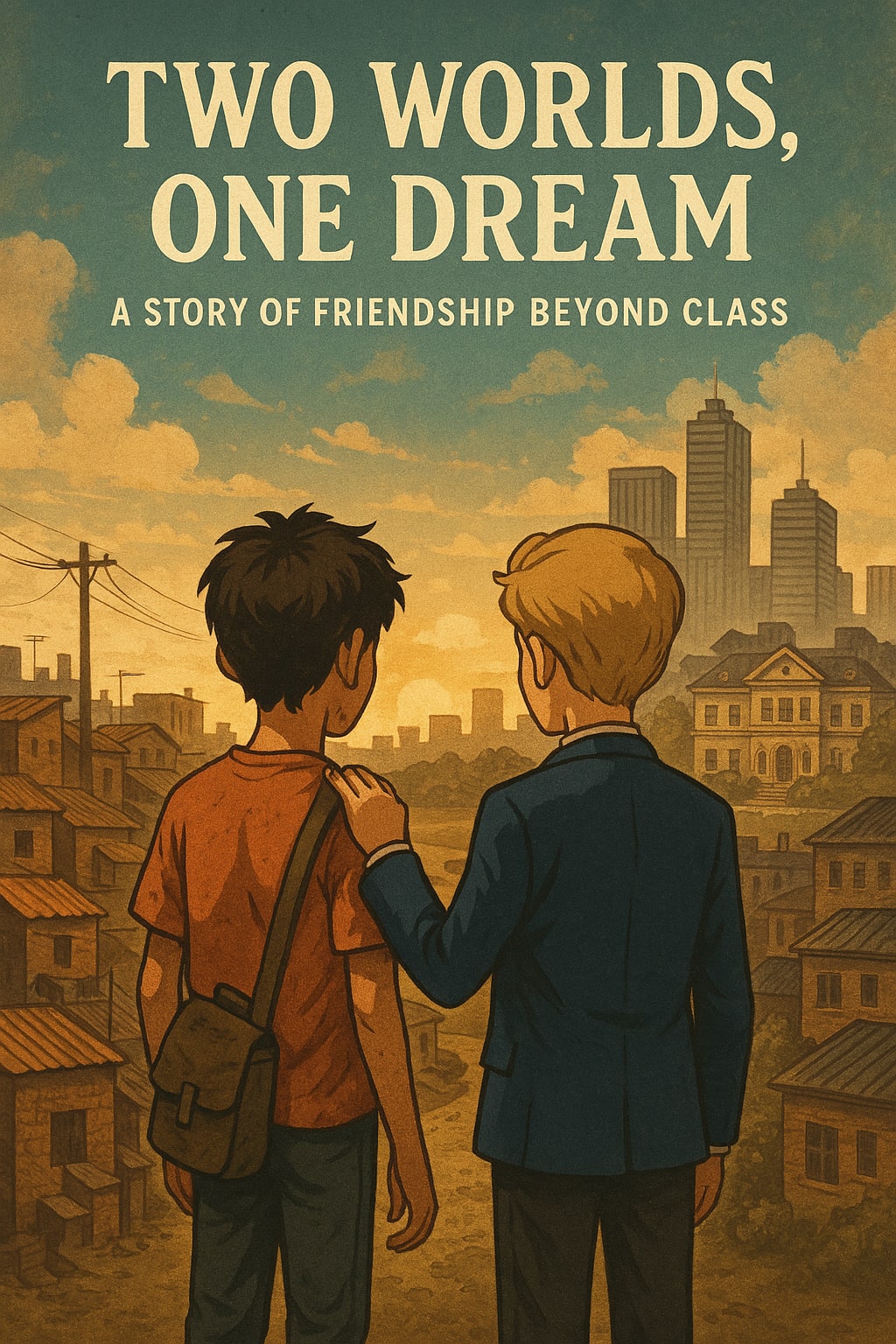
Luca lived in the narrow alleyways of Eastbrook, where the buildings leaned like tired old men and the sound of traffic never quite drowned out the laughter of kids playing soccer with a duct-taped ball. He was fifteen, clever in ways that didn’t show up on report cards. His shoes had holes, but his spirit didn’t. Every day after school, he would help his mother at the corner diner she waitressed at, scrubbing dishes and wiping tables until the last customer left.
Just three miles away, in the manicured neighborhood of Silver Pines, lived Adrian. Also fifteen, he had never washed a dish in his life. His home had more bathrooms than people, and he arrived at school in a sleek black car with tinted windows. Adrian’s life was quiet, structured, and loaded with expectations—honor roll, tennis practice, and piano recitals. Everyone assumed he’d take over his father’s financial firm someday, but Adrian wasn’t so sure.
They should’ve never met. And yet they did—on the soccer field.
It was early spring, and the school was hosting a city-wide tournament. Luca’s school didn’t even have proper uniforms; some kids wore jerseys, others just white T-shirts with numbers drawn in permanent marker. Adrian’s team looked like professionals in matching gear and pristine cleats. Everyone expected a blowout.
But Luca was fast. Lightning fast. He moved like the wind and thought three plays ahead. The rich kids didn’t know what hit them.
Adrian noticed. Not just the way Luca played, but how he led, how he cheered even when his teammates missed, how he never gave up. After the game, as their teams shook hands, Adrian said, “Hey. You’re good.”
Luca grinned. “You too. You play smart.”
It could have ended there—a polite exchange and nothing more. But something clicked. Over the next few weeks, they kept running into each other at other matches and eventually started practicing together in the public park between their neighborhoods.
Adrian brought new balls and cones. Luca brought his street-style tricks and grit. They talked about everything—life, dreams, frustrations. Adrian admitted he didn’t want to take over the family business. He wanted to study architecture, to design spaces that made people feel alive. Luca confessed he wanted to be a coach, maybe even run his own youth league someday, to give kids like him something to believe in.
“We should start a team,” Adrian said one evening, panting after practice. “Not like school team. Like…a real team. Open to anyone.”
Luca looked up. “You serious?”
“Why not?”
And just like that, the dream began.
They called it Street Stars. They begged for space at the local rec center and collected secondhand cleats, jerseys, and cones. Adrian’s connections helped them fundraise. Luca recruited kids from Eastbrook and nearby neighborhoods. They trained on weekends, coached together, and learned more about each other with every passing day.
But not everyone approved.
Adrian’s father found out and called it a “distraction.” He warned Adrian it would ruin his chances at top colleges. Luca’s uncle told him, “Rich kids don’t care about us, boy. He’ll leave when it gets hard.”
For a while, they started to believe it.
There was tension. Misunderstandings. One rainy Saturday, Luca didn’t show up to practice. Adrian found him later, working extra shifts at the diner.
“You could’ve told me,” Adrian said.
“You wouldn’t get it,” Luca replied. “You don’t have to worry about bills or rent. This—this dream? It costs me real stuff.”
Adrian was silent. Then he said, “You’re right. I don’t get it. But I want to try.”
And he did. He started helping at the diner, cleaning tables beside Luca after practice. In return, Luca began sitting in on Adrian’s architecture club meetings. They taught each other, leaned on each other, challenged each other.
Two boys. Two worlds. But one dream.
By the time they turned seventeen, Street Stars had over thirty players, some as young as nine. They competed in local tournaments, wearing mismatched socks and borrowed jerseys, but they played with heart—and they won.
The local paper ran a story about them: “Street Stars: A Field Where Class Doesn’t Matter.” It included a photo of Luca and Adrian standing side by side, beaming, mud on their shoes and hope in their eyes.
In their final year of high school, they applied together for a youth leadership grant. In the application, they wrote:
"We come from different lives, but we believe in the same thing: that talent, heart, and friendship are more powerful than background or money. Our dream isn’t just about soccer—it’s about building bridges.”
They won.
Luca used his part of the grant to start coaching certification classes. Adrian used his to begin studying architectural design, focused on community centers and youth spaces.
When they graduated, they stood on the same stage. One wore a suit bought secondhand, the other tailored. But no one could tell who was rich or poor. All they saw were two best friends—two dreamers—who had found something in each other that the world told them they weren’t supposed to have.
And in the crowd, watching with quiet pride, were dozens of kids from Street Stars, wearing mismatched shirts and wide smiles, proof that the dream was real.
About the Creator
Keep reading
More stories from UZAIR WARIS and writers in Writers and other communities.
Paws of Devotion
The first time Henry saw Max, the dog was barely more than a puff of fur and oversized paws. He was the last of the litter—quiet, awkward, and always trailing behind his siblings. Henry hadn’t come to adopt a dog that day. At sixty-two, he lived alone in a small house nestled at the edge of the woods, his children grown and scattered across the country, his wife, Lily, gone three years now. The silence in his home had settled like dust. Heavy. Constant.
By UZAIR WARIS10 months ago in Writers
15 Creative Marketing Ideas That Still Work in 2026
Marketing trends change every year, but effective marketing principles rarely disappear. As we move deeper into 2026, audiences are more informed, more selective, and more resistant to empty advertising than ever before. This doesn’t mean marketing is harder — it simply means it needs to be more thoughtful, creative, and human.
By Jhones Benn6 days ago in Writers



Comments
There are no comments for this story
Be the first to respond and start the conversation.