


Jacob was a writer, but he wasn't like other writers. His magnum opus would not be a book that has not come out on paper, at least. Churning thoughts of ideas, characters, and plots were always rushing through his mind. From the outside, it seemed that he was blankly staring at the screen or writing half-constructed ideas in his notebook. But inside his mind, it was a boundless universe of possibilities, stories waiting to be told, though most of them were sealed away inside his head.
Jacob loved to think. His friends teased him, playfully renaming him from "The Writer Who Writes" to "The Writer Who Thinks." But for Jacob, the processes of writing went two ways: the thinking was as vital as the words. He felt every story had to be stewed, sitting in those quiet spaces of the brain until it could be properly put onto paper.
Jacob's favorite time to think was in the mornings. He would sit at the window with his coffee, watching the world wake up slowly as the sun crept up the street below. He watched this dance unfold as if a silent bystander. To Jacob, every passerby was a potential character, every sound a backdrop to some new scene. His imagination took him to far-off places, having stringed together bits of what people said in passing, imagining the rest of people's lives beyond those few moments he was a part of.
One morning, while sipping his coffee and watching a young woman hurry past his window, Jacob imagined her as a character in his story. He saw her as a struggling artist, not arriving on time to an important gallery opening. Her work was brazen, incendiary. It set the art world on its ear. She both longed for, and feared, what people would say about her artwork. Jacob thought how he might incorporate this character in that novel he'd been wanting to write but then, like many other ideas, she drifted out the window, becoming just another interesting story floating around his mind.
It's not that Jacob did not want to write. He loved the process and wrote with fever for all manner of things. But sometimes, paralyzed by infinite possibilities, he was unable to settle on one idea. Each seemed to spawn another, until, talking over the "what ifs," he became lost in his own mental labyrinths: what if the suffering artist was a detective, what if the gallery opening was in fact a deeper, darker entity? What if her art had the ability to change the world? All possibilities swirled through his mind, one more intriguing than the last, until he could not choose which way to go.
And so Jacob was a thinker.
But something was different that day. It started with a visit from his old friend, Marcus. Marcus was also a writer, but unlike Jacob, he was the kind who could sit down and churn out a story in one sitting. His writing wasn't always perfect, but it was there; it existed in the world, while Jacob's remained locked in his thoughts.
"Why don't you just start?" Marcus asked him one evening as they sat in Jacob's cluttered living room, surrounded by unfinished notes and sketches. "Stop overthinking it and just put something down. It doesn't have to be perfect."
Jacob knew Marcus was right, but it wasn't that simple. "I don't know where to start," he admitted. "There are so many directions the story could go. I don't want to waste an idea by choosing the wrong one."
Marcus laughed. "There is no 'wrong' idea. You can explore all of them if you want. But you can't know where the story will lead unless you start writing.".
That night, lying in bed, Jacob thought of all the things Marcus had told him. Maybe he was right; perhaps it is that simple-the reason his stories never come out of his head is that he is too afraid to begin. Too afraid that once the words are on the page, they never live up to the grand ideas he has imagined.
Jacob sat at the window nursing his coffee as he did every morning. But on this day, as on so many others, Jacob did not let thoughts drift away but, instead, took up his notebook and started writing. It began as short sentences, developed into paragraphs or pages of what had been, earlier, just the outline of the essence of the young woman.
Jacob hadn't written a story in a long time-not only was he thinking about it but actually considering putting it on paper. The words didn't come easily, though; he doubted every sentence. But he kept going. And something magical happened as he wrote: the story began to take on a life of its own. Characters started speaking to him, guiding him down paths he hadn't considered before. The more he wrote, the clearer the story became.
By the end of the day, Jacob had filled several pages full of ideas, scenes, and characters. They weren't perfect and nowhere near finished, but it existed. And to Jacob, that was enough. He finally moved from being a think-to-be writer to the writer who writes.
And that, he realized, was the most important step of all.
About the Creator
Usman Zafar
I am Blogger and Writer.
Keep reading
More stories from Usman Zafar and writers in Writers and other communities.
The Knock
It was evening a usual quiet hour. Sarah was sitting near the window when dusk painted long shadows all over her living room and otherwise could not be heard there but with a gentle humming, a sound that represented the buzzing of the world. She had become quite accustomed to the stillness, the silence that she felt had surrounded her life. Days become weeks, and weeks turn into months each day became just one of a thousand others without any marked difference.
By Usman Zafarabout a year ago in Writers
Early March 2026: 4 Goals Accomplished
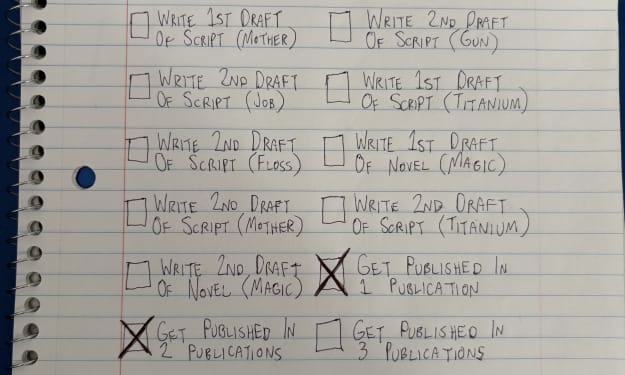
It's early March and I've now accomplished my 4th writing goal for the year of 2026. Before diving into the behind-the-scenes of it... why not tell you up front what that accomplishment was? I was published in a 2nd publication for this year. Published in Helix Literary Magazine out of Central Connecticut State University. You can read it for free right now!
By Stephen Kramer Avitabile6 days ago in Writers
A More Human Vocal
When we launched Vocal nearly a decade ago, the world was a very different place. LLMs did not exist, and stories were created one at a time by people sitting down to write, revise, and share something personal. Many of our assumptions about publishing, trust, and participation were built for a world where effort and output were inseparable.
By Justin @ Vocal7 days ago in Resources



Comments
There are no comments for this story
Be the first to respond and start the conversation.