
The worst day of my life, a (time-traveling?) "sign" & a conspiracy of silence
I Wrote This - A Story About Hope


The worst day of my life was June 23rd, 2023 (I'll explain why I'm telling the story now - exactly two years later)
The day before, my wife grew increasingly concerned that she hadn't felt any baby kicks from our son, who she was six months pregnant with. We visited the emergency room to get an ultrasound. I sat in those uncomfortable metal seats, bracing myself for the worst possible news an expecting father can get. My wife finally appeared speechless and white as a ghost; she slumped down beside me and didn't need to say anything. Our son was dead within her.
And to make matters worse, my wife would need to deliver him soon, stillborn. They suggested she be booked into the hospital immediately, but I questioned them further. There was nothing that could be done at the hospital that day, so we decided to go home and spend a final night with the three of us in bed together. We sat outside the hospital on a bench under a tree for a cruel eternity; we held each other, we cried, we cursed God, and we asked, "Why us?"
Back at home, I jumped to pointless and hurtful speculation. Why had his little heart stopped beating? Might my wife's lack of resolute confidence in her body and ongoing anxiety about the pregnancy have somehow manifested this?
We broke the news in person to my Bulgarian mother-in-law, who was shocked and heartbroken. The prospect of becoming a grandmother, finally, was the only glimmer of happiness this woman had in her life.
I poured myself a glass of Rakia. The harsh liquor burned in my chest, and I descended further into sorrow. I had a glass of wine over dinner while we discussed what would happen next. After dinner, I poured myself another glass of Rakia and stood on our balcony surveying the city lights of Sofia. I'd reached the adversarial bargaining-with-God phase; if my son could be magically re-animated somehow (like in a bunch of questionable stories I've heard), I'd be the best damn Christian I could be for the rest of my life.
In the cruel morning light of June 23rd, I imagined it was all a nightmare. But the nightmare was what we had to rise to meet.
My responsibility was to collect medical paperwork from the doctor managing the pregnancy at a different hospital than where my wife would go into delivery, delivering that which was dead. Our doctor speculated about what might have happened; sometimes in pregnancy, the umbilical cord gets knotted up, cutting off blood and oxygen flow (nobody is in there telling the baby, "Don't tangle that thing up!"), and it is lights out. I dropped off the paperwork at the other hospital and saw my wife a final time; unlike elsewhere, in Bulgaria, the father and mother are separated during delivery. For some stupid bureaucratic reason, they don't want men in the natal unit comforting their women. There was nothing for me to do there.
Back home alone, it was just time to wait. I figured I should educate myself about what my wife was about to go through, so I looked up YouTube videos about stillbirth. These totally triggered me, I broke down and cried in a way I haven't since a girl broke up with me when I was thirteen years old (I was a sort of a wimpy kid, and Tiffany was a jerk!) I called my mom and cried with her.
Friday, June 25th, was the worst day of my wife's life.
She doesn't have much pain tolerance and had to endure round after round of painful dilation checks (think: aggressive deep fingering without a drop of lube). Even after five vaginal capsules of misoprostol, her six-month-pregnant body was just not ready to a deliver a baby so they forced dilation with some kind of balloon contraption. Even anesthetized after two epidurals, it was the most physically torturous thing she ever experienced. The stillbirth itself happened relatively quickly. After several long hours of her being out of touch, she texted me...
Jon .. it's over. I gave birth to our baby boy... he's safe in heaven and has angel wings now. I asked my dad to take over and watch over his little soul.
Going into the hospital, she had been adamant that she did not want to see the lifeless form of our son after delivery. But fortunately, a thoughtful midwife there convinced her otherwise. She was able to hold his tiny body for the saddest moment of her life; she kissed his wrinkled little forehead and told him that Mommy and Daddy loved him and would miss him. They did not allow a photograph for reasons that baffle us. She decided to name him Teofil ("Teo" for short) after his grandfather, who we also lost in 2023. I'd give anything to have been there with her for this.
I went and saw her in the hospital as soon as I could; she was a broken woman. My wife then had to spend three more nights in the hospital, during which we both slept badly. I visited her daily to spend time and bring her decent food and (shockingly) toilet paper (Bulgaria's glorious healthcare apparently doesn't provide this). Having not betrayed my wife digitally (by viewing porn) in over three years (update: five years, now) and knowing that men often relapse into porn use when lonely and dealing with a crisis I refrained from drinking even a drop of alcohol the nights I spent alone. What helped those nights was doing relaxing breathwork sessions and distracting myself by watching war movies.
We broke the awful news to my family in America via text message and an invitation to talk sometime soon. I thought this was better than the ominous "Something happened. We need to talk..." text message. I'd rather get bad news as a gut punch than as a slow burn of anxiety, so that's how I delivered it.
I write this from a depth of sorrow that I haven't known before in my 38 years.
I mourn for the lost future moments of fatherhood I looked forward to; holding him in my arms, changing his diaper, seeing my wife lovingly mother him, teaching him to ride a bike, showing him how to open a coconut by throwing it on the ground, teaching him about Biohacking, giving him advice about girls, and so much more.
But the most helpful thing to hear on that terrible day that my wife delivered was that an umbilical cord complication indeed caused it. It would certainly add a long-lingering extra degree of mental anguish if it were a "cause of death unknown" - that would have left us ever questioning: what we might have done wrong...
A tangled cord is a random thing; we probably all tangled our cords a little in utero, but then they got untangled. In the face of tragedy, I find comfort in my belief in randomness; I'm relieved of self-attacking speculating about causality. And, while this has been a tremendous challenge to my faith, I believe that a good God lets bad things happen to good people because it's only in tragic misfortune that we get the opportunity to exercise our free will - that unique human capacity to rise above habit, impulse, and instinct. The more random and unfair the misfortune, the harder it is to choose not to let it define us, to hold onto hope, to keep faith, and to optimistically make plans for the future.
Why I kept this a secret for two years
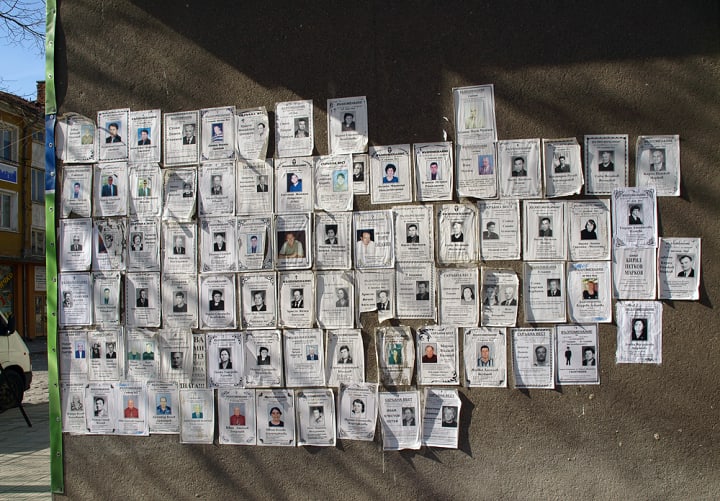
My wife is Bulgarian, and this is a culture that handles death differently: this is a culture that clings to the ghosts of the dearly departed. Walk around any Bulgarian town, and on homes' entrances, you'll see posted notices of residents' deaths. Look closer and you'll note that some of the deaths occurred many years ago, yet the surviving relatives go to the trouble of posting new death notices on their buildings every season.
This loss broke my wife for a long time. She was plagued by that infernal question for at least a year: Why would God let this happen? And my wife mourned the fact that I wasn't on the same grief journey she was on; I cried on June 23rd and wrote some of this article in the preceding days, but after that, I became pragmatic to a fault.
What happened to us is common: one in four pregnancies is lost in the womb. And there is a conspiracy of shame and silence around this, which we contributed to. I'm not sure why, frankly. Maybe it's because people don't really know how to provide sympathy in these events. Maybe it's because we long questioned if we had done something wrong. Maybe it's because it made us feel like failures. But now, we're breaking our silence.
A sign of hope (from the past?)
Over a decade ago, direly distracted by the "scenery" in a sunny cafe in Medellin, Colombia, I started writing this science fiction story about an infamous Biohacking cybercriminal called "Nero" who goes through an epic personal growth journey and ultimately learns (like me) that...
"The only way to capture time and defeat death is through the beauty of a woman."
(There's an epic twist coming, read on)
Literary critics debate whether it makes you a mediocre novelist if your protagonist is too much like the novelist. Well, maybe I'm mediocre because Nero is about 50% me, and Hourglass - a 10-year passion project - is a story that is about (among other things) sex. It mirrors the weird, wacky, sometimes obsessive, and sometimes excessive journey to sexual sovereignty that I've been on.
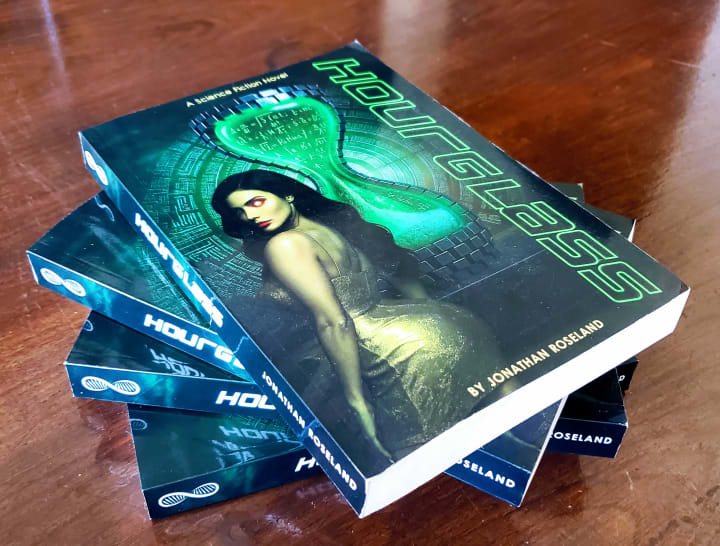
Hourglass begins with this striking scene of a nervous man stuck in an elevator with a beautiful woman. An elevator with four mirrored walls, where "her reflection receded infinitely away from his." (If you can't figure out what this is a metaphor for, you need to drink stronger coffee!) I first wrote this scene over ten years ago, and I don't know what inspired that particular detail; elevators with four mirrored walls are pretty rare, and I've encountered them just a few times in my life. I encountered one eight months ago; my wife and I stepped together into a four-wall-mirrored elevator in a clinic where we would first hear the tiny racing heartbeat of our son, who she will deliver in a few short weeks. That's right! Soon, I'll be NOT a "loss-father" but a "changing-diapers-and-rocking-the-baby-to-sleep-at-4AM-father!" And how coincidentally curious is the fact that a mirrored elevator is involved?
While I believe in randomness, I also believe that this life might be something like a novel written by an unseen author because I find it so pregnant with irony, coincidence, suspense, and redemption arcs reaching climactic conclusions. Perhaps we all have a bit of what I term "pre-cognitive aptitude" in my science fiction story. My wife and I took the mirrored elevator as a sign. A sign of hope. A sign granting us the faith we'd lost in the beauty of the future. A sign of the rebirth we both need after the worst days of our lives. A sign of the incandescence of that which is yet unwritten.
So, in the ultimate act of faith, we've given our son - our second son - a name that will capture all that.
But as I am a novelist, I must hold you in suspense; I'll reveal his name when he's born.
About the Creator
Jonathan Roseland
Adventuring philosopher, Pompous pontificator, Writer, K-Selected Biohacker, Tantric husband, Raconteur & Smart Drug Dealer 🇺🇸
Keep reading
More stories from writers in Writers and other communities.
It's Winter
Anne Bernays and Pamela Painter — What If? Writing Exercise for Fiction Writers prompts The Exercise —Write a scene involving two characters. Have the point-of-view character presume something entirely different about the situation from what the other character's overt behavior seems to imply. For example, a landlord comes to visit, and the tenant suspects that it isn't a visit but an inspection. Make up several situations in which one character can fantasize or project or suspect or even fear what another character is thinking. The Objective - To show how your characters can use their imaginations to interpret the behavior and dialogue of other characters.
By Denise E Lindquist18 days ago in Writers
Why Students Are Turning to a Humanizer AI Instead of Relying on AI Alone
Why Students Are Reconsidering AI-Only Writing in Academic Work Artificial intelligence tools have become deeply embedded in student workflows. From outlining essays to organizing research notes, AI has changed how students approach assignments. However, a noticeable shift is taking place in academic environments. Students who rely exclusively on AI-generated writing are increasingly encountering issues related to grading, feedback, and academic credibility.
By Abbasi Publishera day ago in Writers
So You Decided To Become a Nurse Practitioner:
So you decided to become an "Advanced Practice" nurse. Congratulations!... is what I would say if this was a good idea. Grad school? In this economy? What were you thinking? Likely it was something along the lines of either 1) “I've seen these other chucklefucks do it— Why can't I?” or even 2) “I've got a nice career, I should shake it up. I miss feeling like I have no clue what I'm doing.”
By Sandor Szabo3 days ago in Fiction


Comments (1)
Oh wow. You broke me down with this story. So, sorry for your loss. And great cover art for your book.