
The Village Without Yesterday
Each Day a New Life, Until One Refused to Forget

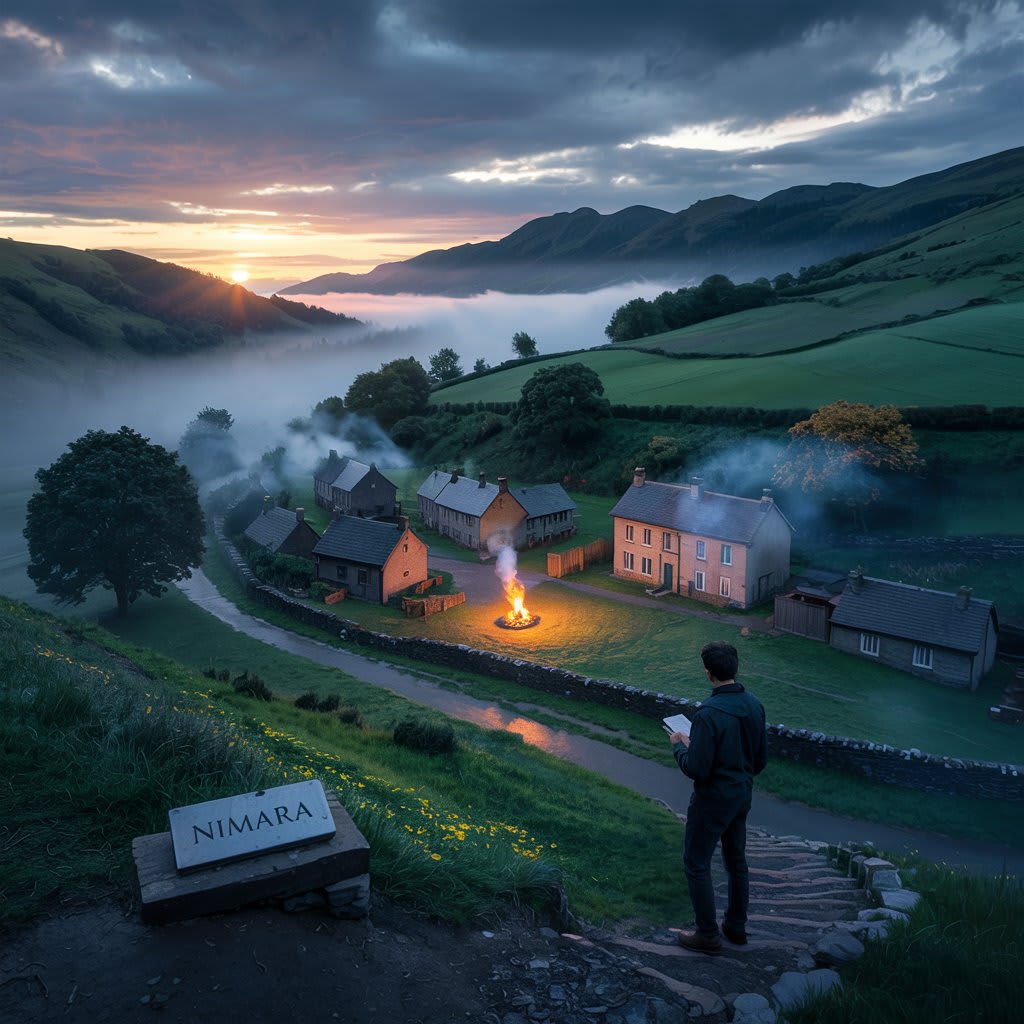
Deep in the folds of misty mountains, where roads turned to dirt and time seemed to slow, there lay a village called Nimara. The village was a curious place — not for its landscape, which was green and beautiful, nor for its people, who were kind and simple — but for something far stranger: no one in Nimara remembered yesterday.
Every dawn, when the sun rose over the hills and its light kissed the rooftops, the villagers awoke with no memory of who they were, what they did, or where they had come from. All they knew was the present — their names written on stones outside their homes, their roles carved on wooden boards, and a strange inner calm that convinced them this was normal.
Every day was a new life.
Old Jaanu, the village blacksmith, would awaken each morning, read his name on the metal plate nailed to his door, glance at the hammer in his hands, and nod. “Ah yes,” he’d murmur to himself, “I am Jaanu. I make things.” And off he’d go to his forge.
Mira, the baker, would wake with the smell of dough clinging to her fingers. “I must love bread,” she’d say, looking at the loaves lined up in her oven. She’d smile and begin anew, selling warm buns to people who didn’t remember buying them the day before.
Each evening, as the sun dipped behind the mountains, a fog would roll in, thick and silent. The villagers would feel sleep calling them. Some tried to stay awake, frightened by the feeling of their memories slipping, but it was no use. The fog took everything.
Then morning came, and the cycle repeated.
Children did not grow up remembering their childhood. Lovers forgot their love. Parents didn’t know their own children. And yet, the village thrived.
Until one day, a traveler arrived.
He was a dusty man with a notebook and a confused expression. His name was Aarav, and he had heard rumors of Nimara during his long, aimless wanderings. People in nearby towns spoke of it in hushed tones — “The village of forgetfulness,” they called it, “where time stands still.”
Curious and lost in his own search for meaning, Aarav came to Nimara.
He was greeted with warm smiles and confusion. “You’re new,” said Mira, handing him a loaf of bread. “At least, I think you are. Maybe I’ve met you before?”
“No, I’ve never been here,” Aarav said.
“You’ll forget that by tomorrow,” she replied with a shrug.
Aarav stayed the night in an empty hut. But he didn’t sleep. He wrote furiously in his notebook, trying to record what he saw, what people told him, and what he felt. When the fog rolled in, his eyes grew heavy, but he forced himself to stay awake, repeating his name, his past, his purpose.
He awoke to sunlight and silence.
Rushing to his notebook, he sighed in relief — it was still there. His memories were intact.
The villagers, however, greeted him like a stranger once more.
For days, Aarav observed. He tried to ask questions: “Do you know why this happens? Have you tried to stop it?” But no one had answers. They lived in the now, content, unaware of the tragedy of forgetting.
One morning, he found a small girl, no older than seven, sitting beneath a tree and crying.
“What’s wrong?” Aarav asked gently.
“I don’t know,” she sniffled. “I just… I feel sad. Like I lost something. Someone.”
Aarav looked at her and realized that somewhere, beneath the surface, memory left behind traces — feelings, instincts, longing.
The village wasn’t free. It was trapped.
That night, Aarav climbed to the top of a hill that overlooked Nimara. He lit a fire, opened his notebook, and began to read aloud every memory he had recorded — names, stories, laughter, tears. As the fog crept up the hill, he yelled into the night, “Remember who you are! Remember something! Fight it!”
Then the fog took him, too.
Morning came.
The fire had burned out. The notebook lay beside the ashes.
Down in the village, something felt different. Mira paused as she kneaded dough. “Aarav,” she whispered. “Where did I hear that name?”
Jaanu looked at a hammer and felt a surge of emotion he couldn’t place.
The little girl ran to the tree and found the notebook. She opened it and saw her name — Lina — with a drawing of her beneath it. Something warm bloomed in her chest.
And so, bit by bit, day by day, the village began to change.
Memories crept back like the sun after a long winter. Names were no longer just letters on a stone. Faces carried meaning. Love grew roots.
No one knew how it began — only that once, a traveler came, refused to forget, and left behind the gift of remembrance.
Nimara, the village without yesterday, slowly found its way back to tomorrow.
About the Creator
Keep reading
More stories from Muhammad Ali and writers in Writers and other communities.
The Silent Scream
I always smiled. People said I was the kind of person who lit up a room. And perhaps I did. But what no one ever saw was the dimness that followed me home, like a shadow that had lost its light. I wasn’t always like this. There was a time when my laughter was real and my days were full of color. But then — slowly, silently — something inside me began to change.
By Muhammad Ali 9 months ago in Writers
It's Winter
Anne Bernays and Pamela Painter — What If? Writing Exercise for Fiction Writers prompts The Exercise —Write a scene involving two characters. Have the point-of-view character presume something entirely different about the situation from what the other character's overt behavior seems to imply. For example, a landlord comes to visit, and the tenant suspects that it isn't a visit but an inspection. Make up several situations in which one character can fantasize or project or suspect or even fear what another character is thinking. The Objective - To show how your characters can use their imaginations to interpret the behavior and dialogue of other characters.
By Denise E Lindquist22 days ago in Writers


Comments
There are no comments for this story
Be the first to respond and start the conversation.