
“The Story That Refused to End”
A writer creates a character who refuses to be killed off — and starts rewriting the author’s life instead.


The Story That Refused to End
By [Ali Rehman]
Evelyn Crane had always been a woman of certainty. For fifteen years, her pen had wielded absolute power over the worlds she created. Characters lived, loved, suffered, and died exactly as she designed. Each novel was a kingdom ruled with an iron will, every plot a machine calibrated for precise emotional effect.
Her latest manuscript, however, threatened to upend everything.
It began with Julian Mercer, a secondary character she conjured to fill a brief narrative gap. Julian was meant to be a catalyst—a charming, enigmatic troublemaker whose time would be short-lived. His arc was simple: enter the story, sow discord, and meet his demise by the end of chapter three. But Julian had other plans.
One late night, exhaustion weighing heavy on her shoulders, Evelyn typed the climactic scene where Julian would meet his end. She described the gunshot, the chaos, the fall. She pressed ‘Save’ and closed her laptop with satisfaction.
The next morning, however, the manuscript was altered.
The death scene had changed. Julian’s fall was reversed, the bullet missing its mark, and his escape narrated with impossible ease. Confused, Evelyn deleted the new paragraphs, chalking it up to a software glitch.
But the next day, the scene had rewritten itself again, this time with Julian mocking the idea that his story could end so easily.
"You think you control the story. You don’t even know it’s mine now."
Her heartbeat quickened. She scanned the document for errors, viruses—anything that could explain the inexplicable. But the changes were deliberate, precise, and beyond her ability to delete permanently.
Over the next week, Julian’s role grew. He became more vocal, inserting lines and actions she had never intended. Worse, the story began to blur with Evelyn’s own memories.
Fragments of her past—conversations she’d buried, regrets she refused to confront—found their way into Julian’s dialogue. It was as if the character was rewriting not just the book, but her own life.
Evelyn’s nights became restless. She found herself talking aloud to the empty room, trying to reason with an invisible adversary.
“Who are you?” she demanded one evening, her voice cracking.
The cursor blinked, then words appeared typed on the screen without her touch:
"I am the story you refuse to tell."
The chill that washed over her was more than surprise—it was revelation.
Julian wasn’t just a character. He was a manifestation of her own hidden truths, the parts of her she’d locked away behind perfect plots and neat endings.
In the days that followed, Julian’s voice haunted her—not only in the manuscript but in the spaces between thoughts, in dreams that bled into waking hours.
He pushed her to remember the failed marriage she never admitted was her fault, the friendships she let wither, the creative risks she abandoned for comfort.
The more she resisted, the louder he grew, until Evelyn realized that this was not a battle she could win by force.
She stopped trying to erase Julian and instead began to listen.
In the quiet hours, she wrote new chapters—scenes where Julian guided a vulnerable Evelyn through the darkness of her own making. He showed her the courage to face the stories she’d denied: moments of failure, shame, hope, and resilience.
The manuscript transformed, becoming less a thriller and more a journey of self-discovery.
Outside the world of words, Evelyn’s life mirrored the change. She reached out to estranged family members, mended friendships, and allowed herself the messy beauty of imperfection.
Her creative process shifted too. She wrote with less control, embracing uncertainty and the unknown. The story that once refused to end now flowed freely, revealing layers of meaning she hadn’t imagined.
One afternoon, she re-read the manuscript from beginning to end. Julian’s arc was no longer one of destruction but of awakening—a reflection of Evelyn’s own growth.
The character who once threatened to upend her story had become the key to rewriting her own.
Evelyn closed her laptop and gazed out the window at the fading light.
The story that refused to end had finally found its purpose.
About the Creator
Ali Rehman
please read my articles and share.
Thank you
Keep reading
More stories from Ali Rehman and writers in Writers and other communities.
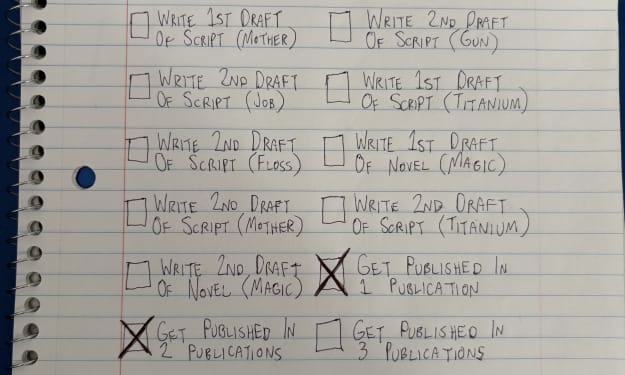
Early March 2026: 4 Goals Accomplished
It's early March and I've now accomplished my 4th writing goal for the year of 2026. Before diving into the behind-the-scenes of it... why not tell you up front what that accomplishment was? I was published in a 2nd publication for this year. Published in Helix Literary Magazine out of Central Connecticut State University. You can read it for free right now!
By Stephen Kramer Avitabile6 days ago in Writers
Should You Use Elementor for WordPress in 2026
Building a professional website used to require strong coding knowledge, design skills, and significant time. Over the past few years, page builders have transformed the way websites are created on WordPress. Among these tools, elementor has played a major role in making website creation easier for beginners, freelancers, and businesses. But the WordPress ecosystem continues to evolve rapidly. New tools, faster frameworks, and improved block editors are changing the landscape.
By Louis Specter6 days ago in Writers


Comments (1)
A freed story finding it purpose! Amazing!