
The Sadness Of The Nostalgic
Levar’s Social Commentary

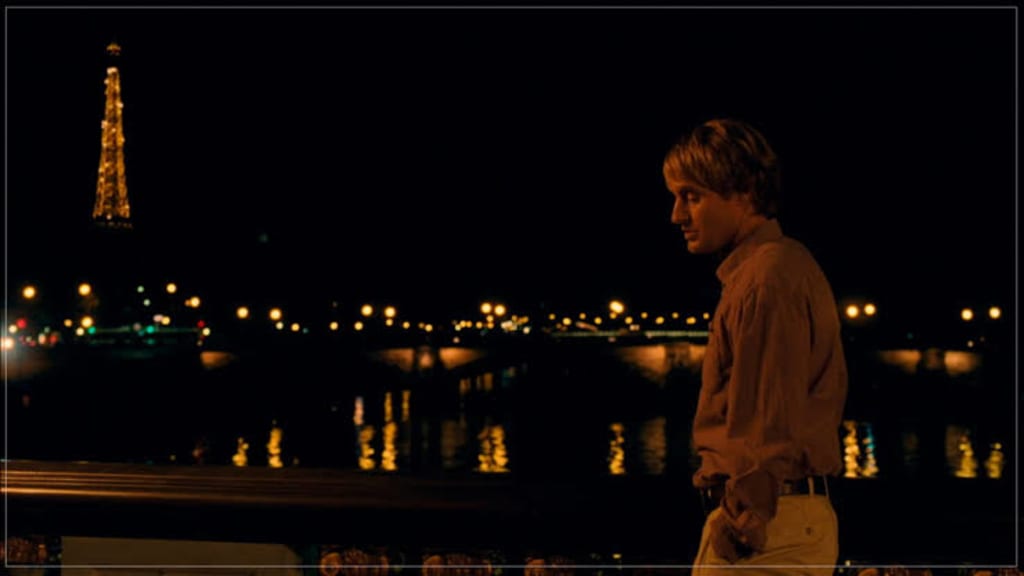
I watched ‘Young Adult’ directed by Jason Reitman (Juno, Up in the Air) and Woody Allen’s ‘Midnight in Paris’ over a Saturday evening. At surface value, the two films could not seem more different. Young Adult is a leisurely, brooding comedy, were Charlize Theron plays a semi-successful, thirty-something novelist, who returns to her home town aiming to rekindle a lost flame who is now happily married. Midnight in Paris is an archetypal Woody Allen picture, including his signature long-takes filled with quick wit and an endearing visual vibrancy. Yet for their respective settings and dissimilar delivery, the key theme of nostalgia ties the two films.
I’d like to point out that I appreciate there are different forms of nostalgia and clear distinctions to be made between them. For one to lingeringly dwell on the past is a negative, regressive form that can lead to things like longing, isolation and depressive states at what no longer is. Then there’s everyday sentimental recollection, which I’d argue, the vast majority of people experience. To illustrate the distinction, take the latter variant, for example. Like good music, good films by nature, promote nostalgia. I defy you to think back to a happy or memorable moment in childhood and/or adolescence that doesn’t in some way also peripherally involve the memory a song or film(s) you saw during that time, be it Disney, or Darabont. Good films usually promote a feeling of reminiscence and there’s nothing necessarily wrong with that.
The two protagonists of these films, however, fall into the former, more harmful category of negative nostalgia, both displaying similar types of past longing, as a means of escaping the pain and unpleasantness, of their present.
Midnight in Paris follows Gil Pender (Owen Wilson), who wishes for nothing more than to be a part of the romanticism and inspiring artistic flair of the Parisian 1920’s. He is a frustrated screenwriter and wishes to be a novelist, but lacks support from his spoilt fiancé, who is more interested in expensive fashion and would be best described as Malibu chic with a vengeance. In classic fairytale tradition, the stroke of midnight sees Gil’s period longing fantastically come into fruition, as if by desperate hope, he is mystically transported to the 1920’s.
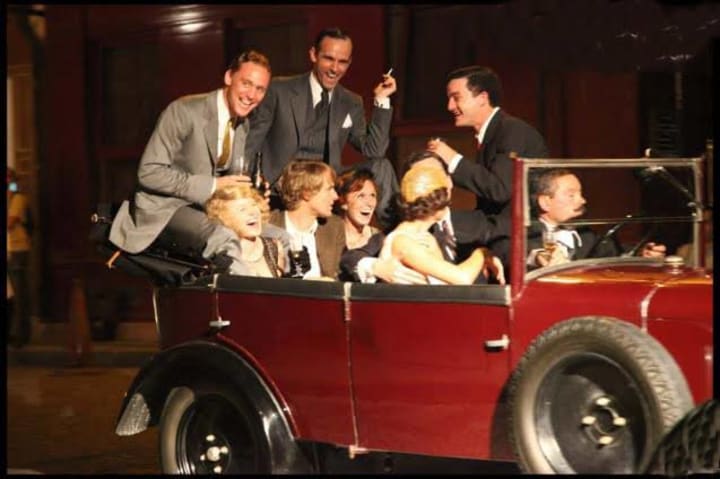
Here, Gil encounters members of the artistic high society he so wishes to be a part of. He meets the likes of Picasso, Salvador Dali and Ernest Hemingway, along with the 1920’s woman of his dreams (the effortlessly elegant Marion Cotillard). However, Gil soon realises that nonsensical nostalgia may be a pervasive concept that can exist, even in times past. He realises it is ultimately his present that requires both honest deconstruction and careful restructuring.
I appreciate a film that suggests the need for careful consideration of what may be lacking from your present, may be more beneficial than searching for answers from an idyllic past.
Unlike Gil, Charlize Theron’s, Mavis Gary, is fundamentally unhappy. She’s one of those people you may recognise, who seems to have a lot but in actual fact requires things for validation of self-worth. I’ve heard her described as narcissistic, but I don’t think that’s an accurate assessment. It would be fairer to say she’s selfish and lonely. Mavis wants to be loved, but the object of her affections is unattainable and so as selfish people do, she rejects outside perspectives and pursues happiness regardless of who it may hurt.
It’s important for me to state why I found Mavis particularly interesting at this time. There’s currently talk about a secondary school reunion taking place with many of the people from my year group. This is being organised, like a great many modern day event, via a private Facebook group. I’ve noticed an almost infectious undercurrent of excitement is permeating through it. Now, I’m no Oscar the Grouch at all and I genuinely think it’s a nice idea getting together after a number of years, in some way, but I just find the whole idea of a massive reunion, an almost veiled intrusion of ‘where are you now’ to be so cheesy and so ridiculously American, like an episode of Friends! I like a party, probably more than the next person, but the whole reunion format is so organised, so unspontaneous, so structured and so overbearingly nostalgic. But I’ll probably end up going, because hey, Facebook makes things official and you wouldn’t at all want to be an outsider when it comes to official shit!

So this brings me back to Mavis.
Mavis could be happy, but she, like Gil cannot let the past go, albeit the past in this case is her own, not an imagined era of which she didn’t belong. My mind was cast back to a quote I had heard at some point about the uselessness of misery and longing. The quote, by Dante Aligheri, states; “There is no greater sorrow than to recall a happy time when miserable.” Indeed, Mavis would be the first person to put her name on the list for her high school reunion, but she’d invariably end up leaving it feeling the most dejected.
As a spectator you do feel sad for both of these characters at times, because you soon realise that neither of them confronts their unhappiness in the right way. Neither accepts that their nostalgia is tethered to their very misery.
It was Gandalf the Grey, both the literary and filmic embodiment of wisdom, who stated; “All we have to decide, is what to do with the time that is given to us”. To this, I nod my head in an inspired fashion, thinking how right you are Sir and oh, what a nostalgic moment.
About the Creator
Lev. Life. Style
I’m fascinated by culture’s ability to shape thought and behaviour. I value creativity as a means of aiding wellbeing and growth. Film, analysis, travel and meaningful discussion, are personal passions that I’m grateful to share.
Lev
Keep reading
More stories from Lev. Life. Style and writers in Writers and other communities.
More Than Mere Contenders - Cinema’s Emotional Heavyweights
When I think back to the first film that made me cry, I recollect a visceral experience that was more than a light tear event. I was no older than five or six when my dad, who was watching what seemed to be an “old film”, accomplished greatness by making me sit still and watch it with him. The film was “The Champ” (1979) and it starred Jon Voight as a washed-up, prize fighter, who struggles to reclaim his glory days, whilst being a single parent to his young son, played by an excellent Ricky Schroeder. Maybe it was the films’ father:son dynamic that resonated with me and immediately had me relating it to my own wonderful relationship, with my dad. It’s quite possible that this was what Jacques Lacan would refer to as a ‘mirror stage’ experience, but I’ll choose not to indulge in over-academicism by deconstructing this memory, as it exists in my mind simply as a significant moment.
By Lev. Life. Style 9 months ago in Writers
Laaster and the Language of the Digital Future
In the digital era, names are no longer just labels. They are identities. They shape perception before a user ever opens an app, visits a website, or interacts with a platform. In a world where first impressions are increasingly formed on screens rather than in person, language has become one of the most powerful tools of modern design.
By Abbasi Publisher7 days ago in Writers
Wild Card Weekend Recap: What Happens Now?
I think I figured out why I love Wild Card Weekend so much. It's because it's the first playoff anything of the calendar year. The NFL season starts in the fall, and once upon a time, the champion was crowned either on or slightly before New Year's. The evolution of the NFL schedule has resulted in the playoffs starting just into the New Year, and currently, the final week of the season falls on the first weekend of the New Year, with Wild Card Weekend coming a week after that. So yes, chronologically, the NFL's Wild Card Weekend serves as the first playoff anything of the calendar year.
By Clyde E. Dawkins6 days ago in Unbalanced



Comments
There are no comments for this story
Be the first to respond and start the conversation.