
The rise and political transformation of the Umayyad Caliphate
উমাইয়া খেলাফতের উত্থান ও রাজনৈতিক রূপান্তর

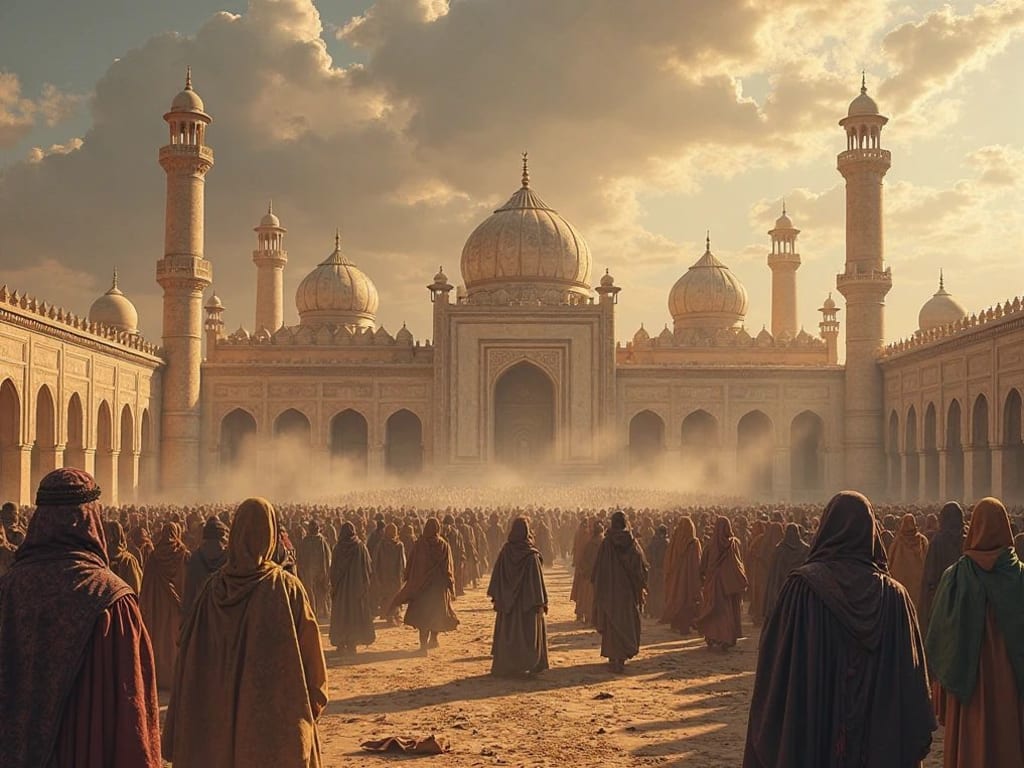
The Rise of the Umayyad Caliphate and Political Transformation: The Beginning of a New Chapter in the History of Islam
After the 30-year era of good governance of the Caliphate Rashidah ended, the political history of Islam entered a new turn, which is known in history as the era of the Umayyad Caliphate. This era began in 661 AD after the martyrdom of Hazrat Ali (RA), when Muawiyah ibn Abu Sufyan seized power in the Muslim state and declared the city of Damascus in Syria as the new capital of the Islamic Caliphate. The rule of the Umayyad dynasty lasted for about 90 years (661-750 AD). During this period, both the geographical boundaries and the political structure of Islam changed dramatically.
With the beginning of the Umayyad Caliphate, a fundamental change occurred in the political philosophy of Islam. Whereas the Rashidun Caliphate was a system of election of caliphs by consensus, the caliphate under the Umayyads was transformed into a hereditary monarchy. Muawiyah (may Allah be pleased with him) appointed his son Yazid as the next caliph during his lifetime. This decision was considered unpopular and dangerous by many of the Companions. In particular, Husayn ibn Ali (may Allah be pleased with him), the beloved grandson of the Prophet, did not accept Yazid's caliphate and it was against this that his difficult life and martyrdom took place on the plains of Karbala.
This event left a deep scar in Islamic history, which became one of the main foundations of the Shia-Sunni divide in the following centuries. Husayn's martyrdom was not just a family affair; rather, it was a revolutionary sacrifice for the ideals of Islamic justice. This brutal massacre during Yazid's reign challenged the moral acceptability of the Umayyad Caliphate, although politically the Caliphate remained intact.
The Umayyad Caliphate was a well-organized and strong administrative structure. Muawiyah ibn Abu Sufyan was a skilled politician and organizer. He built a powerful empire through diplomacy, espionage, and central control. During his reign, several military campaigns were conducted against the Byzantine Empire. An attempt was made to siege Constantinople, although it was unsuccessful.
One of the greatest contributions of the Umayyads was the geographical expansion of Islam. During this time, Muslim forces crossed North Africa and reached Andalusia in Spain. In 711 AD, Muslim forces led by Tariq ibn Ziyad crossed Gibraltar and entered Spain, and a large part of Spain came under Muslim control. While Spain was conquered in the west, the Islamic state expanded to Sindh (now part of Pakistan) in the east through the campaigns of Muhammad bin Qasim. Muslim conquests in Central Asia reached as far as Turkestan.
During this period, Islamic civilization moved beyond the borders of the Arabs and towards a cosmopolitan or multi-ethnic culture. People from Persia, Rome, Berbers, and other nations began to come under the Caliphate. Many of them converted to Islam, while many others were citizens of the Caliphate as non-Muslims. However, a political complication arose here: the Umayyad rulers often discriminated against non-Arab Muslims, especially the 'Mawali' (non-Arab Muslim) community, while maintaining the supremacy of the Arabs. This division created social discontent, which became one of the reasons for the fall of the Umayyad Caliphate.
While the rulers of the Umayyad Caliphate strengthened their political authority, they also consolidated the structure of the Islamic state through the construction of mosques, urban development, administrative record keeping, and the introduction of a monetary system. The famous Umayyad Mosque in Damascus is one of the architectural monuments of this era.
However, some of the kings of the Umayyad Caliphate were politically and religiously controversial. After Yazid, his son Mu'awiyah II ruled the caliphate for a few days, but he fell ill and abdicated shortly after. After that, Marwan ibn Hakam and his son Abdul Malik ibn Marwan held the caliphate firmly. During Abdul Malik's reign, the Umayyad administration took on a permanent form. On the one hand, he introduced gold coins, introduced Arabic as the state language, and brought the Hajj and other religious regulations into a controlled framework.
The period of his son Al-Walid ibn Abdul Malik was the period of the Umayyad Caliphate's greatest expansion and golden age. Under him, an empire stretching from Kashgar to the Atlantic was built. During this time, the Qutub Minar, the expedition to the Tamil region of Karnataka, and the spread of Islamic influence in Central Asia took place.
But behind this external success, internal weakness began to accumulate. The rulers gradually became accustomed to a luxurious life, divisions within the royal family increased, and discrimination against the Mawalis intensified. This was joined by religious discontent, especially the growing protest against the deprivation and injustice of the Shia community. All this spread the fire of rebellion in the Islamic world.
This rebellion was organized by the Abbasid dynasty. They continued a long secret movement against the Umayyad rulers. Finally, in 750 AD, the Abbasid revolution succeeded and the Umayyad Caliphate fell. Caliph Marwan II was brutally killed and the center of the Caliphate was transferred from Damascus to Baghdad. Some members of the Umayyad dynasty fled and established a new dynasty in Spain—known as the "Umayyad Caliphate of Andalusia."
The history of the Umayyad Caliphate is therefore a dual nature: on the one hand, it is a symbol of the astonishing expansion and political success of Islam, and on the other, it is a reflection of the social divisions, religious neglect, and arbitrariness that resulted from hereditary rule. We have much to learn from the history of this caliphate—notably the lesson that while it is important to build a strong empire, it is even more important to maintain it on the basis of justice.
About the Creator
Keep reading
More stories from Abdul Barik and writers in Writers and other communities.
Balfour Declaration
Balfour Declaration: The Birth of the Palestine Crisis There are some declarations in history that, although limited to a few short sentences on paper, have had an impact that has lasted for generations, shedding blood, displacing people and bringing unrest instead of stability to the entire region. The “Balfour Declaration” of 1917 is just such an event, which is a deep wound not only for Palestine, but for the entire Muslim world. This declaration laid the foundation for the creation of the State of Israel in the Middle East and began the miserable history of the Palestinian people.
By Abdul Barik8 months ago in Writers
It's Winter
Anne Bernays and Pamela Painter — What If? Writing Exercise for Fiction Writers prompts The Exercise —Write a scene involving two characters. Have the point-of-view character presume something entirely different about the situation from what the other character's overt behavior seems to imply. For example, a landlord comes to visit, and the tenant suspects that it isn't a visit but an inspection. Make up several situations in which one character can fantasize or project or suspect or even fear what another character is thinking. The Objective - To show how your characters can use their imaginations to interpret the behavior and dialogue of other characters.
By Denise E Lindquist18 days ago in Writers
When USCIS Questions a Specialty Occupation Petition
For many employment based visa applicants, the term “specialty occupation” becomes central to the approval process. When U.S. Citizenship and Immigration Services issues a Request for Evidence questioning whether a role qualifies, it can feel like the entire case is at risk. In reality, these RFEs are common and often stem from how a position is described rather than whether it truly meets the legal standard.
By Sheila Danzigabout 20 hours ago in Writers
A Dart at Dusk
Seconds ago, the sullen sun set on the two of us… my exuberant furry companion and me. A fresh breeze embraces us, delivering welcome relief from the day’s oppressive heat. His typical stumbling and staggering along — apace with a sloth — has turned into trip-trapping, high-stepping, almost skipping along.
By Angie the Archivist 📚🪶6 days ago in Petlife



Comments
There are no comments for this story
Be the first to respond and start the conversation.