
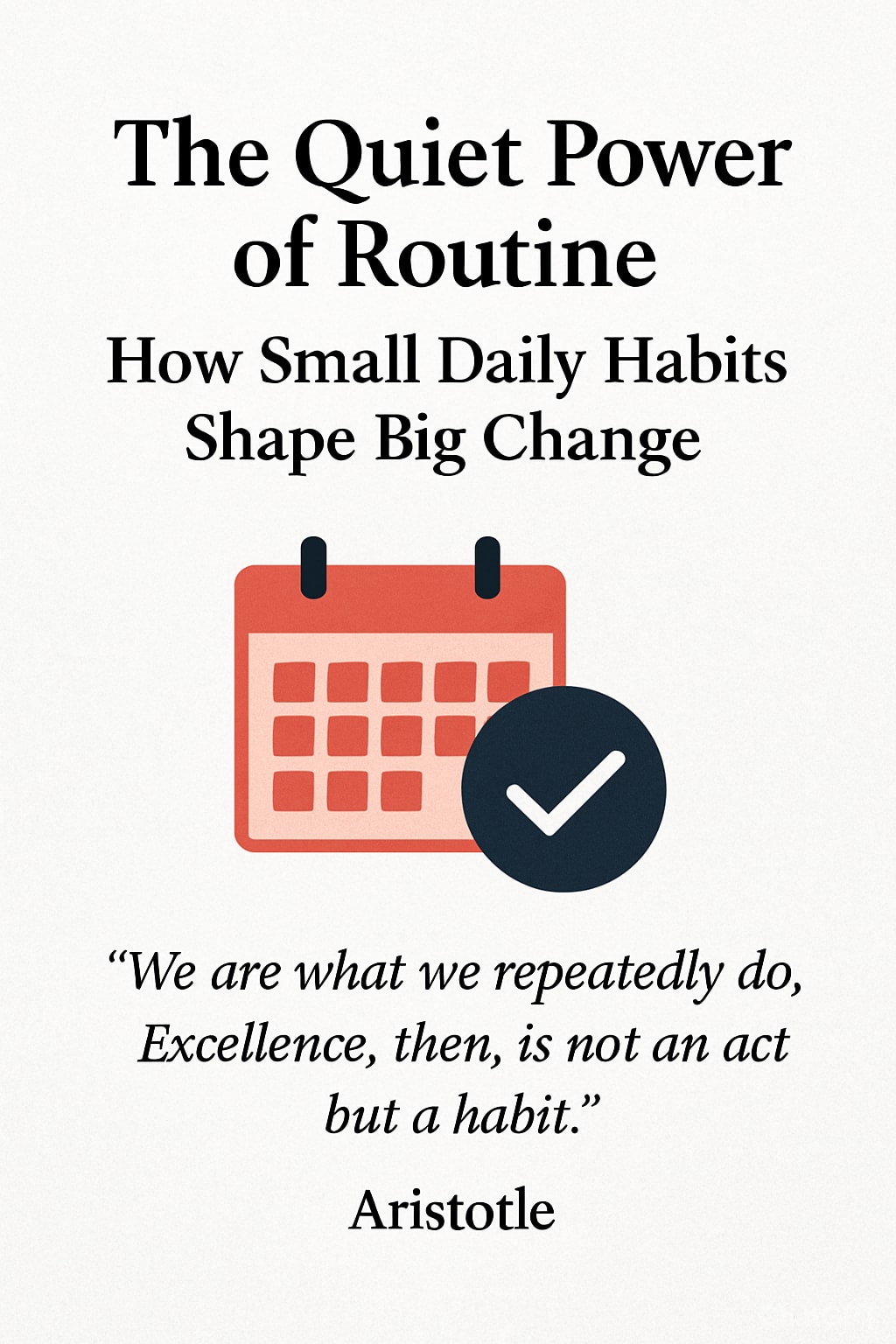
The Quiet Power of Routine: How Small Daily Habits Shape Big Change
How incremental shifts in daily behavior can transform your life, one habit at a time

Introduction
We often wait for “someday” to change our lives, “I’ll start tomorrow,” “When conditions are right,” “Once I have more time.” But big transformations rarely arrive by chance. They form through the accumulation of small, consistent actions repeated over months and years.
In this piece, I want to share why routines matter more than spontaneous bursts of effort, how to build habits that last, and examples from real life that show the compound effect of tiny shifts.
Why Routine Matters More Than Motivation
Motivation is fickle. Some days you wake up energized; others, you feel drained and uninspired. Relying solely on “motivation” to get things done is a shaky strategy at best.
By contrast, routines automate behavior. When your environment and schedule support a habit, you do it with less friction. Instead of asking “Do I want to do this today?”, you ask “What time will I do this today?”
Neuroscience backs this up: the more your brain practices a pattern, the more that pattern becomes second nature. Over time, the decision-making burden fades, and the habit becomes intuitive.
Building Habits That Stick
Here are five practical steps to help you build sustainable routines:
- Start small. Don’t try to overhaul your life overnight. Want to meditate? Begin with 2 minutes daily. Want to read more? Start with one page per day.
- Pick a consistent cue. Attach your new habit to an existing event: after brushing your teeth, after lunch, before going to bed.
- Track your progress. Checking off that you did something, even a small thing, gives your brain a mini dopamine hit and reinforces consistency.
- Design your environment. Remove friction: place your workout clothes within reach, keep your journal open on the desk, or block distracting apps during focus time.
- Allow “off” days. Perfectionism is the enemy of consistency. If you skip one day, don’t abandon the habit altogether, get back on track tomorrow.
Real-Life Examples of Tiny Routines, Big Impact
- The 1% rule in fitness: Someone who improves 1% each day becomes ~37× better over a year (by compounding).
- Daily writing: Writers who write just 200 words every morning often outpace those who sporadically binge.
- Micro-saving: Saving a dollar a day may seem small, but by automating savings, you can accumulate significant reserves over time.
These examples show that consistency, not intensity, is often the secret to long-term success.
Overcoming Common Challenges
- Plateaus: When progress slows, reassess your habit, maybe increase the dose or change the cue.
- Distractions: Use “if-then” plans. E.g., “If I get distracted, then I’ll walk around for 60 seconds and refocus.”
- Burnout: Occasionally step back and simplify your routine. Reset, then reintroduce habits gradually.
Conclusion
Routines aren’t glamorous, but their magic lies in their persistence. Over time, the small, disciplined actions accumulate like interest in a bank account. The version of you one year from now depends heavily on the habits you commit to today.
About the Creator
Artista Pirata
Artista Pirata thoughtfully curates a collection of free software for various operating systems. Visit us @ https://artistapirata.pro/
Keep reading
More stories from writers in Writers and other communities.



Comments
There are no comments for this story
Be the first to respond and start the conversation.