
The Most Annoying Phrases Writers Use, According to Readers
and how to tighten your writing to be more original without writing crutches.

In the world of writing, certain phrases have a way of sneaking into manuscripts, often without the writer even realizing it. While some might seem harmless or even useful at first glance, readers often find these overused or cliché phrases grating and unoriginal. Once they were a breath of fresh air in the language, but today is nothing more than crutches writers cling to, even though readers despise them.
Although there certainly is a time and place for most phrases and perhaps some writers can grind them into something new again, but for most writers, they should be abandoned in the first draft after coming up with something new.
Here’s a look at some of the most annoying phrases writers use, according to readers, where they came from and why they should be avoided... Perchance
1. "I let out a breath I didn’t know I was holding"
Where did this phrase come from, and why does it irk so many? There are entire threads dedicated to this phrase, trying to figure where it came from, why it's so much used and why it's so hated.
Most likely it's one of those echo chamber things. Perhaps it became videly used by some writers inspiring each other. Perhaps it was after one made a meme or comment about this particular phrase that made it so hated.
This phrase has become a cliché in many genres, particularly in emotional or suspenseful scenes. It’s often criticized for being overused and for its lack of logical coherence, as readers might question how someone could be unaware of holding their breath. After all, this is one of those bodily things that not everyone actually do or experience.
2. "At the end of the day"
This overused phrase is often employed to sum up or conclude a point, but it has become so common that it can come across as lazy or redundant. Of unknown origin, the phrase had a steady rise in the mid 1900s until it saw its peak around 2020. Could this be the end of the phrase?
3. "In the blink of an eye"
While this phrase is meant to convey something happening quickly, it has been used so frequently that it often fails to create the desired impact. Orignally the latin phrase "In ictu oculi" with examples of its use as far back as in the bible, perhaps it's time we put this cliche on the shelf for a while.
4. "It was a dark and stormy night"
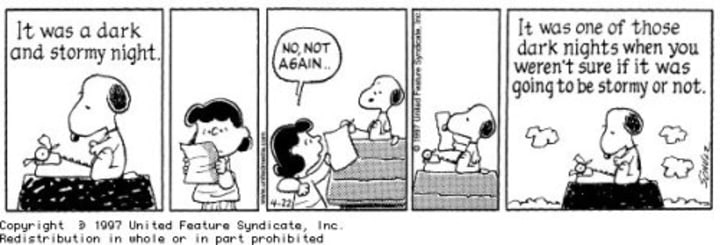
This phrase has become the quintessential example of clichéd writing and is mostly used as a parody today. Originating from Edward Bulwer-Lytton’s novel Paul Clifford, it’s often mocked for its melodramatic tone. Old, overused and dramatic, it still sneaks into books today or other similar purple prose with it: "a storm was brewing," "the night was dark and it rained heavy," "nothing could be seen in the darkness of the night" and other rain and storm heavy opening sentences.
5. "She ran her hands through her hair."
Introducing a female character focuses a lot on the color of their hair or their eyes. One way of conveying the color with action is this placeholder. It is used in so many contexts to show visuals, a feeling of insecurity or femininity, and ends up meaning little.
6. "Suddenly, out of nowhere"
Intended to introduce an unexpected event, this phrase often feels redundant. Other similar phrases like "Suddenly, many things happened at the same time," uses a lot of word, saying little to nothing. If something is sudden or surprising, it should be clear from the context without needing to spell it out.
7. "With bated breath"
Though this phrase has a poetic origin, it has become clichéd through overuse in moments of suspense. Coined by William Shakespeare in The Merchant of Venice it has been used since the 1590s. It literally means holding your breath eagerly or even anxiously. Readers might find it more impactful if the suspense is conveyed through the unfolding action rather than relying on this tired expression.
8. "Time will tell"
Another entry that some claim dates back to the 1500s. This phrase can feel like a filler, adding little to the narrative or character development. Readers often prefer when the text moves forward with purpose and leaves unnecessary phrases behind.
9. "Without a second thought"
Often used to show a character acting on impulse, this phrase has become a writing crutch. Some of the earliest evidence for the phrase is from 1581, in a translation by George Pettie who wrote romances.
It’s better to illustrate the character’s impulsiveness through their actions or decisions.
10. "At this moment in time"
This is a wordy way of saying “now.” Readers appreciate brevity and clarity, and this phrase can feel unnecessarily verbose. In fact, some surveys claim this is the fourth most annoying phrase used. The earliest use of the phrase could be from a 1959 issue of The Journal of Aesthetics and Art Criticism, writing: “the most favorable moment in time.”
11. "Muttered under her breath"
his idiom, first recorded in 1832, is probably a hyperbole, alluding to a sound that is softer than breathing. It is a way of explaining how people talk that have become more a crutch than imaginitive, as it has been used so much.
Honorable mentions of overly used words to explain talking is the: he/(but mostly) she murmured.
12. "He threw his head back and laughed"
A phrase to show how a character is laughing hard, so much the characters is tilting the head back. Although an actual thing people do, the phrase has become so overused it now seems more cartoonish. It is also a classic villain move and how many villains in books have now suffered severely whiplash because of this phrase used so carelessly?
13. "His/hers eyes darkened"
What really happens when someones eyes darken? Is it the pupils dilating? Is it the shine in them mattifying? Mostly used to express anger or hate, it has now become a crutch for every writer and an annoyance to readers wondering what really happens.
Honorable mentions of explaining feelings through eyes include: "the eyes flashed" or a "shadow passed over her face".
14. "For a long moment"
Time can be a tricky thing to convey through writing, and writers often lean on well known phrases to explain. One of them is the well used "for a long moment." Some will perhaps not think much of it as it is so ingrained in the language. But what are we actually trying to say, and how can we make the readers not spending long moments reading redundant phrases?
Other honorable mentions like this is: “He sat there waiting for what seemed like an eternity.” Just a matter of time, in the nick of time, A waste of time" and other time related phrases.
15. "Felt it in my bones"
The phrase itself means to have a premonition or an instinctive reaction about something and is another Shakespearean entry from Timon of Athens. Some say it comes from someone who has arthritis, or rheumatism, and when cold and wet weather approaches, some claim to feel pain in their bones. As much of Shakespeare's clever inventions of words and phrases, this has become a placeholder for something better in the second draft, hopefully.
16. "Made the blood run cold"
According to the Oxford Dictionary of English Idioms, it's from the Medieval science that melancholy, phlegm, blood, and choler made up the body and these had to be in balance. Blood was a hot element and when people were scared, it was unable to supply the body with heat or energy, making it cold. However, the expression has only been used since the early 1800’s though, perhaps from the medieval revival of Gothic literature.
Honorable mentions of blood related phrases are mostly the taste of it to give the reader a sensory experience of it: "the taste of blood filled my mouth", "the coppery scent of blood".
17. "In the distance, a dog barked..."
Readers have started to notice and wonders why so many writers fills the silence with barking dogs. Some date the phrase back to the 1910 from The New York Journal where the writer T. Dorgan liked to play around with words and often used dogs as a metaphor for feet. It has since been adapted, often to show people being tired. It is also mixed with the idea of dogs being dangerous, as an ominous warning. However, it is also just used as backroom noise in so many books, readers are starting to get annoyed at these barking dogs serving no purpose.
18. "His face was unreadable"
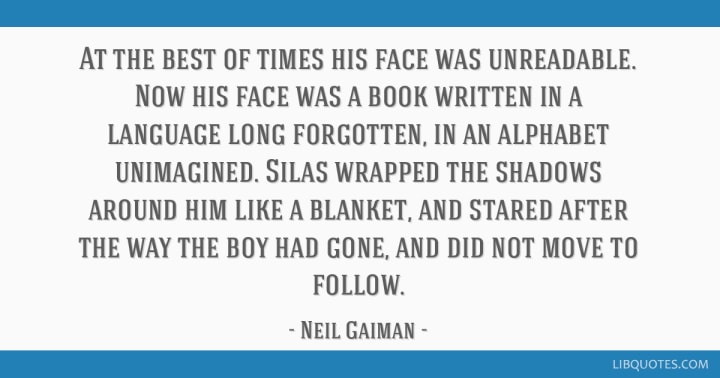
The phrase is used to explain that you can't know the characters emotions or feelings by looking at their face. A phrase used so much, readers doesn't really registrer it anymore. But taking a closer look at it drives them mad. Because if applied to anything else it will take a new meaning. If a book is unreadable, it's because it's so bad you can't stand it or so damaged the words doesn't make any sense, much like the dismantle phrase itself.
19. "I couldn't care less"
Another phrase so redundant that many people even have started to say "i could care less" instead, as the phrase have been repeated som much it means nothing anymore. Much like the irks of regardless and irregardless.
20. "In a beat"
There are a lot of phrases using the word beat. Not only as being beat, like a drum, but also the rhythmic connotation with the word. It is often used when describing time, a short time, often a short pause, I'll be with you in a heartbeat, Doing it in a beat, be on beat.
The phrase is from theater, where actors are instructed to pause briefly, or "taking a beat," for dramatic effect of a scene and has now morphed offstage and into books.
How to fix the problem
Avoiding these common, overused and often misused phrases can elevate your writing by making it feel fresher, more original, and engaging. Readers appreciate when writers put effort into crafting unique expressions and vivid descriptions rather than leaning on clichés that seems more lazy than anything. This is why we write new stuff and doesn't settle to just be readers, no?
To not make the list too long, I had to archive most of them, as the list goes on and on and on... I personally feel victimized by doing research for this article as many phrases and idioms I use over and over again.
What are some of your biggest irks and hated phrases when reading?
About the Creator
Dark Constellations
When you can't say things out loud, you must write them down. This is not a choice, it's the core of life, connection. I just try to do that...
Missing a writing community from university days, come say hi:)
Keep reading
More stories from Dark Constellations and writers in Writers and other communities.
Things Your Book Character does that Pisses your Readers off
As writer, we all fall into certain holes we can't seem to climb out from when it comes to our characters. Phrases we use as crutches because we can't come up with anything else, tropes that we sort of just fall into by habit to keep the story moving. Sometimes this is fine, there are reasons why some tropes are popular. People love to read about them and writers relish to exist in their creation.
By Dark Constellationsabout a year ago in Writers
Unofficial Challenge: Black History Celebration
Forward: February 28th, 10:53 PM, EST... The final hour of Black History Month, 2026. Hello fellow writers. I've had this challenge waiting in my drafts for most of the month. But I held off on publishing it, until now.
By Sam Spinelli6 days ago in Writers
A New Song
A New Song I woke up the other day and heard this new song. It seemed a bit familiar, but I could not place it. I don’t know where it was coming from either. So I smiled and listened to it. It was one of the most beautiful songs, I have heard in a long time.
By Alexandra Grantabout an hour ago in Writers
Becca
"Everything is so... flat." Denille said stupidly as she looked around her new neighborhood. She looked around at the muted desert where even the smallest sign of life seemed to have given up. The plant life was shrubs that were half cooked by the heat and where there should have been a lawn, a mess of white rocks laid glistening in the sun. Even the sky looked stretched thin, like the sun had ironed it smooth. She’d moved from Riverside, where at least there were hills, but here in Barstow, everything felt baked and brittle.
By Sara Wilsonabout 18 hours ago in Fiction


Comments
There are no comments for this story
Be the first to respond and start the conversation.