
"The Ministry of Truth"
"A Tale of Totalitarianism and the Struggle for Truth"
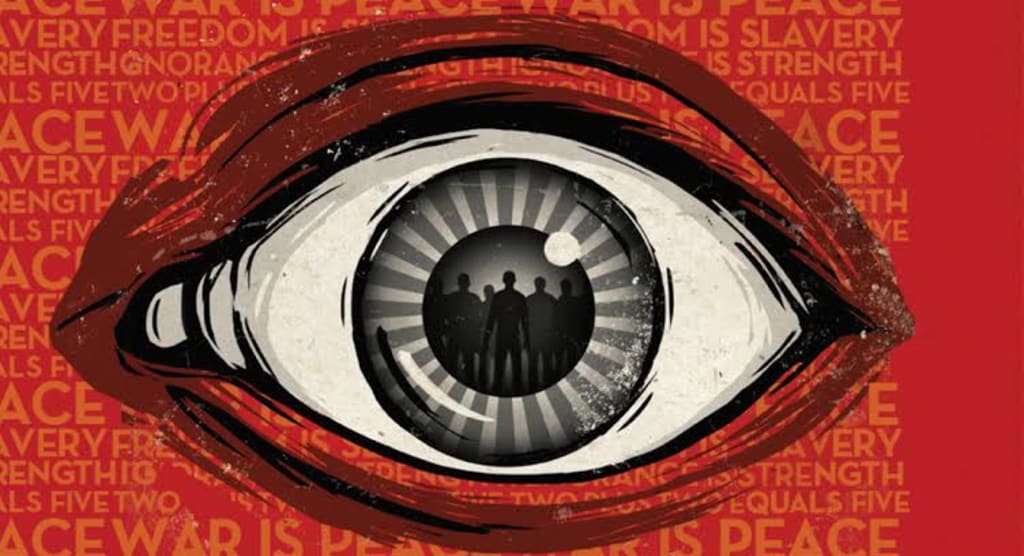
1984: A Story of Surveillance and Suppression
In a dystopian future, the world is divided into three superstates: Oceania, Eurasia, and Eastasia. The story unfolds in Airstrip One, formerly known as Britain, a province of Oceania. The Party, led by the elusive figure known as Big Brother, controls every aspect of life, down to the very thoughts of its citizens. The Party's slogan, "War is Peace, Freedom is Slavery, Ignorance is Strength", encapsulates the twisted logic that governs this society.
Winston Smith, the protagonist, is a low-ranking member of the Party. He works at the Ministry of Truth, where his job involves rewriting historical records to align with the Party's current narrative. History is constantly being altered, with any record of past events that contradict the Party’s version being erased or changed. This manipulation of history serves the Party’s goal of maintaining absolute power and controlling the minds of the people.
Winston is a small, disillusioned man, trapped in a world where individuality is crushed and the Party's surveillance is all-encompassing. The Thought Police, an omnipresent force that monitors and punishes even the slightest deviation from Party ideology, instills constant fear. There is no privacy, no freedom—only submission to Big Brother, whose face is omnipresent on posters, coins, and telescreens. The telescreens, which constantly broadcast Party propaganda, also watch and listen to citizens at all times, ensuring that no rebellious thoughts are ever entertained.
Despite this, Winston harbors a rebellious spirit. He despises the Party and dreams of a world where freedom of thought and expression exists. In secret, he begins writing in a diary, an act considered thoughtcrime—a crime punishable by death. He writes, “Down with Big Brother,” fully aware that, if discovered, this small rebellion could lead to his demise. But his desire for truth and freedom is stronger than his fear.
Winston’s despair deepens as he navigates a world devoid of love, trust, and authentic human connection. His interactions with others are superficial, dictated by the Party's rules. But then, he meets Julia, a young woman who works in the Fiction Department of the Ministry of Truth. She is also disillusioned with the Party, and the two share a forbidden, passionate relationship. Their love affair represents an act of defiance against the Party’s control over personal relationships, which is regulated through the Junior Anti-Sex League, a group that aims to eliminate personal desire in favor of loyalty to Big Brother.
Together, Winston and Julia visit an old, abandoned room above a shop, a place that seems to offer a rare illusion of privacy. Here, they are free to be themselves, even if only for a brief moment. Their relationship becomes a symbol of resistance—a desire for truth, intimacy, and rebellion against the suffocating control of the Party.
However, their relationship and rebellion are doomed from the start. Unknown to them, they are being watched. The Thought Police have been aware of their actions from the very beginning. Eventually, they are betrayed. Winston and Julia are arrested by O'Brien, a high-ranking member of the Inner Party, whom Winston initially believed to be an ally. O'Brien has played the role of a mentor to Winston, giving him false hope that there is an underground resistance movement known as the Brotherhood. But in reality, O'Brien is a loyal servant of the Party, and he orchestrates Winston’s capture.
At the Ministry of Love (a misnomer, for it is a place of torture and reeducation), Winston undergoes brutal physical and psychological torture. O'Brien is the one who personally breaks him down, using methods designed to force Winston to abandon his independent thoughts and accept the Party’s absolute truth. Through excruciating physical pain and mental manipulation, Winston is made to betray Julia and renounce his rebellious thoughts. O'Brien’s ultimate goal is not just to punish Winston, but to rewrite his very mind, to make him accept the Party’s reality and believe that 2 + 2 = 5 if Big Brother says so.
Winston is forced into a process of total submission. He is broken down, his mind reshaped by the Party’s relentless power. The final step of his reeducation occurs in the infamous Room 101, where each prisoner is subjected to their greatest fear. For Winston, this is the fear of rats. In his final moments of suffering, Winston betrays Julia—his love and his last act of rebellion.
By the end of the story, Winston is a hollow shell of the man he once was. He has been completely transformed into a loyal servant of Big Brother, having fully accepted the Party’s version of reality. The last scene shows Winston sitting in the Chestnut Tree Café, a broken man, watching a telescreen broadcast. He now loves Big Brother. The rebellion that Winston had once dreamed of has been crushed, and the Party remains firmly in control, unchallenged and eternal.
In the world of 1984, individuality is the ultimate crime. The Party seeks not only to control what people do but to dominate what they think, making the very concept of truth subjective. In the end, Winston's struggle is not just against an oppressive regime but against a system that seeks to erase the very notion of personal truth and reality itself. The Party’s control is so absolute that, in the end, it rewrites even the consciousness of those who dare to challenge it.
This version condenses the key elements and themes of 1984, while exploring Winston's transformation and the impact of totalitarianism. Would you like to dive deeper into any particular part of the story or themes?
About the Creator
Reader insights
Nice work
Very well written. Keep up the good work!
Top insight
Easy to read and follow
Well-structured & engaging content
Early March 2026: 4 Goals Accomplished
It's early March and I've now accomplished my 4th writing goal for the year of 2026. Before diving into the behind-the-scenes of it... why not tell you up front what that accomplishment was? I was published in a 2nd publication for this year. Published in Helix Literary Magazine out of Central Connecticut State University. You can read it for free right now!
By Stephen Kramer Avitabile6 days ago in Writers
My Process
The protracted, almost ritualistic rhythm of my writing—hours spent wrestling with each sentence, revisiting paragraphs, and constantly rearranging ideas—has become a crucible for my thought, reshaping it in ways that are both subtle and profound: as I linger over a single metaphor, the mind is forced to unpack layers of meaning it would otherwise skim, prompting connections between seemingly unrelated concepts; the inevitable pauses between drafts act like mental respirations, allowing subconscious insights to surface and then be interrogated with fresh, analytical eyes; the iterative cycle of drafting, erasing, and refining compels me to articulate not only what I know, but why I know it, exposing hidden assumptions and inviting me to renegotiate them; consequently, the very act of writing becomes a form of sustained meditation, where each painstaking turn of phrase sharpens focus, expands the horizon of curiosity, and cultivates a disciplined patience that permeates every subsequent line of reasoning, ultimately turning the long process of writing into a powerful engine that drives deeper, more nuanced, and increasingly self‑aware thinking.
By Forest Greenabout 16 hours ago in Writers




Comments (1)
One of my favourite books! Everyone should read it atleast once