
The migration and the establishment of the state of Medina.
হিজরত ও মদিনা রাষ্ট্রের প্রতিষ্ঠা।

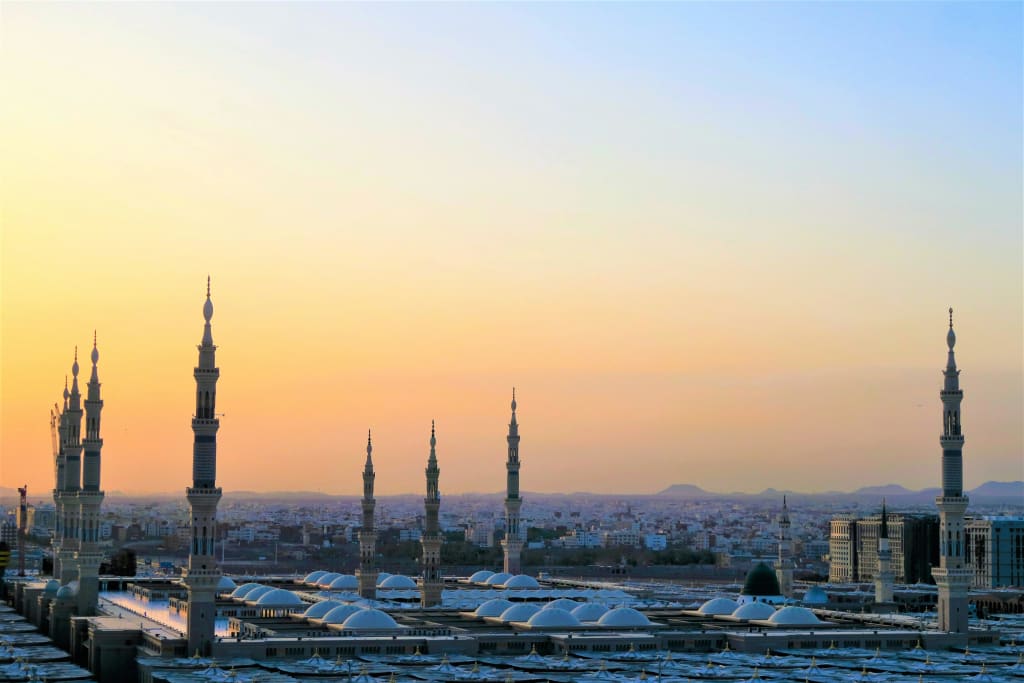
A turning point in the history of Islam is the migration of the Prophet Muhammad (peace be upon him) from Mecca to Medina, which was not just a geographical shift, but the beginning of a new political, social and religious reality. This migration marked the beginning of the first full-fledged Islamic state, where Islam was not limited to personal beliefs and practices; rather, it became a complete state ideology and social system. This context remains a unique milestone in the history of Islam.
The Prophet's thirteen-year call to Mecca was based mainly on faith, monotheism, accountability in the afterlife and moral purification. He was building a moral revolution against social oppression, injustice towards women, the practice of slavery, economic inequality and religious superstition. But the Quraysh leaders and the wealthy class of Mecca considered this revolution a threat to their power. As a result, the Prophet and his followers were persecuted. Many companions were subjected to physical torture, some were martyred. At one point, the situation became so unbearable that the Prophet, along with his followers, had to leave Mecca and set off for Medina in search of a safe haven.
The migration was not merely a self-defense tactic; it was part of a larger plan. Medina was a city where conflicts and bloodshed had already been going on between different tribes. Not long before, the two main Arab tribes, the 'Aws' and the 'Khazraj', had grown weary after a fierce war. They were looking for a neutral and just leader for peace and leadership. On the other hand, there were also several Jewish tribes living in Medina who wanted to remain independent with their religious and cultural identity. When the Prophet Muhammad (peace be upon him) arrived in Medina, he emerged not only as a religious leader, but also as a social reformer, diplomat, and statesman.
The first thing the Prophet did when he arrived in Medina was to build the Prophet's Mosque. It was not only a place of prayer; it was also an administrative center, a base for war planning, a court of justice, a center of education, and a shelter for the poor. In other words, the center of the first Islamic state was a mosque—through which the state and religion were united to a unique degree. Islam was not just the name of a faith here; rather, it became the basis for building a complete society.
The next important step was the writing of the 'Misaqul Medina' or the Medina Charter. It is considered one of the oldest written constitutions in the history of the world. This charter signed an agreement between Muslims, Jews, and followers of other religions on the basis of a joint citizenship. Each religious group would be able to practice its own religion and laws, but would not wage war or conspire against each other. No one would be able to make a unilateral agreement against an enemy coming from outside Medina. In this charter, the Prophet was recognized as the head of state and all parties accepted him as the final arbiter. This political and social agreement was an unprecedented example of people of different religions and ethnicities coming together under a common political umbrella.
The Prophet's activities in Medina were well-planned and pragmatic. He tried to make the society economically self-reliant. He established a brotherhood with the Ansar for the Muhajirin who had migrated from Mecca, through which wealth and responsibilities were shared. This "mu'aqat" or bond of brotherhood was not just a reflection of emotion or goodwill; rather, it was the beginning of a well-organized social structure. Among the Muhajirin were merchants and artisans, whose labor and skills animated the economy of Medina. As a result, the economic base of the Islamic state of Medina gradually began to strengthen.
Medina was also challenging politically and militarily. The Quraysh of Mecca saw Islam as a political threat. They were terrified by the growing popularity of Islam and the possibility of forming a state in Medina. As a result, the Muslims had to face three major battles: Badr, Uhud, and Khandaq. The victory of the Muslims in the Battle of Badr became a historical milestone. It boosted the morale of the Muslims and established Islam as a strong political force among the Arab tribes outside Mecca. The Muslims were defeated in the Battle of Uhud, which taught them a lesson in their lack of discipline and strategy. But in the Battle of Khandaq, a combined attack was repelled through the strategic leadership of the Prophet. These battles demonstrated not only military prowess, but also political foresight, discipline, and moral fortitude.
In addition, the Prophet Muhammad (peace be upon him) continued to expand the scope of the Islamic state by making treaties with various tribes in Medina. He sent invitations to Islam to foreign kings, including the rulers of Rome, Persia, and Egypt. This diplomatic initiative marked the beginning of Islam's emergence on a global scale. The Medina-based state was no longer just a local power; Rather, it became a global ideological movement.
The most important aspect of the Prophet's Medinan period was his principles of justice, tolerance, and showing mercy to his enemies. He did not retaliate even in the face of the conspiracies of the Jews and hypocrites; rather, he confronted them with political tactics. He gave directions for building a balanced society by emphasizing the dignity of women, the rights of orphans, the emancipation of slaves, fairness in business, and family ties. Thus, the Islamic state of Medina was established as an ideal society, where religious ideals, social justice, economic balance, and political foresight combined to create a unique model.
The experience of this Medina state laid the foundation for the Caliphate that followed. The four eras of the Caliphate—the Rashidun, Umayyad, Abbasid, and Ottoman—all developed under the shadow of this Medina model. Therefore, the migration and establishment of the Medina state were not just historical events; they were the implementation of a divine plan that continues to be a source of inspiration for many nations, civilizations, and state systems around the world.
About the Creator
Keep reading
More stories from Abdul Barik and writers in Writers and other communities.
Story Name: “Light of the Path”
A small village on the outskirts of the city of Medina—Al-Haya. In that village lived a young man, his name was Saleh. Growing up in the arms of his mother, Saleh was lonely from birth. His father Ali was a woodcutter, who went to the mountains every day to cut wood. One day, Ali was killed in an attack by a wild fox in the forest. Saleh was only six years old at that time. That small hut was wet day and night with his mother's tears. But poverty, sorrow, and deprivation could not extinguish the light of faith in Saleh's heart. On the contrary, from a young age, he was a prayerful, truthful, and unusually patient.
By Abdul Barik9 months ago in Writers
It's Winter
Anne Bernays and Pamela Painter — What If? Writing Exercise for Fiction Writers prompts The Exercise —Write a scene involving two characters. Have the point-of-view character presume something entirely different about the situation from what the other character's overt behavior seems to imply. For example, a landlord comes to visit, and the tenant suspects that it isn't a visit but an inspection. Make up several situations in which one character can fantasize or project or suspect or even fear what another character is thinking. The Objective - To show how your characters can use their imaginations to interpret the behavior and dialogue of other characters.
By Denise E Lindquist18 days ago in Writers
Why Students Are Turning to a Humanizer AI Instead of Relying on AI Alone
Why Students Are Reconsidering AI-Only Writing in Academic Work Artificial intelligence tools have become deeply embedded in student workflows. From outlining essays to organizing research notes, AI has changed how students approach assignments. However, a noticeable shift is taking place in academic environments. Students who rely exclusively on AI-generated writing are increasingly encountering issues related to grading, feedback, and academic credibility.
By Abbasi Publisherabout 16 hours ago in Writers


Comments (1)
Interesting!!