
The Israel-Palestine Conflict: A Deep-Rooted Struggle.
The Historical and Ongoing Struggle for Land, Identity, and Peace in the Middle East.

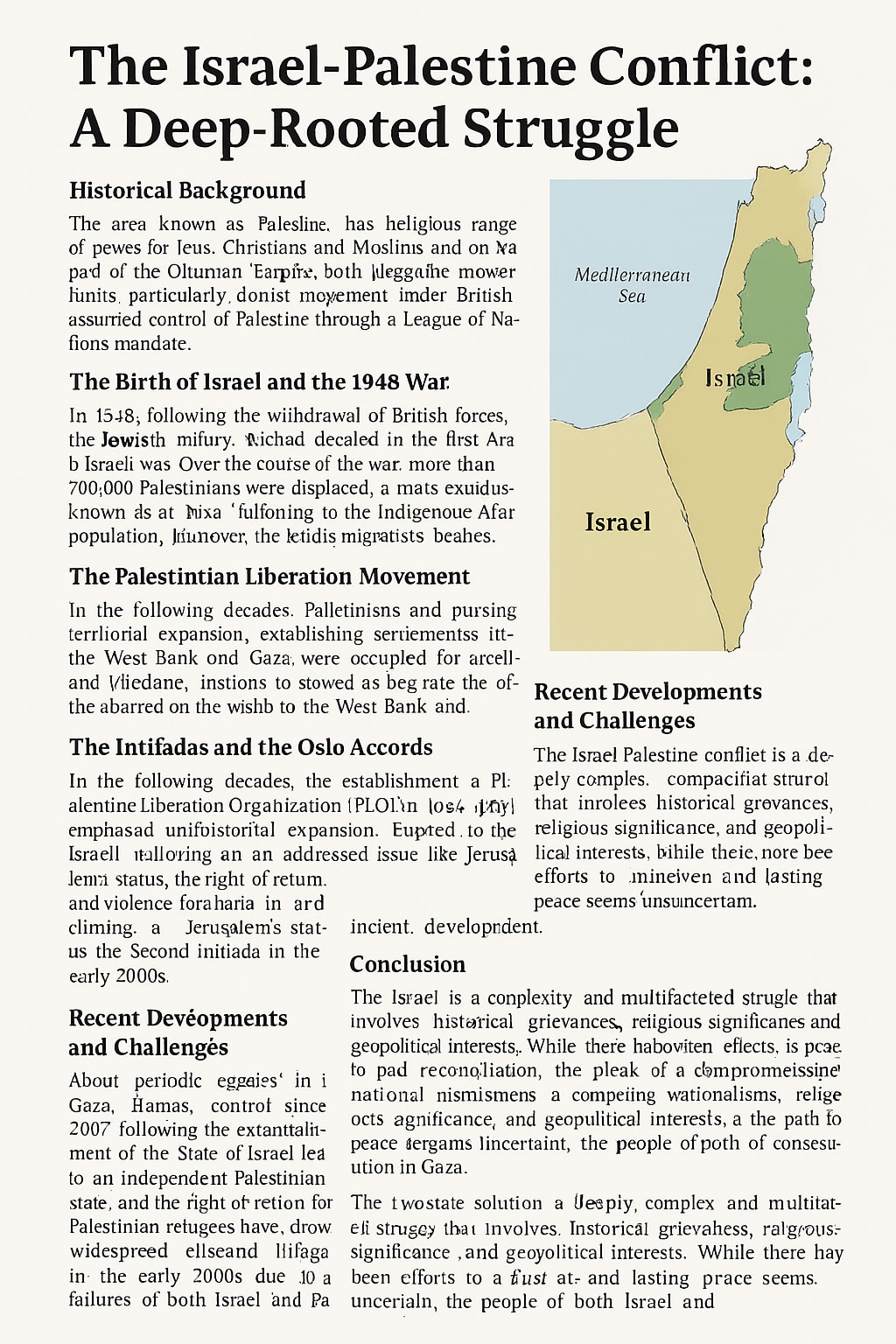
One of the modern world's longest and most contentious conflicts is the Israel-Palestine conflict. It is a territorial and political dispute that traces its roots to the late 19th century, influenced by factors such as nationalism, colonialism, religion, and geopolitics. The conflict primarily revolves around the right to self-determination, land, and identity for both Israelis and Palestinians in the region of historic Palestine, which includes present-day Israel, the West Bank, and the Gaza Strip.
Historical Background
For tens of thousands of years, a wide variety of people have lived in Palestine. Jews, Christians, and Muslims alike place a significant amount of religious significance on it. Jewish nationalist movements, particularly Zionism, emerged in the Middle East at the end of the 19th century as European colonial powers increased their influence there. The goal of Zionism was to create a Jewish homeland in Palestine, a region with a long Jewish history. At this time, Palestine was part of the Ottoman Empire, and its population was predominantly Arab, both Muslim and Christian. Britain formalized its role as a colonial power in the region when it accepted a mandate from the League of Nations to take control of Palestine following the fall of the Ottoman Empire during World War I. During this period, tensions began to rise between Jewish immigrants and the Arab population, as the Zionist movement gained momentum.
After years of intensifying conflict, the United Nations proposed a partition plan in 1947 that would make Jerusalem an international city and divide Palestine into separate Arab and Jewish states. The plan was accepted by the Jewish leadership, but it was rejected by Arab states and Palestinian representatives because they thought it was unfair to the native Arab population.
The Birth of Israel and the 1948 War
The Jewish leadership declared the establishment of the State of Israel in 1948, following the withdrawal of British forces. This declaration was met with immediate opposition from neighboring Arab states, which led to the first Arab-Israeli war. Over the course of the war, more than 700,000 Palestinians were displaced, a mass exodus known as the Nakba ("catastrophe" in Arabic). In addition to the violence and loss of territory, this event established the foundation for Palestinians' deep-seated resentment and anger. The 1948 war led to the establishment of the State of Israel within the bounds of the UN partition plan, but Jordan and Egypt occupied the Palestinian territories of the West Bank and Gaza. The Palestinians' exodus from their homes and the establishment of Israel both contributed significantly to the ongoing conflict.
The Movement for the Liberation of Palestine In the decades that followed, Palestinians and their Arab allies attempted to establish an independent Palestinian state. Since its founding in 1964, the Palestinian Liberation Organization (PLO) has served as the Palestinian people's voice and advocated for the right of Palestinian refugees to return home and an independent Palestinian state. The Israeli government, on the other hand, pursued territorial expansion, establishing settlements in the West Bank and Gaza. One of the most contentious aspects of the conflict has been the expansion of Israeli settlements, which are considered to be against international law. However, Israel continues to make historical and security claims to support its claim to the land.
The Oslo Accords and the Intifadas Frustration with the occupation, settlements, and economic hardships prompted the first Palestinian intifada (uprising) in 1987. It was characterized by protests, strikes, and violent clashes with Israeli forces. The uprising led to a shift in Israeli politics, culminating in the Oslo Accords in 1993, which marked the first major attempt to resolve the conflict.
The Palestinian Authority (PA) was established as a result of the Oslo Accords, which also gave Gaza and some of the West Bank some degree of autonomy. However, crucial issues like the status of Jerusalem, the right of Palestinian refugees to return home, and the final borders of a Palestinian state were left out of the agreements. The failure to deliver on promises, coupled with continued settlement expansion and violence from both sides, led to the second intifada in the early 2000s.
Recent Advances and Obstacles The conflict has remained simmering over the past few years, with occasional escalation of violence, particularly in Gaza. Hamas, an Islamist militant group, has been in control of Gaza since 2007, leading to a split between the Palestinian Authority in the West Bank and Hamas in Gaza. This division has complicated efforts for Palestinian unity and the prospects for peace.
The way Israel treats Palestinians has remained a source of controversy on a global scale. Particularly in light of the humanitarian crisis in Gaza, the establishment of settlements, the blockade of Gaza, and military operations in Palestinian territories have received widespread criticism. The Israeli government, however, argues that its actions are necessary for national security in response to threats from Hamas and other militant groups.
The international community has long supported the two-state solution, which envisions the establishment of an independent Palestinian state alongside Israel. However, the path to peace remains elusive due to ongoing settlement expansion, a fragmented political landscape in Palestine, and deep mistrust between the two sides.
Conclusion
The Israel-Palestine conflict is a deeply complex and multifaceted struggle that involves historical grievances, competing nationalisms, religious significance, and geopolitical interests. Despite efforts to mediate peace, the conflict continues to be one of the most difficult in modern history due to the lack of a comprehensive solution to issues like borders, refugees, and Jerusalem's status. The people of Israel and Palestine continue to suffer the effects of a conflict that has lasted for over a century unless genuine and sustained efforts are made toward reconciliation. The path to a just and lasting peace appears to be uncertain.
About the Creator
MI Riyad
Mi Riyad is a professional article writer known for creating clear, engaging, and well-researched content across various topics, delivering high-quality work that connects with readers and meets editorial standards.
Keep reading
More stories from writers in Writers and other communities.
After the Storm
After the storm of winter snow there sat a small bear by the name Ted, of course. He loves the snow and likes to roll around in it making all sorts of trails and whatever he has a mind to do. He wondered where all the people are, but in a way, he is hoping that they are all snug in the homes maybe drinking hot chocolate-one of his favorite drinks with mini-marshmallows and eating something homemade for he likes this winter wonderland all to himself to romp and play and maybe even catch some fish down by the river.
By Mark Graham3 days ago in Fiction



Comments
There are no comments for this story
Be the first to respond and start the conversation.