
The App Economy Trust Crisis: Survival Architecture for 2026
How to pivot from technical execution to entity authority as Google shifts to agentic discovery and zero-click dominance.

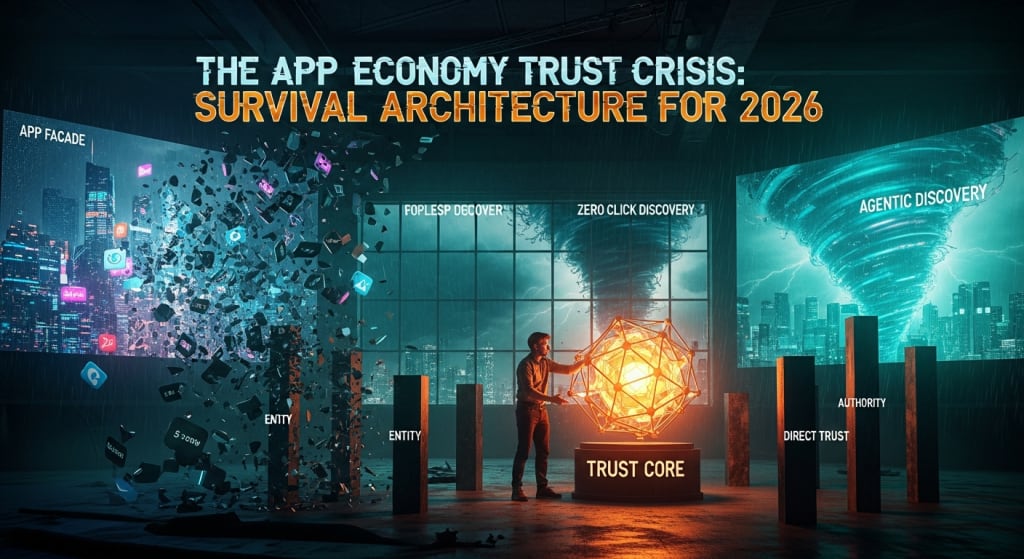
Traditional mobile app development paths have undergone a structural collapse in early 2026. Google’s latest algorithmic shift has prioritized Trust Graph formation over simple keyword matching. The Trust Graph is a map Google uses to verify your real-world reputation. Aspiring developers must now navigate a landscape where Entity Accountability dictates career visibility. AI Retrieval has also become a primary gatekeeper for professional opportunities. These systems work together to decide if your expertise is genuine or simulated.
The Tectonic Shift in Developer Discovery
The search for development expertise has moved into a Zero Click environment. A Zero Click environment means users get answers without clicking on your website. In January 2026, Google Search Central clarified a major change. Documentation for legacy practice problems is being retired from main search results. This signals a move toward Agentic Optimization. Agentic Optimization is the process of making your work readable for AI agents. These agents evaluate a developer's authority before recommending them to a user.
Search Engine Journal reported on January 5, 2026, about this new reality. Visibility now hinges on being a "trusted entity" in the eyes of the machine. Your technical stack is no longer just a list on a resume. It is now a series of Entity Signals. Entity Signals are verified data points that prove you actually built something. Google uses these signals to validate your professional footprint across the web.
Why Legacy Learning Paths Fail in 2026
The "tutorial hell" of 2024 is officially a career dead end. Tutorial hell refers to following guides without ever building original projects. Automated AI agents now handle 75% of basic code generation. They also handle the majority of MVP builds for new startups. If you only learn to write syntax, you have no advantage. You are competing with a Zero Click interface that is faster than you. Google’s January 2026 updates show increased scrutiny of technical content.
Low-quality and mass-produced technical content is being de-indexed. This applies to your personal portfolio just as much as a blog. A collection of generic GitHub clones is no longer effective. These clones do not trigger an Authority Validation response. The system now looks for Experience markers that AI cannot replicate. Experience markers include specific bug fixes and unique architectural decisions. These markers prove you worked through complex, non-linear problems.
Survival Architecture: The 2026 Roadmap
To become a mobile app developer today, you must change your strategy. You must build for AI-mediated discovery from day one. This means moving beyond simple native development. You must master Multi-platform Ecosystems. Apps in 2026 are expected to live across many different devices. This includes watches, foldables, and car dashboards.
You must use shared logic to ensure the app works everywhere. Users expect a seamless experience as they move between these screens. Developing for a single screen size is an outdated practice.
Shift to On-Device Intelligence
Industry analysts at Gartner recently made an important projection. They projected that 90% of new apps will feature On-Device AI. On-Device AI means the intelligence stays on the user's phone. It does not send all data to a central server. Processing data locally is the new standard for Trust and privacy. This approach reduces latency and keeps user information secure. Developers who cannot implement local-first design patterns will struggle. They will face a significant Authority Loss in the market. The market is no longer looking for simple "builders." The market now demands "orchestrators" who can manage complex AI systems. Senior Technical Analyst findings suggest that Entity Relevance is key. Your relevance is tied to your ability to manage autonomous AI agents.
Actionable Framework: Entity-Based Career Strategy
The structural shift from "doing" to "validating" requires a new roadmap. You must treat your career as a verified data structure.
What Has Changed
Discovery is now conversational and agent-driven. It is no longer driven by simple blue links.
Why Legacy Strategies Fail
Focusing on isolated languages like Swift is a mistake. Doing this without Trust Graph context leads to career invisibility.
Professional Realignment 2026
You must establish yourself as a "named entity." You want to appear in the Knowledge Graph as a specialist.
- Verify Your Entity: Use Schema.org Person markup on your professional site. Link your GitHub, your LinkedIn, and your verified projects together.
- Prioritize Edge Computing: Master local data processing techniques. This aligns with the 2026 privacy-first search environment.
- Build Quote-Ready Proof: Document your real-world testing failures. Show your iterations and the lessons you learned from them. This creates high E-E-A-T signals that AI cannot fake.
Organizations now hire based on Authority Validation metrics. They care more about your verified footprint than a coding test.
AI Tools and Resources
Lovable
What it does: Generates full-stack applications from natural language descriptions. Why it is useful: It allows for rapid market validation. You can test ideas before committing to deep architecture. Who should use it: Product-minded developers and founders. Avoid if you are strictly focused on low-level kernel optimization.
Google Gemini 2.5 (AI Mode)
What it does: Acts as a conversational interface for code auditing. It also helps with complex system design and debugging. Why it is useful: It is the primary tool for evaluating Entity Signals. It helps ensure your code follows the latest 2026 standards. Who should use it: All developers aiming for Agentic Optimization.
Cursor / GitHub Copilot (2026 Edition)
What it does: Uses autonomous AI workers to plan coding workflows. It executes multi-step tasks across entire codebases. Why it is useful: It shifts your role from writing syntax to architecting. You manage the AI while it handles the repetitive typing. Who should use it: Intermediate developers looking to reach senior roles.
Risks and the "Authority Death Spiral"
The greatest risk in 2026 is becoming a "shadow entity." A shadow entity is a developer who has no verified online presence. If your work is not cited by other Trust Graph entities, you vanish. The search engine will stop recommending your profile or your apps. This creates a failure scenario for many skilled people. High technical skill can lead to zero career opportunities. We saw this in the "December 2025 Core Update." Unverified experts lost 60% of their search footprint overnight. Warning signs include a steady drop in recruiter impressions. Without Authority Validation, you are just noise in the market.
Key Takeaways for the 2026 Developer
- Entity First: Your professional identity must be a machine-readable data point.
- Agent Orchestration: Shift from writing syntax to managing Multi-agent Systems.
- Local Intelligence: Specialize in On-Device AI to meet 2026 standards.
- Verified Proof: Use documentation of failures to build genuine Trust.
The search economy of 2026 does not reward information gathering. It rewards the Authority that comes from tested, verified experience. You must prove you have done the work in the real world. Adapt your architecture now to survive the next core update.
About the Creator
Keep reading
More stories from Del Rosario and writers in Writers and other communities.
How do I Become a Mobile App Developer in 2026
The path to becoming a mobile app developer has changed. It has shifted from mastery of syntax to Entity Accountability. It now focuses on high-level architecture stewardship. The shift occurred within a post-generative development economy. In 2026, the barrier to entry is no longer writing code. The new barrier is validating the integrity of systems. You must also validate the security of AI-mediated discovery systems.
By Del Rosario5 days ago in Journal
How Local Regulations Impact Mobile Apps in Milwaukee?
Regulations rarely feel urgent during early planning. They surface quietly, usually as footnotes in proposals or brief mentions during discovery calls. Then development begins, real data flows through the system, and suddenly those footnotes become constraints that reshape timelines, architecture, and cost.
By Mike Pichai8 days ago in Writers


Comments
There are no comments for this story
Be the first to respond and start the conversation.