
The 2001 Indian Parliament attack.
The 2001 Indian Parliament attack: A mysterious behind-the-scenes state strategy.

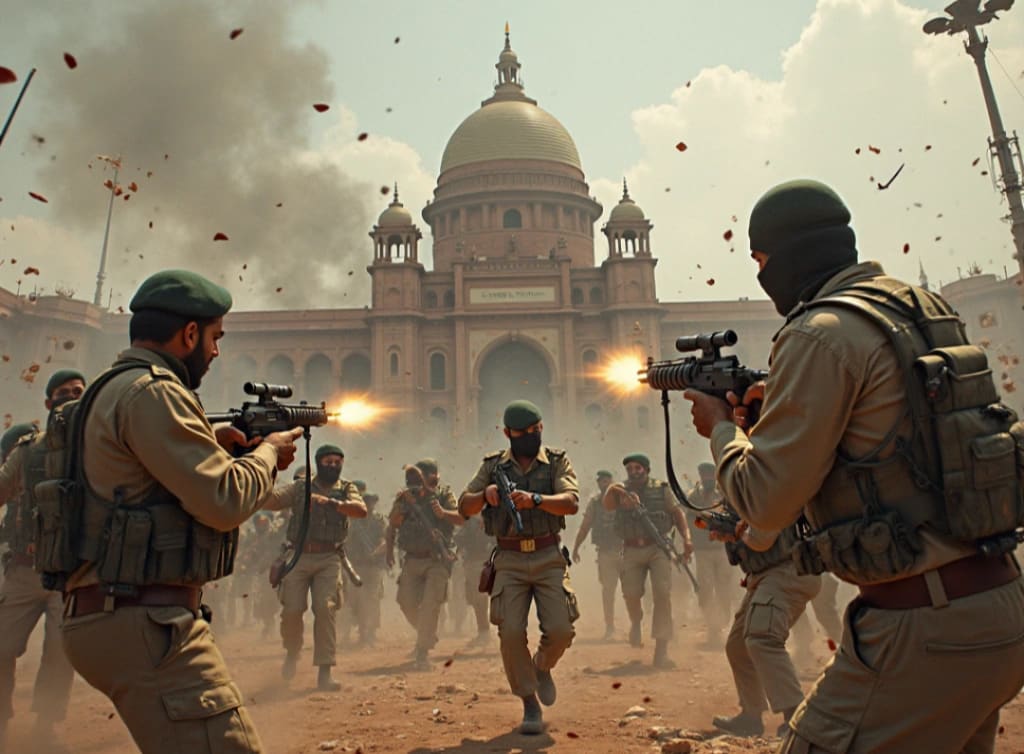
Thursday, December 13, 2001—the day has become a nightmare in the history of Indian democracy. That day, the Parliament building in the heart of Delhi was attacked. Multiple gunmen in a heavily fortified area detonated an explosive at the entrance to the Parliament building and opened fire. Five Delhi Police personnel, a CRPF jawan, two Parliament security guards and a gardener were killed in the attack. The security forces also killed five attackers in a counter-attack. The entire country was stunned by the incident. The government quickly announced that Pakistan-backed Kashmiri militant groups ‘Jeesh-e-Mohammed’ and ‘Lashkar-e-Taiba’ were behind the attack. Soon, a nationalist roar, deployment of troops, threats of war—and a silent process of political profiteering began.
A young Kashmiri, Afzal Guru, was presented as the main accused in the attack. He was accused of facilitating the arrival of the attackers in Delhi and providing them with accommodation. He was sentenced to death in a speedy trial, which was carried out in 2013. But Afzal Guru’s trial has raised so many questions and controversies that many see it as a state conspiracy, or a kind of ‘false flag operation’. Why have such suspicions arisen? There are many reasons, and each one deserves in-depth analysis.
First, the timing of the attack is crucial. India was in power at the time when the BJP-led NDA government was under increasing pressure from political and economic weakness. The Ram temple issue, the outbreak of communal tensions in Gujarat, diplomatic challenges in the international arena—all these factors put the government under pressure. Such a security crisis could have strengthened the government’s national security image. The result? That is exactly what happened. After the attack, the BJP campaigned extensively on the ‘fight for national security’ and accused the Congress and other opposition parties of ‘weak statesmanship’.
Second, the evidence against Afzal Guru was highly questionable. His confession was used as key evidence, but many human rights groups say it was obtained through police interrogation, which was marred by a lack of transparency. Many of his lawyers have complained that they were not given adequate preparation time, that the court process was rushed and that it was politically influenced. The Supreme Court's verdict contained a chilling phrase: "to satisfy the collective conscience of society," meaning that he should be sentenced to death. Such language is a deeply troubling sign for any legal verdict.
Third, the nature of the attack and the security loopholes are suspiciously inconsistent. How could five gunmen drive into Parliament, one of India's most heavily guarded buildings, and attack it? How did they know the exact time and route? An investigation report even said that some of the attackers used Indian passports and were moving around Delhi normally—which many analysts see as a deliberate ‘silence’ rather than a failure of intelligence.
Fourth, India-Pakistan relations reached an all-time high after the attack. Both countries deployed about 1 million troops on the border. A military operation called ‘Operation Parakram’ was launched, which lasted about 10 months, but no full-scale war took place. Nevertheless, this tension put the government in a nationalist position and put the opposition under pressure. This can be seen as a kind of political strategy—“create a crisis, then show the greatness of your leadership.”
Fifth, the media coverage of the incident was one-sided, bloodthirsty and unquestioning. There was a tendency to prove the guilty of those who stood up for Afzal Guru’s rights, fair trial and transparent investigation. The media has almost overtaken the judicial system to shape public opinion—which many believe may be part of a state strategy.
One particular aspect is noteworthy here: the organizations accused of this attack—JeS and Lashkar—could not directly prove their involvement, and the Pakistani government has also denied responsibility. But India has not allowed any impartial international investigation, instead accepting the state investigation as the final one. As a result, many international analysts, such as Arundhati Roy, have termed the attack a kind of “staged threat”—which was probably not planned, but was allowed to happen through silent support.
The long-term impact of this incident is very significant. The death sentence of Afzal Guru gave the BJP, the Hindutva political force, a huge ‘freedom fighter’ image. Helplessness and distrust of justice were created among Muslims. Anger increased among Kashmiri youth, and separatist sentiments took root. At the state level, this attack transformed from a ‘national crisis’ into a ‘political opportunity’.
Finally, it can be said that the incident of the Parliament attack has not yet answered many questions. The way the state has been unilaterally blaming, hasty trial, and politically abused, it will be marked as a ‘profound state failure and possible opportunistic silence’, if not a ‘false flag operation’.
About the Creator
Keep reading
More stories from Abdul Barik and writers in Writers and other communities.
The migration and the establishment of the state of Medina.
A turning point in the history of Islam is the migration of the Prophet Muhammad (peace be upon him) from Mecca to Medina, which was not just a geographical shift, but the beginning of a new political, social and religious reality. This migration marked the beginning of the first full-fledged Islamic state, where Islam was not limited to personal beliefs and practices; rather, it became a complete state ideology and social system. This context remains a unique milestone in the history of Islam.
By Abdul Barik9 months ago in Writers
Learning Hurt First
Before learning ever felt like progress, it felt like punishment. No one tells you that at the beginning. They dress learning up as curiosity, as growth, as something gentle. They show you graduation photos and success stories and say, See? It was worth it. But they never show you the bruises learning leaves behind—the small humiliations, the quiet failures, the moments where you realize you don’t know as much as you thought you did.
By LUNA EDITHabout 19 hours ago in Writers




Comments
There are no comments for this story
Be the first to respond and start the conversation.