
Still time to rewrite a legend?
As I write, there's only one day left to enter Legends Rewritten. Ten top tips on how to do it

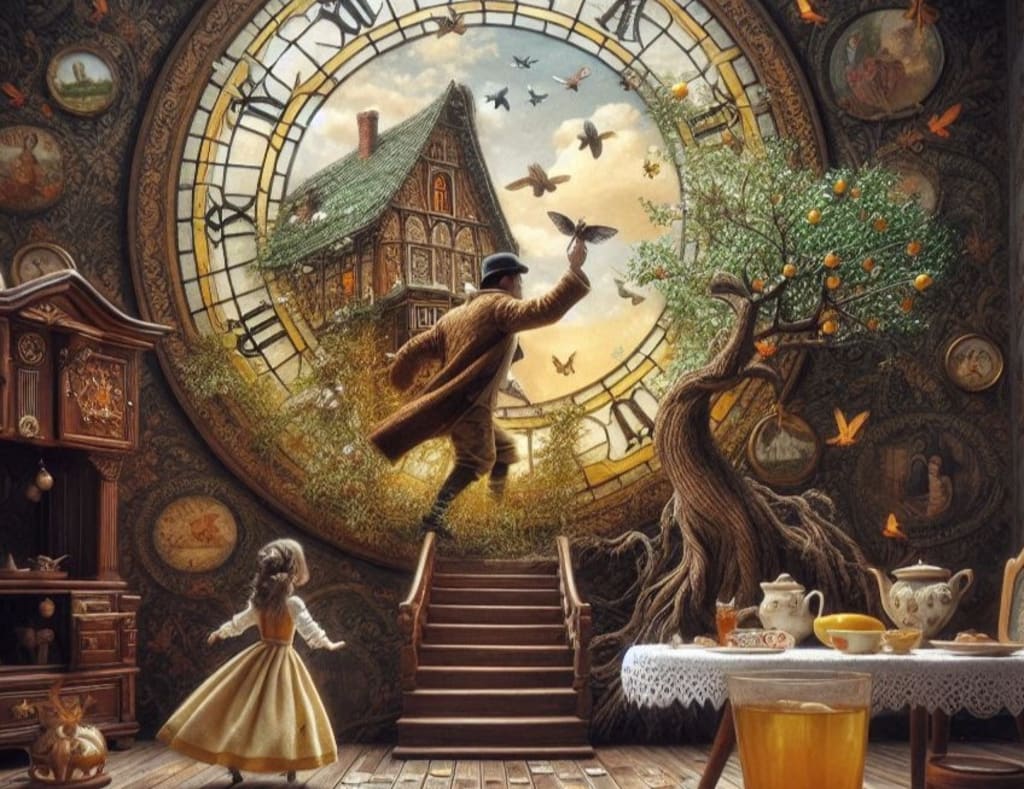
If, like me, you often leave off writing your brilliant entry to a Vocal challenge to the last few days, you may be wondering how to complete your Legends Rewritten draft in time. Perhaps you haven't even started yet. Here is a top-ten list of hints, tips and cheats. Don't tell everyone...
TOP TEN TIPS FOR WRITING QUICK-FIRE ENTRIES
ONE Remember, half the job is done already. If you are going to rewrite a myth, legend or fairy tale, then the original is already there. You could even incorporate the original into your own adaptation and modernisation.
TWO Research, research, research. You may not think you have enough time to do this but, if you use the quick and dirty research method described here, it might take only a few minutes, and this could speed up the actual writing.
THREE Start with some simple search engine questions. If you pose an actual question to Google, chances are the answer will be generated using 'AI' to assist, which helps for reasons set out below.
FOUR If you ask something like "What is the legend of Herne the Hunter?" You will probably get a nice summary. You could also ask Google, or your Chat-GPT assistant, to summarize "the fairy tale of Hansel and Gretel," for example.
FIVE Once you have your answer, you can copy and paste it into your story and then edit or paraphrase the summary into your own words. Assuming you are using no more than a few sentences and paraphrase, there is no need to credit your source. This is a short story exercise not an academic essay.
SIX This rewritten story is then the core part of your own reimagination. So do just that. Image a situation that is similar to the one in your story but perhaps in a modern and/or more real-world context. For instance, if your story is Red Riding Hood, you could imagine a situation in which a young child wanders alone into the woods and is confronted by danger. This might be an ill-intentioned adult, an encounter with dangerous animals, water, other hazard, or it could be literally an encounter with a wolf. As in one of my entries.
SEVEN If you are trying to write an old story in a modern context, you might find it best to stick to what you know. If you work in an office, for instance, why not set your legend in a modern office with characters that are typical office workers? For that matter, why not make your MC a story writer or poet?
EIGHT Don't make your characters too wooden. In a fairy story, a character might be pure evil or totally good, but your own story needs to make characters believable in the context of the setting. Give them little challenges to overcome, and choices to make, to test their mettle.
NINE Look for an illustration to help inspire you. You might even be able to illustrate the story at the start of the writing process. Unsplash is all very well, but the results can be a bit samey, and may not draw readers into your work. How about trying Wikimedia Commons for a change? Or look at the vast public domain resources of the Library of Congress or, for wildlife, check out the National Parks Service, which has thousands of photographs of nature. So much to choose from you have no excuse for having a bland and boring featured image. Don't forget to credit your source. Here is a good example of wonderful illustration of a poem, using a painting from an art museum website.
BTW Paul's wonderful work (read it! It might give you some ideas), having been submitted to the Poets community, is not eligible for Legends Rewritten. But if your Legends story is wolf related you can submit the same story to both challenges. Or perhaps you would like to write a Red Riding Hood or Three Little Pigs story, in which case check out the Wolfy challenge page here for some ideas and notes on how to enter:
TEN Finally, whenever you write, and particularly if you are short on time, don't spend too much time worrying over your language usage, spelling and grammar as you write. This will slow you down and impedes the creative process. Write your draft quickly as the story unfolds in your imagination. You can come back and tidy up at your leisure. Remember:
WRITE FAST ~ EDIT LATER
Best of luck with the challenge and I hope you found these top tips useful for this challenge and perhaps for other writing too. If you did, please let me know in comments. And do consider entering my wolfy challenge for a chance to win a nice new $10 tip.
Ray
About the Creator
Raymond G. Taylor
Author living in Kent, England. Writer of short stories and poems in a wide range of genres, forms and styles. A non-fiction writer for 40+ years. Subjects include art, history, science, business, law, and the human condition.
Keep reading
More stories from Raymond G. Taylor and writers in Writers and other communities.
Unofficial Challenge: Black History Celebration
Forward: February 28th, 10:53 PM, EST... The final hour of Black History Month, 2026. Hello fellow writers. I've had this challenge waiting in my drafts for most of the month. But I held off on publishing it, until now.
By Sam Spinelli7 days ago in Writers
I want to run
It was 6:15. He had been watching the digits change since 5:37. He would get up, he liked an early start for his long run of the week. His wife and kids were used to his early morning routines. His wife was long past caring, and the kids now seemed oblivious even to his presence. They would all carry on doing their own things.
By Keith Butler3 days ago in Writers


Comments (5)
Writing the story has never been the problem for me because like you mentioned, I type it out fast without worrying about anything. And then there's the editing that comes after that. That's the killer, lol
Write fast, edit later is great advice! Excellent article, Ray!
Love the encouragement and quick tips - thanks - have been putting off my draft. Perhaps I'll knock it out today right before the deadline.
Great tips, Raymond, thanks for putting this together.
Nice tips, im a totally last minute writer. But have a rough draft, hopefully get it sorted tomorrow 😅