
SpaceX Starship Flight 11 Launch: Mission Highlights, Key Milestones & What's Next in Space
Learn about SpaceX Starship Flight 11, its coding highlights, critical testing, and the launch vision for future moon and Mars missions.

SpaceX Starship Flight 11 Launch: Mission Highlights, Key Milestones & What's Next in Space
Learn about SpaceX Starship Flight 11, its coding highlights, critical testing, and the launch vision for future moon and Mars missions.
Introduction: The Next Chapter in Space Exploration
On October 13, 2025, SpaceX launched Starship Flight 11, representing exciting steps forward in pursuing reusable heavy-lift space vehicles.
Flight 11 is believed to be the last flight of the Block 2 Version (V2) of Starship before transitioning to even more advanced versions of the vehicle.
The mission continued with the testing philosophy embedded in previous missions along with new experiments including developing and launching the engine relights and testing the heat shield integrity while demonstrating the use of mock payloads.
In this article, we will share how SpaceX Starship Flight 11 built upon its predecessor missions, its critical highlights, and what is next for the Starship program.
Background : The Road to Flight 11
Before Flight 11, SpaceX conducted a static fire test for its booster B15 at Starbase, lighting all 33 Raptor engines for approximately ten seconds.
One part of a fast turn-around philosophy, the run of test B15 was made easier by Flight 10 having accomplished many mission objectives and been a high point for reliability.
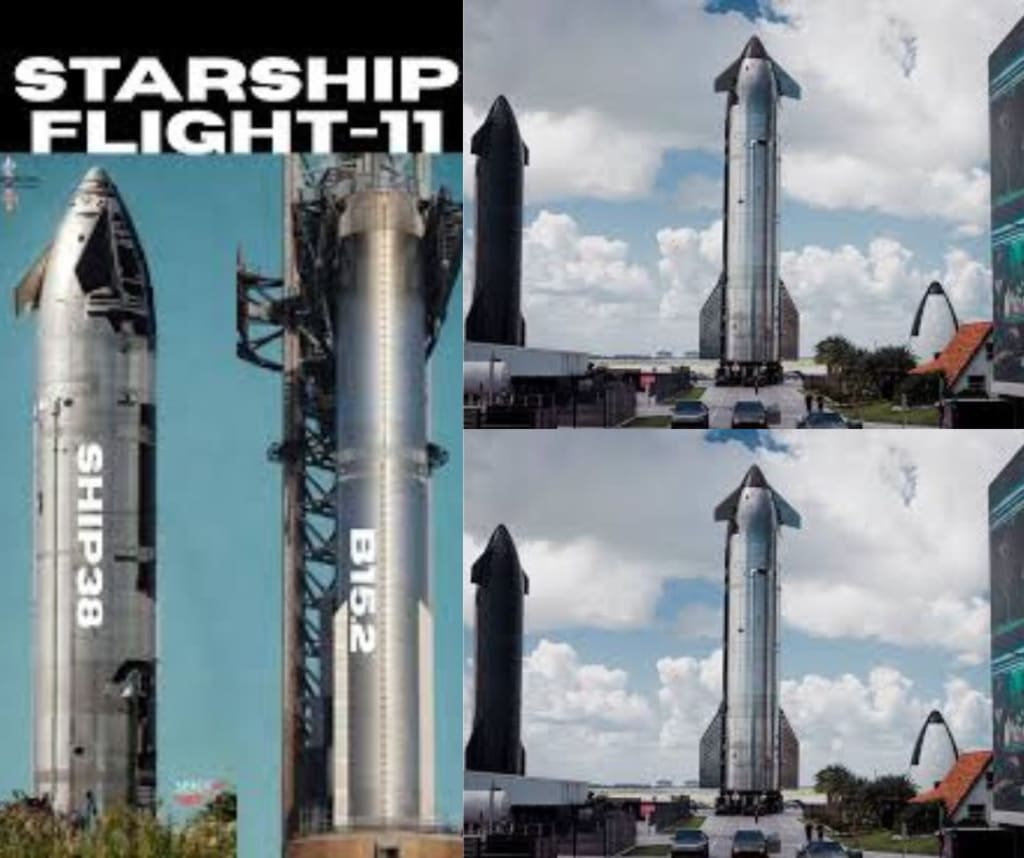
Flight 11 was already signaled to be a game changer: it would use Ship 38 as the second stage and Booster 15-2 as the Super Heavy.
This would also mark the final flight of Block 2 before SpaceX transitioned to new versions of Starship.
Starship's earlier flights had included uncertainty but not consistency in regards to flight termination or structural failure.
Flight 10 had been a transition point because it demonstrated, with reliable certainty, that many of the primary objectives of the Starship test program could be accomplished.
Thus, Flight 11 was more than a test but a closing to a generation of testing and transition to the next generation.
Mission Profile & Key Objectives
Launch Time & Vehicle:
The launch was planned for 6:23 p.m. CT from Starbase, Pad 1.
The vehicle stack consisted of Booster 15-2 + Ship 38.
Flight Path & Tests:
After staging, the Super Heavy booster performed a soft water landing in the Gulf of Mexico.
The Starship upper stage performed splashdown in the Indian Ocean following payload deployment and a series of orbital reentry tests.
There were 8 Starlink mass simulators onboard, meaning dummy payloads were flown to validate the deployment systems.
There were also engine relight tests in space and heat shield / tile experiment(s), including the removal of a number of thermal tiles to evaluate thermal load performance through re-entry.
One of the re-entry tests includes a dynamic banking maneuver (controlled attitude change during descent) to simulate a landing approach for future flights.
In sum, the goal of Flight 11 was to verify and extend the learnings from Flight 10, while pushing components to a more extreme experience.
Accomplishments & Highlights
1. Successful Completion of Core Tests
Flight 11 repeated many of the objectives of Flight 10 but added the challenges of losing tiles and a bank turn. Accomplishing these tasks will help build confidence in how the design is maturing.
2. Final Flight of Block 2
This flight was the last mission for Block 2 (V2) Starship version. All future flights will be expected to be (Block 3 or more) launched with upgraded systems and capabilities.
3. Booster Reuse & Engine Cycling
Booster B15-2 flew again, contributing to SpaceX's ongoing reliability concerning reuse. The booster reused 24 Raptor engines that had previously flown for this mission.
4. Reentry and Thermal Performance Data
This flight was designed to remove tiles from the vehicle and create additional reentry stresses, while simultaneously collecting additional data on the limits for materials and the thermal protection system for future flights.
5. Full Payload Deployment & Maneuver Validation
By deploying mock Starlink simulators while also maneuvering and re-igniting engines, we have greater confidence for future missions with payload deployment and operating in more harsh environments.
These five accomplishments will continue to push SpaceX and the Starship program to the next phase of development, eliminating unknowns and improving reliability.
What Flight 11 Means for Future Exploration
Flight 11 represents successful step but also a crucial link to much more ambitious objectives:
New Starship Variants: With Block 2 at sunset, Spacex can devote its attention to more capable variants of later developmental and operational use, that are ever more reliable, capable and have higher lift capabilities.
Moon Missions & NASA: Starship is the centerpiece in NASA's Artemis program and especially in lunar landing systems. Frequent reliable Starship flights aid in making moon missions more feasible.
To Mars: Our ultimate goal is interplanetary travel. Each test flight draws closer to total reusability and thermal characteristics ultimately supports that long-term view.
First Catch Attempts: Elon Musk has hinted at a future tower “catch” of the boosters (via mechanical arms) in expected future flights. And some believe in the 13-15 range flight, they may see Starship catch attempts.
Evolution of Launch Pad 1: The report suggests that Flight 11 was the last under the current configuration of Pad
1. This would suggest that changes or upgrades to pad infrastructure is ahead.
Each step builds confidence, lowers risk and builds more toward crewed deep space missions.
Challenges and Critique
Of course, there are challenges that remain,
Safety and Reliability: Even with successful outcomes, there is a lack of perfect performance that results in added structural or thermal unknowns.
Environmental and Regulatory Oversight:
Launch and splashdown impacts on the local environment, debris, and airspace safety are an ongoing issue, particularly with increased launch rates.
Transition Risks: In the movement from Block 2 design to some new version of design, there is a risk of new failure modes or integration.
Cost and Timeline Pressures: Stakeholders (NASA, private partners) will expect to see incremental progress. Even small and temporary delays would impact mission timelines.
There is no denying the value of Flight 11 success for building up energy to deal with many of these challenges.
Conclusion
As seen in the evidence that Flight 11 was much more than a test; it represents a threshold in the development of the mission. It officially closes the door on Block 2, helps establish a purpose for new and/or higher levels of stress experiments, and extends expectations for greater and bigger designs of Starship.
Today, with this flight, SpaceX came one step closer to realizing a vision: a reusable, heavy-lift spacecraft that takes us to the moon, to Mars, and eventually allows us to become multi-planetary.
Over time, the evidence from Flight 11 will assist in creating the subsequent, safer, more advanced work. At this point in time, the stars appear a bit closer, and the future seems much more bright.
About the Creator
Daily Blend
Daily Blend serves up a dynamic mix of lifestyle tips, wellness information, trending events, and everyday inspiration. Your daily dose of a dose of balance, simplicity, and smart living—blended just the way you like it.
Keep reading
More stories from Daily Blend and writers in Writers and other communities.
Hostages Released Today: What to Check for Recent news and Responses, Global Responses, and Peace Efforts.
Hostages Released Today: What to Check for Recent news and Responses, Global Responses, and Peace Efforts. All 20 Israel hostages will be released today in a historical deal with Hamas. Read the latest news and world reactions to the hostage release as well as anticipated attempts at peace.
By Daily Blend3 months ago in Writers
Untitled
I pat my brows with a handkerchief I fancy, and I think about the plight we are in today; it makes me squirm. In all my words you seek to find a formula, but your ledgers are filled with trending tabs (ephemeral tallies). You make me feel like I should be held in a box. It is impossible for someone to grow or be better than they were yesterday; simply by choice, they wish to step back and publish a little slower, less frequently.
By Caitlin Charltonabout a month ago in Writers
What Is Online Hazard Assessment Training and Why Is It Essential in 2026?
Workplace safety is no longer optional; it’s a critical responsibility for every organization. As industries evolve, new risks emerge, making hazard identification more complex than ever. This is where online hazard assessment training plays a vital role.
By Abbasi Publisher4 days ago in Writers


Comments
There are no comments for this story
Be the first to respond and start the conversation.