
Space Frame Design in Kuwait
Innovating Structures with Geometric Precision


Kuwait’s architectural landscape is embracing space frame design to achieve vast, column-free interiors and iconic rooflines. From modern malls to stadiums, space frame structures are redefining what’s possible in construction. This article explores the significance of space frame design in Kuwait, the advantages of these systems, types and trends, and how Metalart Space Frame’s projects are shaping the nation’s skyline.
What Is a Space Frame Structure?
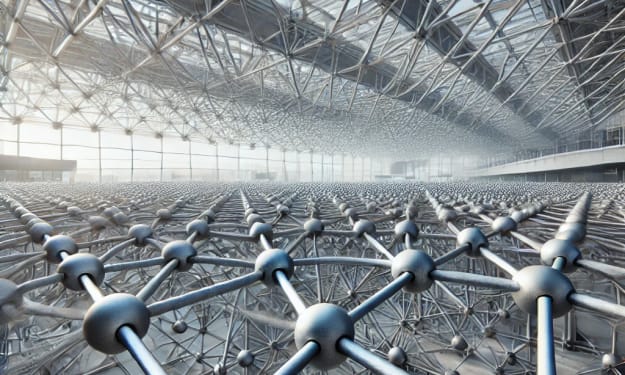
A space frame structure is a three-dimensional structural system formed by interconnected struts or beams arranged in a repeating geometric pattern. In simple terms, it’s like a 3D truss that is lightweight yet extremely strong. These structures derive strength from their triangular components – the inherent rigidity of triangles means the frame can bear heavy loads with minimal bending. In fact, a space frame can span large areas with very few internal supports
EN.WIKIPEDIA.ORG
. This is why space frames are popular for wide-roof spans like arenas, atriums, and airports.Space frame systems consist of linear elements (tubular steel or aluminum members) that connect at node joints (often spherical nodes or hubs). When assembled, the structure behaves as a single robust unit, distributing loads through tension and compression along each member
EN.WIKIPEDIA.ORG
. The result is a rigid, tensile and compressive grid that can cover big distances without sagging. In essence, space frames combine strength and lightness – an ideal combination for ambitious architectural designs.
Why Use Space Frame Design in Kuwait’s Architecture?
Why are space frame designs gaining traction in Kuwait? There are several reasons tied to both practical needs and ambitious architectural goals. Kuwait’s climate and infrastructure demands require roofs and canopies that can span large areas (for example, covering stadiums, exhibition centers, or mall atriums) while providing shade and open, unobstructed space beneath. Traditional concrete or heavy steel structures would require many columns or thick beams, which can clutter a space. Space frame design in Kuwait offers a solution by enabling wide, column-free spaces – perfect for accommodating large gatherings, sports events, or expansive retail floors without visual interruption.Moreover, Kuwait is experiencing a boom in modern architecture and innovative structural forms. Space frames align with this trend by offering incredible architectural flexibility. Designers can create sweeping curved roofs, striking domes, and intricate facades that are both functional and visually iconic. The geometric nature of space frames allows architects in Kuwait to experiment with form and shape (be it a graceful space frame roof over a new mall or a unique canopy for a public plaza) without compromising structural integrity. In a region where signature architecture is a source of pride, space frames provide the means to execute bold designs that stand out on the world stage.Another factor is speed and efficiency. Space frame components are prefabricated and then quickly assembled on site. In Kuwait’s construction industry – where timelines are often tight – this prefabrication capability is a huge plus. Large roof structures can be assembled like a kit of parts, reducing on-site construction time and labor costs. This efficiency, combined with the durability of space frame systems in harsh weather (they perform well under wind and seismic loads), makes them especially attractive for Kuwait’s ambitious projects.
What Are the Advantages of Space Frame Systems?
Space frame systems offer numerous advantages for modern construction, which explains their growing popularity in Kuwait and beyond. Here are some key benefits of using space frames in architectural projects:
Large Clear Spans – Space frames can cover vast areas with minimal supports. They enable enormous column-free interiors, which is ideal for airports, sports arenas, convention halls, and malls. Fewer columns not only improve sight-lines and space usage but can also cut foundation and civil costs by around 40% due to reduced point loads on the ground (as industry data suggests).
Lightweight yet Strong – Thanks to their truss-like geometry, space frames achieve an excellent strength-to-weight ratio
EN.WIKIPEDIA.ORG
. The use of triangular units means loads are efficiently transferred as tensile and compressive forces, making the structure very rigid for its weight. This reduces material usage without sacrificing safety, an economically and environmentally smart benefit.
Architectural Flexibility and Aesthetics – Space frames are often celebrated for their visual appeal. The crisscrossing geometric pattern of struts can be an architectural feature in itself, conveying a hi-tech, modern look. Internally, an exposed space frame roof with skylights can create a stunning effect. Externally, space frames enable innovative shapes – from flat planes to sweeping curves and domes – giving architects immense creative freedom. This architectural flexibility allows visually iconic designs that still maintain structural soundness
INSIGHTSLEADER.COM
.
Ease of Installation – Most space frame systems are modular. Components are prefabricated (cut and welded with precision in the factory) and then bolted together on site. This modularity ensures high quality (thanks to factory manufacturing) and rapid assembly at the construction site. In Kuwait’s context, where quick project turnaround is often needed, the ability to assemble a large space frame roof in a short time is a major advantage.
Durability and Low Maintenance – Made typically of structural steel (often with protective coatings) or aluminum, space frames are durable and can be designed to resist corrosion (e.g., with rust-proof powder coating). The rigidity of the system means less structural deformation over time. Additionally, the replaceable modular parts make maintenance or repairs easier – individual members can be replaced if needed without affecting the whole structure. Some space frame structures are even designed to be disassembled and reassembled, offering reusability for temporary installations or future relocations.
In summary, space frame systems provide a combination of practicality and innovation: they’re strong, lightweight, versatile in form, and efficient to build. These advantages align perfectly with the needs of many Kuwaiti projects, where ambitious designs must meet real-world performance and timeline requirements.
How Do Space Frame Roofs Cover Large Spans?
One of the most remarkable applications of space frame systems is in long-span roofs. How exactly can space frame roofs cover such large spans without many columns? The secret lies in their three-dimensional truss configuration. Unlike a conventional beam that might bend under heavy load, a space frame roof disperses the load through a network of interconnected triangles (or other polygons) in all directions. Essentially, the roof becomes a lattice shell where forces travel along the members and down to the supports in a distributed manner.Imagine the roof as a mesh of small pyramids or tetrahedrons joined together. If designed properly, when weight (like wind pressure or the weight of the roof itself) is applied, the force gets split into smaller forces that are carried by each component of those pyramids. The top chords of the space frame handle compressive forces and the bottom chords handle tensile forces, while diagonal web members stabilize the shape. Because each geometric unit (triangle) is inherently rigid, the entire assembly acts like a single, stiff plate or shell across the span.In practical terms, a space frame roof can be extremely thin relative to the area it covers, yet still support heavy loads (like HVAC equipment or large crowds beneath). For example, many airport terminals and sports facilities use space frame roofs to achieve column-free halls. The Kuwait International Fairgrounds and certain university campus structures have employed space frame canopies for large exhibition halls – enabling open space that can be reconfigured easily for different events. By using a space frame, the roof weight is reduced compared to a solid concrete slab, which in turn lessens the burden on columns and foundations. This efficient load distribution is why space frame roofs are favored for any structure requiring a wide span and open interior.Furthermore, space frame roofs in Kuwait are often combined with modern roofing materials like standing seam metal panels or glass skylights. The space frame provides the supporting skeleton, and then cladding or glazing is attached on top. The strength of the space frame ensures that these roofing elements are well-supported, even over very large spans like airplane hangars or stadiums. This synergy between the steel frame and roof covering results in a weather-tight, expansive roof that can also incorporate insulation and ventilation as needed. In summary, space frame roofs cover large spans by turning the roof into a web of small interconnected struts – an approach that Mother Nature herself uses (think of how a spiderweb or a bird’s wing distributes loads) to achieve strength with minimal weight.
What Are the Different Types of Space Frame Structures?
Space frames can be classified in a few ways, and understanding the types of space frame structures is useful for choosing the right system for a project:
By Curvature: Space frames can be flat or curved. Flat space frames (often called space plane covers) are like flat mats of structural grid, used for flat roofs or floors. Curved space frames include barrel vaults (arched shapes like an airplane hangar roof) and spherical domes (geodesic-like dome structures). In Kuwait, for instance, a shopping mall atrium might use a spherical dome space frame for a grand skylight, while a sports hall may use a barrel vault frame for its curved roof. Each curvature type addresses different architectural needs – flat grids for horizontal spans and curved for creating arching enclosures or dome spaces.
By Layer: Space frame structures are commonly built in single-layer, double-layer, or even triple-layer grids. A single-layer space frame is essentially one skeletal layer (often used in smaller spans or facades). Double-layer space frames, the most common, have an upper and lower layer of nodes connected by diagonal struts, forming a deep truss – this increases load capacity for larger spans like roofs. Triple-layer frames add another layer for even more stiffness (used in very large roofs or where extra redundancy is desired). The Kuwait Airport’s forthcoming expansions or large convention centers might opt for double-layer space frames for roofs to balance strength and material efficiency.
By Geometry/Module: The pattern of the modules can vary. Many space frames are built from square pyramids and tetrahedra as the basic repeating units
EN.WIKIPEDIA.ORG
. The octet truss (made famous by Buckminster Fuller) is one common geometric configuration, which uses alternating tetrahedral units to create an efficient grid. Other patterns include hexagonal grids or free-form nodes defined by computer algorithms for complex shapes. The geometry chosen affects the appearance and the structural behavior. For example, a triangular-based grid might use all equilateral triangles, whereas a square-based grid might use a mix of squares and triangles. In practice, engineers and architects decide on a geometric module based on structural requirements and aesthetic preferences. The geometric pattern is crucial – it must allow forces to flow through the structure evenly.
By Material: While steel is the most prevalent material for space frames (due to its high strength and availability), aluminum is also used for lightweight structures (especially smaller canopies or where weight is a critical factor, like atop an existing building). There are also examples of wooden space frames or composite material space frames in niche applications, though these are less common. In Kuwait’s construction market, galvanized or painted structural steel is the go-to choice for space frame fabrication, offering a good balance of strength, cost, and durability, with coatings to protect against corrosion from marine air or sand.
Each type of space frame structure offers its own advantages. Engineers will often categorize a project’s space frame by combining the above descriptors (e.g., a “double-layer spherical dome space frame in steel”). Understanding these types helps stakeholders communicate effectively about design requirements. For instance, Metalart Space Frame’s engineers in Kuwait work closely with architects to determine whether a project needs a flat grid for a ceiling or a curved space frame for a unique roof form, and whether a single-layer system will suffice or a double-layer system is needed for additional rigidity.
Geometric Patterns in Space Frame Design: Why They Matter
The beauty and strength of space frame design lie in its geometric pattern. These patterns aren’t chosen just for looks – they directly impact the structural performance. In a space frame, geometry is everything: the way individual members connect and the shapes they form (triangles, squares, hexagons, etc.) will determine how loads are distributed across the structure.For example, triangles are the fundamental building block of most space frames because they are inherently stable shapes. If you have a triangle made of rigid bars pinned at the corners, it won’t deform without changing the length of the bars (which are usually steel and resist stretching/compression very well). This is why many space frame patterns subdivide surfaces into triangular components or use pyramid units. When you see a space frame roof, you might notice it’s a tessellation of triangles or pyramids – this isn’t coincidental; it’s what makes the structure stiff and reliable.However, designers often mix in other polygons for various purposes. A common pattern is the octet truss, which can be visualized as an array of alternating pyramids (tetrahedra) and octahedra. This pattern was patented by Buckminster Fuller and is known for its excellent isotropic properties (meaning it’s equally strong in all directions). Other geometric patterns might include hexagonal grids or even free-form, where the lengths of members vary to create a certain surface curvature or artistic effect
EN.WIKIPEDIA.ORG
. In Kuwait, where some projects aim for avant-garde architecture, we might see complex free-form space frame designs that create asymmetric canopies or facades – essentially functional art pieces formed by structural geometry.Geometric precision also matters for practical reasons: a well-chosen pattern can optimize the use of material. Certain configurations might achieve the required strength with fewer members, making the structure lighter or more cost-effective. For instance, a double-layer grid of square pyramids can often use longer spans between supports than a single-layer flat grid. The choice of pattern is a dance between engineering and architecture. Aesthetically, a repeating geometric motif (like a series of diamonds or triangles) can become a signature element of the building’s design. Structurally, that motif ensures every load (from the weight of a hanging light fixture to a person walking on the roof) finds a path through the triangulated network down to the supports.In summary, geometric patterns are at the heart of space frame design. They matter because they are the key to achieving both the visual elegance and the remarkable structural capacity of space frames. The pyramid-like units and other shapes form the skeleton that holds everything up. When Metalart Space Frame’s designers approach a project, they pay close attention to choosing or inventing the right geometric configuration so that the resulting space frame is not only strong and safe but also meets the architectural vision for the project.
Space Frame Structural Systems and Materials
A space frame structural system is more than just the sum of its parts – it’s an engineered solution that integrates design, materials, and assembly technique. Let’s break down how these structural systems are put together and what materials are commonly used:Components of the Structural System: Any space frame system has a few basic components:
Struts (Members): These are the straight bars or tubes (usually steel) that form the frame. They can be circular hollow sections (pipes) or rectangular/square tubes, depending on design needs. The members are typically cut to precise lengths and often have end connectors (like cones or threaded ends) that will attach to nodes.
Nodes (Joints): Nodes are the hubs where multiple struts meet. A popular node type is a spherical steel ball with drilled and tapped holes, known in the industry as a “Mero” node (after the MERO system). Each node can connect anywhere from 3-18 members coming in at various angles. The node is crucial – it must transfer loads from one member to others. High-quality nodes and bolts ensure the space frame behaves as a unified mesh.
Connector Bolts/Plates: In some systems, the struts and nodes are bolted via special high-strength bolts. In others, there might be welded junctions or plates. The connections are engineered so that they can resist shear and tension forces where members join. The structural system as a whole relies on each connection being secure, since a loose joint could introduce unwanted flexibility.
Supports: Space frames usually rest on perimeter or point supports (like columns or ring beams). The way the space frame attaches to the support (hinged, fixed, or with a sliding bearing for thermal expansion) is also part of the system design.
Materials: The choice of material impacts the performance of the space frame.
Steel: By far the most common material, steel (often high-strength structural steel) provides excellent load-bearing capacity. Steel space frames can be galvanized or painted to protect against rust. In Kuwait, given the coastal environment and occasional sandstorms, corrosion-resistant coatings are important for longevity. Steel is also preferred because it’s ductile (it can bend or deform slightly under extreme loads rather than snapping suddenly, which is good for safety).
Aluminum: Aluminum space frames are much lighter (about one-third the weight of steel for the same volume). They are naturally corrosion-resistant. However, aluminum is also less stiff and can be costlier than steel. You might find aluminum space frames in smaller canopies or decorative structures, or where minimizing weight is critical (like on a rooftop addition).
Other Materials: In experimental or special cases, space frames could use timber or composites. Timber space frames create a warm aesthetic (suitable for interiors or eco-focused projects), but wood must be carefully engineered and protected from the elements. Composite materials or stainless steel might be used for highly specialized projects (perhaps a sculptural pavilion or an art installation in Kuwait City) but are not common in large-scale construction.
Fabrication and Assembly: Metalart Space Frame, for example, manufactures space frame components in a controlled factory setting. Struts are cut to length, their end connectors welded or threaded on, and nodes are machined with precision. Each piece is labeled for assembly. On site, assembling a space frame structural system is a bit like assembling “adult-sized” Tinker Toys or a Meccano set – every member and node fits together according to an engineered layout. Crews typically start at one end and build the frame in sections, either using scaffolding for support until it’s self-supporting or assembling on the ground and lifting sections into place with cranes. The efficiency of this process means a complex roof can often be installed faster than if one were to build large trusses or conventional steel frames piece by piece.Overall, the space frame structural system is a triumph of modern engineering – by leveraging standardized components and high-quality materials, it creates a versatile kit-of-parts that can be adapted to a wide variety of spans and shapes. The materials ensure strength and durability, while the system design ensures that all those pieces work together to form something much greater than the sum of its parts.
What Are the Latest Trends in Space Frame Design in Kuwait?
As with any facet of the construction industry, space frame design continues to evolve. In Kuwait and the broader GCC region, several trends and industry insights highlight where space frame technology is heading:1. Increasing Adoption in Large-Scale Projects: Space frames have moved from niche use to mainstream for large projects. The GCC space frame market has witnessed remarkable growth in recent years
INSIGHTSLEADER.COM
. Market research indicates that the GCC space frame sector (which includes Kuwait) was valued at about USD 78.3 million in 2023 and is projected to reach USD 175.6 million by 2032 – growing at an impressive CAGR of 10.7%
INSIGHTSLEADER.COM
. This growth is driven by the demand for innovative structures in airports, malls, sports complexes, and industrial facilities. In Kuwait, mega projects such as new airport terminals, sprawling shopping centers, and even infrastructural projects are increasingly looking to space frame solutions for their combination of strength and aesthetics.2. Integration with Sustainable Design: Modern Kuwaiti architecture is putting emphasis on sustainability. Space frames are being integrated with features like solar panels and green building systems. For example, a space frame skylight might double as a support for photovoltaic panels, turning a roof into an energy generator while providing shade. The ability of space frames to support glass panels also means they are used in daylighting – large atriums with space frame and glass roofs reduce the need for artificial lighting. Moreover, because space frames use less material than traditional structures (thanks to efficient load distribution), they inherently can lower the carbon footprint of a building’s structure, aligning with green building goals.3. Complex Free-Form Designs: Advances in computer-aided design and manufacturing mean architects are no longer limited to simple dome or barrel shapes. We are seeing more free-form space frame designs in the region. These are structures where each node and strut might be slightly different, creating an organic or fluid shape (think of a canopy that waves like a desert dune or a façade that twists in a unique pattern). In Kuwait, where iconic design is a competitive advantage, architects and developers are exploring these complex space frame forms to create statement buildings. Metalart Space Frame’s engineering team, for instance, uses advanced 3D modeling to design such free-form grids and ensure they remain buildable and structurally sound. This trend marries cutting-edge architecture with precision engineering – a space frame that’s as much art as it is structure.4. Enhanced Coatings and Materials: Given the harsh Middle Eastern climate, there’s a trend toward even more durable materials. Companies are experimenting with high-performance coatings that can last decades without repainting, even under intense sun and sand abrasion. There’s also interest in weathering steel (which develops a protective rust patina) for certain projects, although the aesthetic of that is more rustic and might be less common in Kuwait’s polished urban contexts. Nonetheless, the push for longevity means today’s space frames are being built to last with minimal maintenance, using the best of material science.5. Local Fabrication and Expertise: As space frame usage grows, Kuwait is developing local expertise in their design and construction. While companies like Metalart Space Frame operate regionally (with manufacturing in the UAE and projects in Kuwait), we see knowledge transfer happening. More local engineers and contractors are getting trained in space frame technology, which in turn lowers costs and improves customization for the local market. This maturation of local capabilities is a trend that points to space frames becoming a standard option in the design toolkit for Kuwait’s architects.Staying on top of these trends is important for decision-makers. The combination of rapid market growth
INSIGHTSLEADER.COM
and technological evolution means space frame design in Kuwait is an exciting, fast-moving field. For clients and architects, engaging with experienced space frame specialists early in the project can unlock innovative solutions that align with these trends – whether it’s designing an eye-catching free-form roof or ensuring a building is solar-ready and sustainable from day one.
Metalart Space Frame: Expertise in Design, Fabrication, and Installation
Metalart Space Frame is a leading company specializing in space frame technology, and its name has become synonymous with quality and innovation in the region. With over 30 years of experience in the Middle East, Metalart brings deep expertise in the design, manufacturing, and installation of space frame structures
MEDIA.YELLOWPAGES-UAE.COM
. The company operates its own fabrication facilities (for example, in the UAE’s Hamriyah Free Zone) where raw steel is transformed into the precision-engineered components of space frame systems. This in-house capability as a complete system manufacturer and designer means Metalart can ensure quality at every step – from the initial concept all the way to final bolt tightening.What sets Metalart apart is its holistic approach. The company not only designs the space frame geometry and engineers the structure for safety, but also fabricates every node and strut to exact specifications. Advanced CNC machines cut steel tubes, and skilled welders and technicians prepare node connectors and plates. Each piece is quality-checked and finished (often with protective coatings like galvanization or powder paint to ensure durability in Kuwait’s climate). By controlling the fabrication process, Metalart guarantees that on-site assembly will be smooth – components fit together perfectly like a well-crafted puzzle.Metalart Space Frame’s expertise is not limited to the steel lattice itself. They also integrate complementary systems such as standing seam metal roofing, single-skin roof panels, and skylight systems with their space frames. This means clients can receive a turnkey roofing solution where the space frame provides the structure and Metalart also supplies the cladding or roofing panels that go on top. For example, if a project in Kuwait requires a dome roof, Metalart can design the space frame dome AND provide the curved metal panels or glass that will cover that dome. This one-stop solution approach simplifies coordination for builders and ensures that the end result is a weathertight, optimized structure.On the installation front, Metalart has specialized crews experienced in assembling space frames efficiently and safely. Erecting a space frame is a sophisticated task – often involving working at height and handling hundreds or thousands of pieces. Metalart’s installation teams use cranes, temporary supports, and systematic bolt-tightening sequences to raise the structure. Their project managers coordinate closely with other contractors (for example, the civil contractors preparing support foundations or the cladding contractors following behind). Over the years, this expertise has been honed on projects across the GCC, giving Metalart a practical edge in anticipating and solving on-site challenges.Finally, Metalart’s design expertise deserves special mention. The company employs structural engineers who are well-versed in space frame analysis and use advanced software to model complex forms. They ensure that each design not only meets the architectural vision but also adheres to international building codes and local regulations. For clients and architects, collaborating with Metalart means gaining a partner who can advise on the best space frame configuration for budget, performance, and appearance. Whether it’s a straightforward canopy or an ambitious free-form structure, Metalart Space Frame’s breadth of expertise – spanning creative design to precision fabrication and skilled installation – ensures the project will stand as a proud example of space frame innovation in Kuwait.
Metalart Space Frame’s Projects in Kuwait
Metalart Space Frame has played a significant role in introducing and implementing space frame structures in Kuwait’s construction scene. Over the years, the company has contributed to a number of high-profile projects, showcasing the versatility of space frames across different sectors. Here are a few highlights of Metalart’s space frame projects in Kuwait:
Commercial Complexes and Malls: Metalart provided space frame roofing systems for expansive retail developments, where large atrium roofs and long-span entrance canopies were required. For instance, on a recent mall project in Kuwait City, Metalart engineered a sprawling space frame skylight that forms the centerpiece of the mall’s design. This skylight uses a double-layer space frame with integrated glass panels, flooding the interior with natural light while maintaining structural integrity and safety. The result is a shopping environment that feels open and airy, with the space frame becoming a subtle architectural feature overhead.
Sports and Recreational Facilities: When a major sports arena in Kuwait needed a lightweight roof to cover the stands without obstructing views of the field, Metalart Space Frame was called in to deliver. Metalart’s team designed a space frame roof structure for the facility, leveraging the technology’s ability to span wide distances. The roof covers thousands of seats with minimal columns, ensuring fans have unobstructed sight-lines. The use of a space frame also helped keep the roof weight low, which was crucial for the existing concrete support structure of the stadium. Kuwait’s sports infrastructure has benefitted from such solutions – be it indoor arenas for basketball or swimming pools – and Metalart has been at the forefront, providing durable roofs that inspire confidence under the harsh sun and occasional rain. (For confidentiality, specific venue names are omitted, but these projects stand as testaments to Metalart’s capability.)
Public Infrastructure and Institutional Projects: Metalart Space Frame contributed to the design and construction of space frame structures for public-sector projects, including educational campuses and transport facilities. A notable example is the use of space frame canopies in a government transportation hub, where Metalart delivered a series of interconnected space frame modules forming a large shaded walkway. This not only provides functional cover for pedestrians but also adds a modern visual element to the facility. Similarly, at a university campus in Kuwait, Metalart installed a space frame roof over a large multi-purpose hall, enabling a column-free interior that can host conferences, exhibitions, or exams with equal ease. These projects underline Metalart’s role in enhancing Kuwait’s infrastructure with cutting-edge structural systems.
Each project undertaken by Metalart in Kuwait is approached with a tailored solution mindset. The company works closely with local architects and contractors to ensure that the space frame design aligns with the project’s objectives, whether that’s creating an iconic landmark or simply solving an engineering challenge of covering a big space economically. Through its projects, Metalart Space Frame has built a reputation in Kuwait for reliability and innovation – delivering structures that perform exceptionally while elevating the aesthetic of the built environment.It’s also worth noting that Metalart’s involvement often begins at the conceptual stage. Clients in Kuwait frequently engage Metalart during the early design phase to conduct feasibility studies for space frame options. By doing so, they get accurate cost estimates and engineering input up front, which helps in decision-making. Metalart’s successful projects are a result of this collaborative approach, ensuring that by the time fabrication and erection happen, every detail has been planned out. The company’s portfolio in Kuwait continues to grow, reflecting the trust it has earned and highlighting the increasing embrace of space frame design in the country.
Conclusion: Key Takeaways on Space Frame Design in Kuwait
Space Frames Defined: Space frame structures are lightweight, rigid three-dimensional trusses formed by a network of struts arranged in geometric patterns. They excel at spanning large areas with minimal supports
EN.WIKIPEDIA.ORG
, making them ideal for Kuwait’s big architectural projects.
Advantages for Kuwait: Space frames offer clear-span interiors (great for malls, airports, stadiums), efficient material use with high strength-to-weight ratio, and flexible shapes. Their geometric appeal also enhances architectural aesthetics, aligning with Kuwait’s modern design aspirations.
Structural Versatility: Various types of space frame systems (flat grids, barrel vaults, domes, single or double-layer, etc.) can be employed to suit project needs. The choice of steel or aluminum, node type, and pattern allows customization for optimal performance and visual impact.
Industry Trends: Kuwait is witnessing growing adoption of space frame designs, driven by the need for innovative and sustainable construction. The GCC space frame market is growing ~10.7% annually
INSIGHTSLEADER.COM
, indicating a strong future for this technology. Trends include integration of solar panels, free-form architectural designs, and advanced protective coatings for longevity.
Metalart’s Role: Metalart Space Frame is a key player in bringing this technology to life in Kuwait. With end-to-end capabilities in design, fabrication, and installation, Metalart has delivered successful space frame projects across commercial, sports, and public sectors. Their expertise ensures that clients get a reliable structural solution and iconic design element in one package.
Ready to explore how a space frame structure can elevate your next project in Kuwait? Metalart Space Frame’s team of experts is here to help. With decades of experience and a portfolio of proven projects, we can turn bold architectural visions into reality using state-of-the-art space frame systems. Contact us today at +971-50-443-8255 or via email at [email protected] to discuss your project requirements. Whether it’s a conceptual idea or a detailed proposal, we’ll provide guidance on the best structural solutions. Experience the perfect blend of innovation, efficiency, and beauty in construction – partner with Metalart Space Frame for your space frame design needs in Kuwait. Let’s build something extraordinary together!
About the Creator
Metalart Space Frame & Standing Seam
Leading designer, manufacturer, installer of Space Frame, Standing Seam Metal Roofing, and Single-Skin Roof Panel (Ceiling Panel) for ADNOC Stations in UAE.
Keep reading
More stories from Metalart Space Frame & Standing Seam and writers in Writers and other communities.
Space Frame Technology in Oman
Summary: Space frame technology has emerged as a game-changer in Oman’s construction landscape. By using interlocking structural elements in a geometric pattern, space frame structures create strong yet lightweight frameworks ideal for the country’s modern projects. In this article, we delve into space frame technology in Oman – explaining what space frames are, their key advantages, and how they are being applied in Omani projects. We also share industry trends and highlight Metalart Space Frame’s role as a local innovator. Read on to find out why space frames are revolutionizing architecture in Oman and how this technology can benefit your next project.
By Metalart Space Frame & Standing Seam11 months ago in Writers
Why Australia’s New Psychosocial Safety Laws Are Forcing Employers to Rethink Workplace Risk
Australia has quietly entered a new era of workplace regulation, one where psychological health is no longer treated as a secondary wellbeing concern, but as a formal safety obligation equivalent to physical hazards. This shift represents one of the most significant changes to occupational health and safety governance in decades.
By Abbasi Publisher6 days ago in Writers



Comments