
Slavery in Islam vs. Modern Slavery: Does Freedom Really Exist?
ইসলামে দাসপ্রথা বনাম আধুনিক দাসত্ব: স্বাধীনতা কি আদতেই আছে?

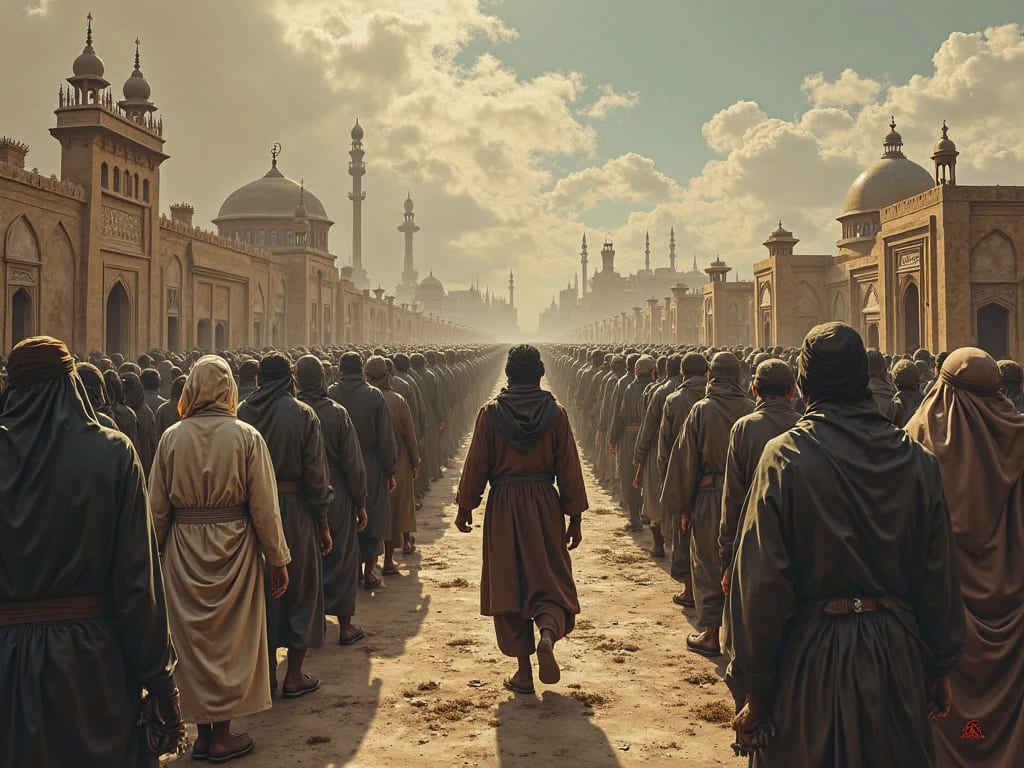
Slavery is a cruel reality in the pages of history. Humans have been bought, sold, and used as mere objects by humans. Slavery was once legal and normal in almost all civilizations of the world—be it Greece and Rome, India, or China. Islam came into that context. But Islam did not support slavery; rather, it gradually showed the way to its extinction through a new moral and social revolution—through humanity, responsibility, and liberation.
At the time of the advent of Islam, slavery was a cruel reality in Arab society. After victory, prisoners of war were converted into slaves, and their subsequent fate was determined by the owner. Instead of directly breaking this structure, Islam created a humane, responsible, and gradual path to its abolition within it, which is unprecedented in history.
First, the treatment of slaves in the language of the Quran and Hadith was very humane. It is forbidden to feed, clothe, and even exceed one's strength for any work. The Prophet Muhammad (peace be upon him) himself freed slaves, honored them, and permanently integrated them into society. Many of his companions considered emancipation to be the highest form of worship.
Secondly, Islam encouraged emancipation in various ways—such as mandating the freeing of slaves as an expiation for breaking an oath or committing a mistake, allocating a portion of zakat as ‘rikab’ (for emancipation), and introducing the voluntary emancipation of slaves called “mukataba”—where the slave could earn his freedom in stages with his own earnings. Emancipation was not just a matter of spiritual reward, but was also a social obligation imposed on every Muslim.
But today we live in a world where there are no slaves—at least in the literal sense. But has slavery really ended? No, it has returned in a more sophisticated, disguised, and terrifying form. We call it—modern slavery.
Today's man is a worker, an employee, a consumer, a customer—he is called a "free citizen," yet every aspect of him is imprisoned by some system. Corporate companies, the banking system, the cycle of debt, consumerist culture, the slavery of jobs embedded in the education system—all together, man lives a highly controlled life, where he is not free, but rather controlled.
The biggest feature of this modern slavery is the illusion of Maya. Man thinks he is free, yet the clothes he wears, the mobile phone he uses, the lifestyle he is accustomed to—all are the result of signals created by some capitalist institution. He lives on bank interest, works in the corporate chain, determines his fate in the stock market, yet thinks he is 'free.' The biggest weapon of modern slavery is the invisible chain.
Islam is a revolutionary declaration against this modern slavery. Islam does not allow man to be a slave to anyone but Allah. “La ilaha illallah”—this sentence is not only a declaration of the existence of Allah, but also a denial of all oppressors, slavery-establishers, capitalists, and hegemonists. Being a Muslim means not bowing down to anyone, not giving full obedience to any rule except Allah alone.
If those who bear the name of Muslims in today’s world were true Muslims, they could break this modern slavery. They would work, but would not be slaves. They would use banks, but would not be slaves to interest. They would use technology, but would not be slaves to brands. Because in Islam, people work, earn, and enjoy—but the goal of everything is the pleasure of Allah. And that is what creates self-respect, personal freedom, and true freedom.
Modern slavery is most deeply rooted in the human mind and consciousness. Therefore, Islam first of all frees the human mind. It says—you are not a worshiper of any institution in the world. You are not a slave to any state, corporation, or leader. You are the only servant of Allah. This consciousness makes a Muslim free in spirit, free in mind, disobedient to the system, but loyal to the laws of Allah.
Therefore, the end of slavery in Islam is not just legal—it is a liberation of consciousness. And the solution to modern slavery is not a law—but rather the consciousness that returns a person to his spiritual identity.
About the Creator
Keep reading
More stories from Abdul Barik and writers in Writers and other communities.
Islam and Capitalism: Two Civilizations, Two Economies, Two Perspectives”
Capitalism is the economic backbone of modern Western civilization. Its fundamental principles are the free market system, private ownership, the maximization of profit, and competition. Capitalism accepts human greed as natural and just, and establishes that greed as the driving force of economic growth. Here, wealth accumulation, interest, investment, corporate dominance, and global trade are the main principles.
By Abdul Barik9 months ago in Writers
The Comeback Generation: Why Starting Over After 30, 40, or 50 Is Becoming the New Path to Success
For decades, society told a simple story about success: figure out your life early, build your career fast, and lock in your future before you get “too old.” The message was subtle but powerful — if you didn’t make it in your twenties, you were somehow behind. Today, that story is breaking apart. Across the world, people in their thirties, forties, and fifties are walking away from careers, routines, and identities that no longer fit. They are starting businesses, learning new skills, moving to new cities, and chasing dreams they once believed were no longer allowed. This shift is being driven by more than just dissatisfaction. It’s being driven by clarity. With age often comes a deeper understanding of what truly matters. Many people spend their younger years chasing external approval — money, titles, or social status. But after years of experience, they begin to ask different questions. Do I enjoy my daily life? Does my work reflect my values? Am I proud of how I spend my time? For some, the answers lead to a powerful realization: staying the same feels riskier than starting over. Technology has made this kind of reinvention more possible than ever. Online courses allow people to learn new careers from their living rooms. Remote work opens doors to opportunities that were once limited by geography. Social platforms give individuals the ability to build personal brands, launch creative projects, or start businesses without massive upfront costs. What once required permission from companies, investors, or institutions can now begin with a laptop and an internet connection. But the comeback generation isn’t just about opportunity. It’s about mindset. One of the biggest barriers to starting over is fear — fear of failure, judgment, and wasted time. Many people worry that changing direction means admitting they made a mistake. But a growing number of voices are reframing that idea. They see their past not as a failure, but as training. Every job, relationship, and challenge becomes part of a skillset. Communication, resilience, problem-solving, and emotional intelligence don’t disappear when someone switches careers or goals. They carry forward, often making older beginners stronger than younger ones. There is also a quiet confidence that comes with experience. Younger people often feel pressure to prove themselves. Older beginners tend to care less about appearances and more about meaning. This shift in focus can lead to deeper commitment and greater satisfaction. Of course, starting over is not easy. It can involve financial uncertainty, uncomfortable learning curves, and moments of self-doubt. Watching younger people succeed in the same space can trigger insecurity. The question “Am I too late?” can echo loudly in the mind. But many in the comeback generation are discovering a powerful truth: there is no universal timeline for a meaningful life. Some of the most successful entrepreneurs, artists, and leaders didn’t find their true path until later years. What they often share is not youthful speed, but persistence. They kept moving forward, even when progress was slow and the outcome uncertain. There is also a cultural shift happening. Communities are becoming more supportive of non-linear life paths. Changing careers, taking breaks, and exploring new identities are becoming more accepted. The idea of having “one job for life” is being replaced by the idea of having many chapters. In this new story, life is not a straight road — it’s a landscape. Sometimes you climb. Sometimes you wander. Sometimes you stop and choose a completely new direction. And that choice, made at any age, can be an act of courage. The comeback generation isn’t trying to turn back time. They are using it — using what they’ve learned, what they’ve survived, and what they now understand about themselves. Because success is no longer being defined by how early you start. It’s being defined by how boldly you choose to continue.
By Hazrat Usman Usmanabout 11 hours ago in Writers



Comments
There are no comments for this story
Be the first to respond and start the conversation.