
Rewriting My Father’s Story
undocumented life through fragments, interviews, and imagination — blending truth and fiction to understand who he really was.

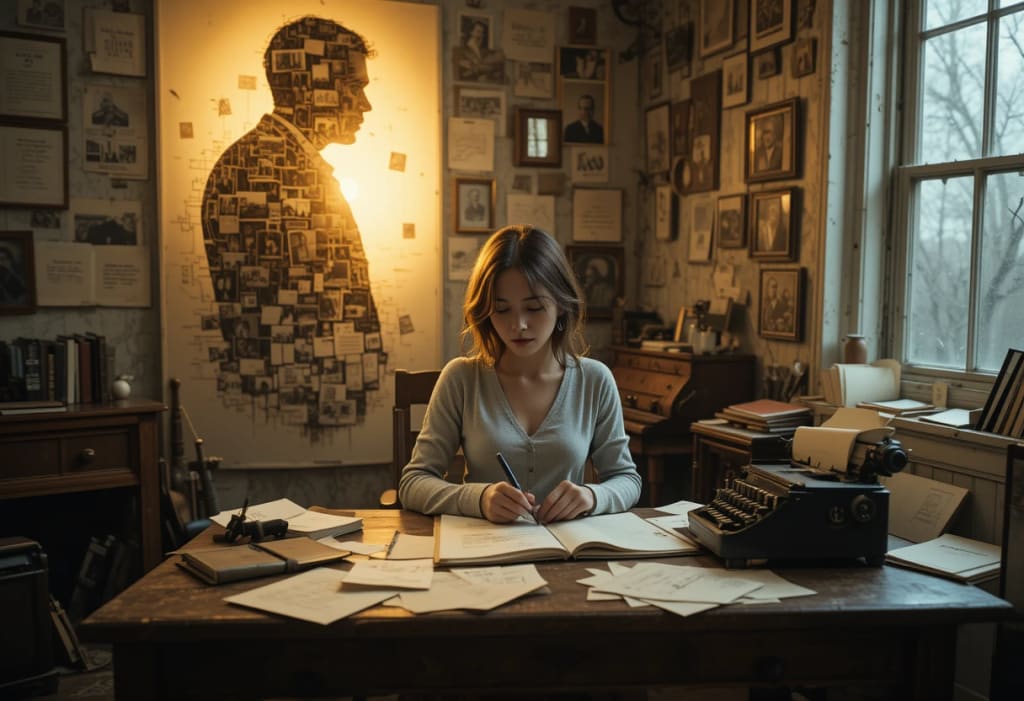
Rewriting My Father’s Story
Genre: Writers / Personal
My father never wrote anything down.
Not a journal.
Not a letter.
Not even a to-do list, unless my mother forced him.
And when he died, he left behind no memoirs. No recorded memories. Just a few black-and-white photographs, his cracked watch, and a quiet house that still smelled of old cologne and rain-damp wool.
At first, I didn’t plan to write about him.
Grief makes us silent, at least at the beginning. Words feel too small. Too artificial.
But grief also makes us curious.
You begin to ask questions not because you want answers — but because you realize there are so few left to ask. And so, I began to reconstruct my father’s story the only way I could:
With fragments. With fiction. And with love.
My father was born in a village so small it didn’t appear on Google Maps. He left when he was fifteen, with a worn satchel and the kind of hunger that cannot be filled with food.
He told me once, in passing, that he crossed a river barefoot to reach his first job — loading bricks in the sun. I don’t know which river, or which town. He never said. So in my retelling, I made the river wide, dangerous, mythical. A place where his reflection first learned what ambition looked like.
I interviewed my uncles, my mother, even an old neighbor who remembered him as “the quiet one who read newspapers like they were sacred texts.” Everyone remembered different things. Contradictory things. Important things.
“He was always laughing,” one uncle said.
“He barely spoke to anyone,” another claimed.
“He cried at your birth.”
“He was never emotional.”
“He hated rain.”
“He danced in it once, on a rooftop, when he got his first job offer.”
Which version was true?
Maybe all of them. Maybe none.
I wrote them all anyway.
In one draft of his story, he’s a dreamer — sketching maps of cities he’ll never visit on the back of grocery bills. In another, he’s a realist — wiping grease from his fingers as he fixes a radio for a neighbor who will never repay him. Sometimes, he’s heroic. Sometimes, painfully human.
But in every version, he loves quietly and consistently.
He shows it not with words, but with action — fixing leaky taps at 2 AM, working double shifts without complaint, eating the burned edges of bread so others didn’t have to.
I remember him sitting in the dark, unwinding the day in silence, his fingers twitching as if still building something. I used to think he was tired. Now I wonder if he was writing stories in his head — ones he didn’t know how to tell.
So I tell them for him.
I found an old suitcase in the attic, full of receipts, faded train tickets, and one photo of him standing beside a tree I couldn’t identify.
In the story I wrote from that, he’s on a journey — having just quit a job that belittled him, about to board a train that will change everything. He stands by that tree to catch his breath. He thinks about calling my mother. He doesn’t. He waits until he’s already miles away, in a city of strangers, where he will eventually build a life with too few words and too much weathered pride.
My sister says I romanticize him.
Maybe I do.
But someone has to.
There are facts, yes. He was born in 1959. He died in 2021. He worked in a machine shop. He smelled of sandalwood and sweat. He had a chipped front tooth and a soft spot for mangoes. He believed in fate and hard work, but mostly the latter. He never read my writing while he was alive — said he didn’t understand fiction.
I wish I could show him now.
Tell him that he, himself, was a story. That we are all stories — messy, contradictory, unfinished. That even silence says something, and that the absence of words only invites more imagination.
When I finished the final draft of his story, I didn’t know what to do with it.
It wasn’t a biography. It wasn’t even wholly true. But it felt real.
So I printed it and placed it beneath his photo on my bookshelf.
In the story’s last line, he says something he never got to in real life:
“I didn’t write it down, because I trusted you would.”
I don’t know if that’s what he would have wanted.
But I like to believe it is.
Because in the end, we don’t rewrite our parents to change them.
We rewrite them to hold on.
To understand.
To fill the silence with something warmer than regret.
To give them the story they didn’t know they had the right to tell.
About the Creator
Keep reading
More stories from waseem khan and writers in Writers and other communities.




Comments
There are no comments for this story
Be the first to respond and start the conversation.