
Q&A with a Script Supervisor
Natalie Zagar Abitbol talks about her journey in film
Q: How did you start out in your career?
A: From a young age, I had a deep love for movies. The art of storytelling captivated me, and the more films I watched, the more I dreamed of being part of that world. Acting was my initial passion, and throughout school, I participated in multiple theater productions. Moving to Los Angeles solidified my dream, and studying in film school allowed me to work on various projects. Watching the magic unfold on set and being surrounded by immense talent made every moment feel like a dream come true. I continue to watch new movies for inspiration, always leaving the theater with a renewed sense of purpose.
Q: What are three of your biggest projects? What made them successful?
A: I have worked on many projects, but three stand out:
• The Mirror (Short Film): My first professional project as a script supervisor. Despite its low budget, the film was selected for multiple festivals and won several awards. It was a significant milestone in my career.
• White Vinegar (Feature Film): My first large-scale production. With multiple locations and a month-long shoot, I became more efficient and confident in my role.
• Falling in Love with My Ex-Husband Again (Vertical Drama Series): My first high-budget production, filmed in LA mansions with a large cast. Shooting 15-18 pages a day was intense, but the series achieved high ratings and continues to grow in popularity.
Q: What’s the worst piece of advice you’ve ever received?
A: "Don’t stress about it; we’ll fix it in post." While some issues are unavoidable, it's always better to prevent problems on set. As a script supervisor, my job is to minimize post-production challenges and ensure continuity from the start.
Q: What advice would you give to others in your field?
A: The devil is in the details. Being precise and catching mistakes before filming starts makes a significant difference. Always scrutinize the frame, look for inconsistencies, and be prepared to address any concerns before the cameras roll.
Q: What is your proudest achievement to date?
A: Two moments stand out:
1. During a script supervising workshop, my instructor recognized my on-set experience and asked me to share my knowledge with my peers. It was incredibly validating.
2. Working on a complex scene involving seven actors playing a board game. I applied all my skills—creating overhead diagrams, preparing blocking strategies, and answering camera and eyeline questions. It was a moment of true professional confidence.
Q: How would your peers describe you?
A: I believe kindness goes a long way, and I strive to treat everyone with respect. My colleagues have described me as dedicated, passionate, and always willing to help with a positive attitude.
Q: Is there anything you wish you had done differently?
A: When applying to universities in Mexico City, I was offered a scholarship to a school that didn’t have my preferred program. I chose a different university that aligned with my goals, leading me to where I am today. While I sometimes wonder about the road not taken, I believe every choice shapes our journey in meaningful ways.
Q: What has experience taught you?
A: Nobody is perfect. Growth is a continuous process, and mistakes are opportunities to learn and improve. Instead of being too harsh on myself, I see setbacks as stepping stones to becoming a better professional.
Q: What projects have you recently completed?
A: This year, I worked on:
• A vertical drama series set to air in April on Kalos TV about a man facing a deadly illness and the mysterious woman who holds the key to his survival.
• A low-budget short film about a couple living in a house haunted by the devil, with an unexpected twist.
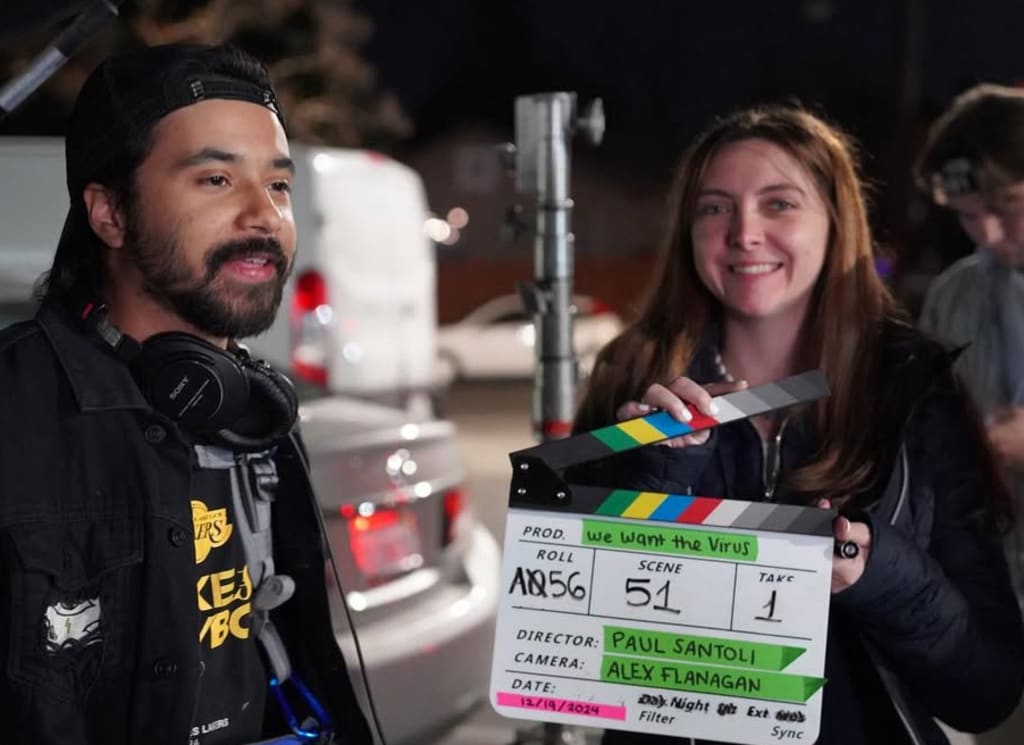
• An independent comedy feature, We Want the Virus, about two struggling actors who create a fraudulent fundraiser, leading to unexpected chaos.
Q: What projects are you hoping to work on in the near future?
A: My future goals include:
1. Working on a weekly sitcom or drama series.
2. Transitioning into directing my own film.
3. Being part of a musical-to-film adaptation, whether as a script supervisor, director, or performer.
With every project, I continue to grow and refine my skills, and I am excited to see where my journey in film will take me next.
Natalie Zagar Abitbol was talking to Noam Friedlander
About the Creator
Alex Wilkins
Journalist for over 25 years, author of over 14 published books and an award-winning screenwriter.
Keep reading
More stories from Alex Wilkins and writers in Writers and other communities.
Sam is wise to his shows
Sam Lang is one of the UK’s most prolific producers, before moving to the United States, Sam worked behind the scenes on leading shows such as So You Think You Can Dance (BBC) and Railroad Alaska (Discovery). A highly diverse career, his shows have been watched by millions. He took some time out to discuss his career as a producer with Alex Wilkins (as well as dishing some stories of the celebrities he’s met along the way )…
By Alex Wilkinsabout a year ago in Interview
Analyse this!
Wanna know how to improve your writing? There is a simple, quick, tried and tested method. Tried and tested by who? By me, as it happens, and I can guarantee that it will work for you. I know what I am talking about. Not always, of course, but certainly in this case.
By Raymond G. Taylor23 days ago in Writers
From System Failure to Human Error: My Journey Through Words ✍️
Writing, for me, is a process that borders on the magical—the art of precision in word choice, the unfolding of complex thoughts, and, most importantly, the act of creating something out of absolute nothingness. It is a craft I’ve fallen in love with, even though it can be as fickle as it is rewarding. 🌌 My literary journey began with a deeply personal, raw reckoning with my past in the book "404: Reality Not Found", where I chronicled the difficult path from the darkness of addiction back to the land of the living. 🕯️ Today, my pen has turned toward pure fiction—specifically, dark sci-fi set in a world dominated by algorithms: "Human.exe Error 0x000". 🤖💻
By Piotr Nowakabout 17 hours ago in Writers




Comments
There are no comments for this story
Be the first to respond and start the conversation.