
Price of Authoritarian Faith
How authoritarian politics hollow out belief and weaponize God
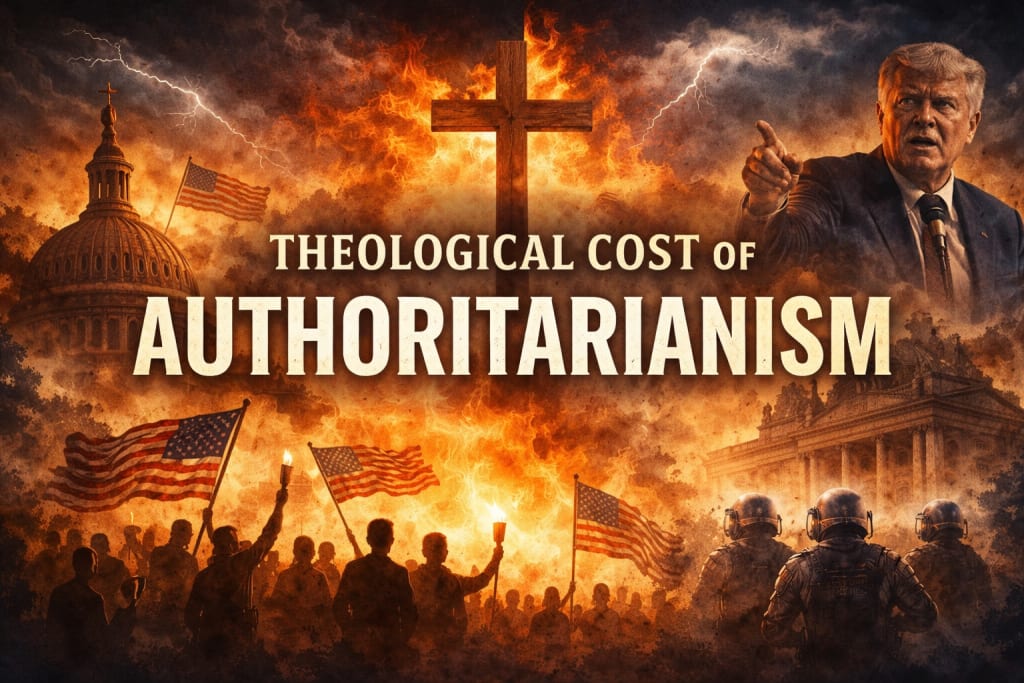
Religion and authoritarianism shouldn't mix. One can bring liberation, dignity, and love. The other demands control, submission, and fear.
Yet across America, we're witnessing their marriage—and the theological bill is coming due.
The Pattern
It happens gradually, then suddenly.
Faith communities emphasize cultural preservation over gospel transformation. Pastors start describing political opponents as spiritual enemies. Congregations stop questioning "us versus them" language that leaves no room for loving thy neighbor.
Soon,a church that once preaching humility glorifies dominance. Sermons once calling for compassion justify cruelty. Faith that once proclaimed God's love sanctifies fear.
This isn't accidental drift. It's the predictable trajectory of authoritarian religion.
Research highlights the connection: Americans embracing Christian nationalist beliefs are more likely to support authoritarianism, including cheering on leaders "willing to break some rules."
Faith-turned-nationalism must be enforced. Enforcement requires concentrated power.
The Strongman Solution
Authoritarian religion requires a strongman. A leader promising to fight your battles, crush your enemies, and restore what you've lost.
That appeal is obvious. Democracy can be messy and slow. Pluralism is exhausting. Living alongside difference requires constant negotiation.
Wouldn't it be easier if a strong leader could fix everything?
This fantasy betraysChristian theology's core. Jesus didn't come lording earthly power over anyone. He came as a servant, teaching that the Kingdom operates by different rules: the last first, the meek inheriting, power wielded for others rather than over them.
Strongman politics requires the opposite. It demands hierarchy, unquestioning loyalty, and the silencing of dissent. It cannot coexist with the gospel's scandal of grace.
But authoritarian religion reconciles the irreconcilable. It transforms Jesus from crucified God into empire's endorser. It makes the Prince of Peace bless violence. It turns radical inclusion into radical exclusion.
What We Lose
Let's name the cost clearly.
We lose the prophetic voice. When religion becomes the state's chaplain, it can no longer speak truth to power. It can only baptize power's truth.
We lose the vulnerable. Authoritarian faith always creates insiders and outsiders, the righteous and the damned. It cannot abide God's preference for the marginalized.
We lose moral credibility. When the world sees Christians supporting cruelty and consolidation of power, it doesn't just reject the church. It rejects the God we claim.
We lose young people. They're walking away in droves, unable to square the love they read about in scripture with the hate they witness in sanctuaries.
We lose the gospel itself. Because you cannot preach grace while practicing domination. You cannot worship the God who liberates while supporting oppression. You cannot follow the crucified Lord while wielding the sword.
The Choice Ahead
This isn't inevitable. We can choose differently.
We can build faith communities that cast out fear instead of baptizing it. We can follow leaders who serve rather than dominate. We can practice the radical welcome the gospel demands.
But it requires courage. It demands we name authoritarian religion for what it is—heresy that distorts faith and threatens freedom. It means resisting the strongman temptation in all its forms.
The stakes are both theological and political, spiritual and civic.
Every sermon matters. Every pastoral conversation carries weight. Every silence gives consent.
We're deciding right now what Christianity will mean to the next generation. Will it be good news for the vulnerable or blessing for the powerful? Liberation or control? Love or fear?
The gospel provides clear answers. Whether we'll live them is the test of our time.
Resurrection remains possible. But only if we let the false gods die.
About the Creator
Rev. Jason Carson Wilson
Politically Pastoral, a media outlet founded by Rev. Jason Carson Wilson, focused on the intersection of faith, politics, and society as well as advocacy for marginalized communities.
Keep reading
More stories from Rev. Jason Carson Wilson and writers in Writers and other communities.
How Elite Content Writers Are Building Personal Brands in 2026
In 2026, elite content writers are no longer invisible contributors working behind brand names. They are brands. The shift didn’t happen overnight, and it wasn’t driven by ego or vanity. It was driven by survival, leverage, and the realization that words alone are no longer enough. In an era where AI can generate articles in seconds, what truly separates elite writers is not speed or volume, but identity, credibility, and influence.
By Sathish Kumar a day ago in Writers



Comments
There are no comments for this story
Be the first to respond and start the conversation.