
Oh Jeff
Seven words to paint a picture


How many words does it take to tell a story? Ernest Hemmingway famously wrote a story in six words, supposedly for a bet:
For sale: baby shoes. Never worn.
A heart-breaking tale of loss, told with feeling, in six words? Writing with economy and precision is good practice for any writer. Try limiting yourself to 200 words for a story, 100 words, 50 words or even fewer. Spend time selecting the words that have the most impact. Once you have written the first draft, rewrite as many times as you need to in order to really hone the writing down to the best possible version. When thinking about how to word your writing, you could also think about how to illustrate the story in a way that helps your reader to know what the story is about and to understand what is going on. For that matter, you could even tell a story without words, just using a picture.
Enter now: Oh Jeff Flash fiction $$$ prize challenge
When I took the above photo, on my ancient iPhone, I was intending to use the image of the Lichtenstein painting that appears on the book cover to illustrate a point about writing with few words. I took a wider shot to start with, in case I wanted to use some of the other interesting images in the shop window.
When I first edited the digital image, I cropped the picture right down to the Lichtenstein painting before thinking that it might be nicer to include some of the bigger picture. The featured image above is what I ended up with. Why? Because the bigger picture tells a bigger story.

Let's start with the Lichtenstein. Typically for the pop artist, Roy Lichtenstein (1923-1997, pictured) painted the image in the style of a panel from a comic-strip with a speech bubble. In this case a young woman speaking on the telephone and looking pensive. She is saying:
Oh, Jeff... I love you too... but
The words in the speech bubble are in block capitals. We can see from the style the face is painted in, and the halting nature of the speech, that the woman is 'dumping' the person on the other end of the line, presumably her boyfriend, Jeff. You could have written something like:
Jeff tried pleading with Jenny not to leave him, telling her how much he loved her, but it didn't work. Although she said she loved him too, she still wanted to leave him.
Which is better? Which tells the story more convincingly, is more authentic and has more emotional impact? It's not just the use of illustration here, we could use the words unillustrated and it would tell pretty much the same story. You might need to add something to make it clear that this is a telephone conversation but, otherwise, the story speaks for itself.
This is a problem with a lot of writing. It describes what is going on in a very, well, descriptive way. It does not evoke the feeling, the atmosphere, the tension (or lack of tension) in the drama. It just strings words together that explain the story. It could be an instruction manual. It does not tell the story in the way a reader can imagine and feel. This is the key point. When you tell a story, you are asking the reader to picture (imagine) the scene. There are many ways you can do this, one of them being illustrated by the seven words chosen by Roy Lichtenstein (an artist, not a writer) to tell this particular story.
These words also leave the rest of the story open. We can imagine what follows, perhaps "I love you too... but there's someone else," "but I have to go away," "but I don't want to marry you." So many possibilities. As a writer, you might even want to continue the story and finish what the painting has started. Otherwise leave it to the reader's imagination to complete.
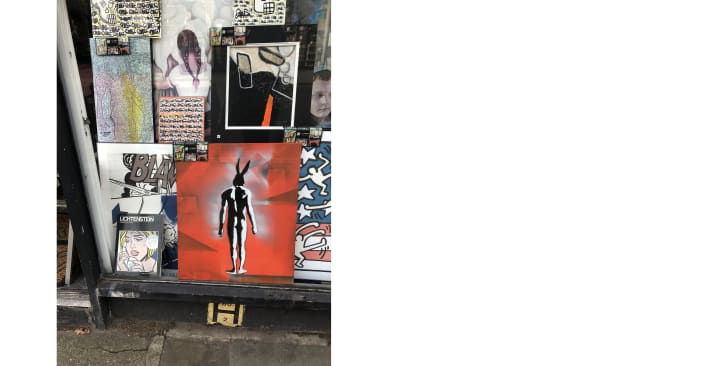
And the rest of the story? Oh yeah, when I tried to crop the photo down to just the book I found that I quite liked some of the other details. There is the art book propped up in a shop window but it's not a book shop. The shop, which is apparently closing down, sells framed and unframed pictures and posters. The one behind the book and the one to the side portray graphic images that seem to fit in well with the Lichtenstein book.
The fabric of the shop building is pretty run down, consistent with the area which is in the Crystal Palace district of South London. So called, because the Crystal Palace constructed to house the Great Exhibition in 1851 was moved there as its permanent home in 1854. It was destroyed by fire in 1936, watched by hundreds of thousands of people, including my mother from her home some eight miles away. The yellow "H" sign, for those who do not recognise it, indicates that there is an underground fire hydrant nearby.
All of these features tell their own story. The seven word bubble speech is a story within a story, within a story, all telling an even bigger tale.
What stories can you see in this image? Can you imagine how the story depicted by Lichtenstein could develop?
Enter now: Oh Jeff Flash fiction $$$ prize challenge
About the Creator
Raymond G. Taylor
Author living in Kent, England. Writer of short stories and poems in a wide range of genres, forms and styles. A non-fiction writer for 40+ years. Subjects include art, history, science, business, law, and the human condition.
Keep reading
More stories from Raymond G. Taylor and writers in Writers and other communities.
How to see 25 years into the future
Imagine what life will be like in the year 2050. Hard, isn't it? New technologies will emerge, new forms of entertainment, political dynamics will have changed. There may be countries that exist in 25 years that do not exist now, there is highly likely to be fundamental political change in some countries and, sadly, there will be many wars.
By Raymond G. Taylorabout a year ago in Writers
Boundless
A geographical map could take you there. To the places I've been, to the sights I've seen, to the landscapes I've climbed. But no compass could point you in the direction of my memories. To the experiences I've lived, to the happiness I've felt, to the wonder I've held so close to my heart.
By Alyssa Musso6 days ago in Writers
Belle of the Bayou
Bad move, cher. Not just the slip of her kitten heel on the rainy February cobblestones in the Fourth Ward. She got caught snooping. Detective Deleon clucked and strutted like a rooster in his rush to clear her from the scene, waving cigar smoke to and fro as he gesticulated amid the thick air of the speak easy. An experienced crime reporter, Marie knew better than to let the coppers catch her on the wrong side of the line, but curiosity had gotten the better of her.
By Maia Gadwall the metAlchemist6 days ago in Fiction

Comments (7)
A fascinating read... including the details of the art sale & surrounding area. ✅
❤️❤️❤️❤️
"but I don't want to marry you." Now that is sooooo me hahahahahaha. Looking forward to that challenge!
Brevity is the soul of wit…. Looking forward to hearing more Ray!
those "buts" always get in the way.... Seriously, though brevity is an art form. Emily Dickinson is one of my favorites in that area. Thanks for illuminating the concept and tempting us all to try harder not be Faulkners or Steinbecks.
What a great idea. I think I do pretty good with my drabbles if you wanted to read any of them and share what you think. Great article.
I feel that she’s gonna dump Jeff too, she’s concerned, she loves him, but there’s something that tells her she can’t go on with him. I would love to write more micro fiction under 100 words, it’s not easy. Thank you for reminding me to put myself through this challenge.