
How to see 25 years into the future
Vocal Future Fragments 2050 challenge top tips


Imagine what life will be like in the year 2050. Hard, isn't it? New technologies will emerge, new forms of entertainment, political dynamics will have changed. There may be countries that exist in 25 years that do not exist now, there is highly likely to be fundamental political change in some countries and, sadly, there will be many wars.
On a happier note, there will almost certainly be some new forms of entertainment that will grip audiences like never before.
How can we imagine what these changes might be? It's not about predicting the future so much as imagining some of the possibilities for the world in 2050, and then painting a convincing picture. Just like any fiction, it only needs a kernel of truth or fact to make it believable.
Where to begin, then? Well, if you want to know the future, you Surely have to look at the past, if only to understand how changes take place. Starting with technology, where were we 25 years ago, at the turn of the 20th century and the 2rd millennium?
In 1999 there was, for instance, a lot of concern about the "millennium bug." This came about as a result of early computer designers, in the 1960s and 70s, using two digit numbers to represent date years, so that "77" meant 1977. Nobody thought about what needed to happen decades later when December 31 1999 became January 1 2000. Those computer boffins were worried that their machines would find themselves recording the date on new year's day as January 1 1900, resulting in some hard-to-believe disasters, not least of which were aircraft falling from the skies, elevators grinding to a halt, and financial and telecommunications systems just shutting down. Billions of dollars were spent making sure the systems could cope and, in the end, the impending disaster (if it was ever going to happen) was averted.
Cell phones, as they were then known, were used by maybe half the populations of most tech-enabled nations. These days, the figure is over 95% phone users. The phones then were fairly bulky and had tiny, text-only, screens. This gave rise to the present popularity of the emoticon, which were coded into simple text characters such as ":" and ")" joined together to make the smiley face :)
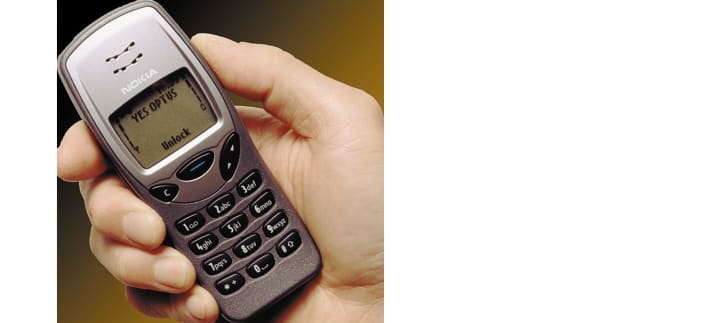
Other than voice calls and text messaging, sometimes crude digital cameras, cell phones had few additional uses or apps and there were no social media of the kind that are popular today.
Airlines and other service businesses relied on paper tickets and telephone booking systems. In order to get any business done, you had to communicate verbally. Other than text messaging on your cell phone, you might use email to communicate with another person. There were far fewer TV channels and no live streaming of music and video of the kind we take for granted today.
Although many businesses and governments used the World Wide Web to provide information and there were large-scale online transaction systems in place, shopping online was still in its infancy and was dominated by the likes of Amazon. Before 1999, the online retailer only sold books. Not all consumers were happy to buy remotely, particularly high-value items.
In entertainment, perhaps the biggest innovation was the coming of reality TV, with series like Big Brother. Streaming services have, since then, allowed so many long-running reality and other drama series to thrive with popular support.
Politically, it was only ten years after the fall of the Berlin Wall and the end of communism in Russia and eastern Europe. Regional conflicts were starting to break out in former communist state Yugoslavia, among other places in the world. This would lead to many new states being created in the Balkan regions, many more wars and minor armed conflicts, and a widescale deliberate genocidal slaughter of tens of thousands of people. There were likewise genocidal massacres in the African state of Rwanda.
42nd President of the USA Bill Clinton was coming to the end of his term of office, having survived impeachment proceedings for "high crimes and misdemeanours." In 1997, Honk Kong ceased to be a British colony and reverted to China after 150 years. On January 1, the European Central Bank introduced the Euro currency for all European Union member states except the United Kingdom, which retained the pound sterling. The UK has since withdrawn from the EU completely.
In 2014, 55% of people in Scotland voted "No" to the referendum question "Should Scotland be an independent country?" What would have happened in the last 10 years had they voted "Yes"? What if a 2030 referendum took place and the vote was "Yes"? Where would Scotland be in 2050?
So what about the future?
Well, if you what to know what is going to happen, consider developments between 1999 and 2024. A good place to start is the science and technology media.
Take a look at Scientific American and/or New Scientist, a UK science weekly. Buy a copy off the bookshelves (or just read snippets online) and read all about the latest developments in genetic and other biotechnology, artificial intelligence, space travel and anything else that comes up. The kind of thing that is being discussed in these journals today, will be the kind of thing that could make an appearance for real in 10 or 20 years time.
Future Fragments challenge: Imagine the world in 2050 and create a story that explores hope, innovation, or the unexpected future.
Think about the possibilities. What if some of these new technologies become realities? Will it be good, will it be bad? How bad? Horror bad? Or just nuisance bad? Convenient good or save-the-world good? One of the frustrating things about so called 'artificial intelligence' is that there has been so much negative comment from writers while few have grasped the possibilities for their own creative writing. Few writers who are critics of AI have used their imagination to create a fictional story based on AI developments. AI is a gift to the future fiction writer.

200 years ago Mary Shelley (then Mary Wollstonecraft-Godwin, pictured above), a 16 year old girl who had just run off on a sexual adventure with a poet, wrote the epoch-making AI story Frankenstein. She was no doubt aware of advances in technology like steam engines and water-powered fabrication, bringing her world into the modern world. She didn't write a boring essay about all the bad things these technologies were about to bring forth (Many of her contemporaries did, and have since been forgotten). She didn't pontificate about smoky factory chimneys or destruction of green spaces, she imaged what would happen if an inventive mind created something truly ghastly. Mary Shelley is the godmother of all modern science fiction. Who will take her place in the 21st century?
Will you write the new Frankenstein?
Of course future fiction does not have to be a doomsday scenario. What happens in your story might occur on a small scale. Even big stories are often best told at the personal level.
One way to develop ideas for future fiction is to imagine what would happen if current new medical, scientific or technology research were to follow its logical conclusion. It might be something mundane like driverless cars, it could be the start of a space colony on the Moon or Mars, or it could be artificial intelligence being taken a step too far, perhaps.
You could try using one of the story writer's best tools, the 'what if'.
- What if, in the newly-created moon base, a scientist is murdered?
- What if an artificial intelligence financial system decided to steal every customer's money?
- What if a driverless car kidnapped a passenger and demanded a ransom?
- What if a reality TV series based on a space ship taking the first settlers to a new colony on the Moon or Mars were to witness the unexplained death of each colonist, one by one?
- What if a real person found themselves trapped inside an imaginary world created by AI for an entertainment series (not unlike Netflix: Joan is Awful)?
These kind of questions can help to build possible story lines. It may be that the first one or two you come up with turn out to be daft ideas that you cannot develop. In which case draw up a list of possibilities, noodle each one around a little and then develop the one you like the most. It doesn't have to be limited to science and technology, of course. It doesn't have to be serious, either. Think Space Force or Futurama.
Or... what if a US President found a way of postponing an election for the next president (thus playing on current political fears among some voters)? What if a billionaire technology innovator decided to take over a whole country in order to further their business aims (ditto)? What if there was a civil war (or threat of one) between certain Northern and Southern states of the USA? If so, what would the points of contention be? What if a hacker found a way to take control of an entire country or any one of its institutions like health, defense, or just refuse collection (possible comedic value here)? What if someone found a solution to climate change and it was quick, simple and only cost a few million dollars to implement?
I use the term 'future fiction' because 'science fiction' sounds so dull
The thing about future fiction is that the possibilities are endless. They are only limited by your imagination. If you still can't think of anything, try getting a large piece of paper and scribbling down some random thoughts. Look to current events to give an idea of how things might develop. Cross out those ideas that just don't work and then think about some of the others.
If you do these things you are pretty much guaranteed to come up with at lease one good idea for a challenge entry.
Having failed to come up with a story idea for this challenge so for, I wrote this article to help get my own creative juices flowing. I hope there is something in it to help you too.
How will you imagine the year 2050?
Have fun with this challenge and please let us know how you are getting on.
About the Creator
Raymond G. Taylor
Author living in Kent, England. Writer of short stories and poems in a wide range of genres, forms and styles. A non-fiction writer for 40+ years. Subjects include art, history, science, business, law, and the human condition.
Keep reading
More stories from Raymond G. Taylor and writers in Writers and other communities.
Order of the British Emp*!*
News has emerged about a possible change of name for appointments made under the Order of the British Empire honours system. OBEs are awarded by the King on the advice of certain important persons, such as the Prime Minister, and managed by various awards committees.
By Raymond G. Taylorabout a year ago in Writers
Unofficial Challenge: Black History Celebration
Forward: February 28th, 10:53 PM, EST... The final hour of Black History Month, 2026. Hello fellow writers. I've had this challenge waiting in my drafts for most of the month. But I held off on publishing it, until now.
By Sam Spinelli5 days ago in Writers
Understanding the Engineering Excellence Behind Aerospace Component Manufacturing
The aerospace industry represents one of the most technically demanding sectors in the world. Every aircraft, satellite, and defense system relies on highly engineered components designed to operate under extreme pressure, temperature variations, vibration, and aerodynamic stress. Understanding the engineering excellence behind aerospace component manufacturing provides insight into how safety, performance, and reliability are consistently achieved.
By Beckett Dowhan4 days ago in Writers
Review of 'Man on the Run'
My wife and I saw Man on the Run, a nearly 2-hour documentary on Amazon Prime, about Wings, Paul McCartney's group that flew around the world from shortly after The Beatles broke up in early 1970 to shortly after John Lennon was murdered at the end of 1980, making a Beatles reunion forever impossible.
By Paul Levinson5 days ago in Beat



Comments (2)
Great idea. In the year 2050 I will be 85 years old if I figured right, and I think I have an idea.
Maybe unrelated but I'll only be impressed with technology if it produces food from nothing hehehe