
Market Syndicates, Government Power: And Then People
People are the economy


One must have an understanding of the times in order to live life in its context. It’s essential to prioritize values and practices that align with the current reality of life. Positive attitudes, supportive groups, and favorable environments can all contribute to promising outcomes in this regard. When life improves, the nation prospers. As a result, if the government does not adopt the idea that "people are the economy," there will be a gap between the rulers and the ruled, which will eventually impede the development of the nation. Therefore, uplifting morale, improving living standards, and acknowledging current realities are vital responsibilities shared by people from all walks of life. Both the government and its citizens must take responsibility in order to escape instability and foster a just and well-governed society. It is not only political parties that align themselves with fascist tendencies; powerful market syndicates often play a more active role. To retain power, governments often allow them unchecked freedom. Both sides are able to pursue control and self-interest through this reciprocal dependence, which causes the country to become disorderly. The general public is reduced to nothing more than pawns in this power play. Caught in the crossfire of exploitation, they are forced to struggle endlessly.
A country can only be said to be truly well-off when its citizens can afford essential goods within their means. Even after a fascist regime is removed, the arrogance of syndicate-backed businesses often remains intact. From economic instability to societal disruption, the government must respond appropriately in each situation. In our context, politeness is often mistaken for weakness—so applying the principle that "even spirits flee at the tip of a stick" may be both necessary and timely.
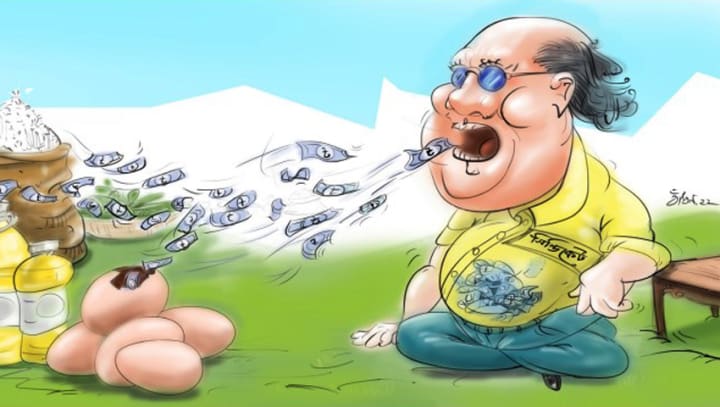
The cost is now beyond what can be afforded, and it's unbearable. If those who aim to benefit from people's misery while pretending to be angels of change are not countered, then peace will drift further out of reach. History has shown that the public voice always emerges—especially when driven by hunger. Therefore, meaningful reform is urgently needed by all responsible parties before the call to revolution becomes inevitable.
Without genuine structural reform, public suffering and democratic decay will only worsen. The government must take an active and transparent role—especially in regulating the market and securing people's trust—to prevent a repeat of historic uprisings. Both state actors and business elites must reflect on the lessons of past revolts and remember: those who ignore the people's voice risk losing everything, as seen in the downfall of autocratic regimes.
No matter what strategies are employed, if market control remains elusive, then the people’s hungry bellies will continue marching toward revolution. As history has proven, when backed into a corner, people will fight back. They did it before, and they can do it again. So now is the time to unite—control the market, restore order, and create a truly democratic and harmonious society.
Because when “the stomach is calm, the world is calm.”

In the current global landscape, economic security and social stability largely depend on transparent markets and a government’s active role in protecting public interest. The sudden and frequent rise in commodity prices in Bangladesh is a clear sign that an unregulated market syndicate has developed into a largely unseen but highly influential force. In addition to controlling product demand, these organizations test the public's endurance. This unchecked price escalation primarily affects the lower- and middle-income populations, who, at the end of each day, seek nothing more than the assurance of food on their tables. Unfortunately, even this basic right is increasingly under threat. On one hand, there is manipulation by unethical traders; on the other, administrative inaction. They create an atmosphere of fragile trust in the system when they work together. A transparent, technology-driven market monitoring system, genuine political commitment, and widespread public awareness are all necessary for the nation to overcome this growing crisis. Only through the restoration of mutual trust between the government and its citizens can meaningful and sustainable solutions be found.
The foundation of a developed and fair society lies in ensuring equal access to opportunities and resources for all. When people are unable to afford essential goods, the result isn’t just economic hardship—it’s social unrest. As a result, strong, inclusive governance and public engagement are not optional but urgent requirements.
.
Written by
Bokul Ahmed
25 November 2024
About the Creator
Bokul Ahmed
Me Bokul Ahmed. Post Graduate in Political Science. My passion is song writing, poetry writing, story writing, script writing and Article writing also Data Entry Expert for creativity and digital proficiency.
Keep reading
More stories from Bokul Ahmed and writers in Writers and other communities.
International May Day: Honoring the Hands that Build the World
Every year on May 1st, countries across the globe observe International Workers’ Day, also known as May Day. While for many it’s a welcome day off, the date actually marks a profound history rooted in sacrifice, protest, and the long-standing struggle for workers’ rights.
By Bokul Ahmed9 months ago in History
CRIMSON
My hands are stained and trembling with a clear, crimson red. A rich and ugly sight to behold, I wonder who is dead. Who’s blood do I have smeared all over me? I don’t think to wash it off, it’s almost exposure therapy, to see how long I could last, evidence, for all to see, show them I am a bad person, so I can be free.
By Liberty Page6 days ago in Writers


Comments
There are no comments for this story
Be the first to respond and start the conversation.