
“Islam and Democracy: Conflict, Coexistence, or Alternative?”
“ইসলাম ও গণতন্ত্র: দ্বন্দ্ব, সহাবস্থান না বিকল্প?”

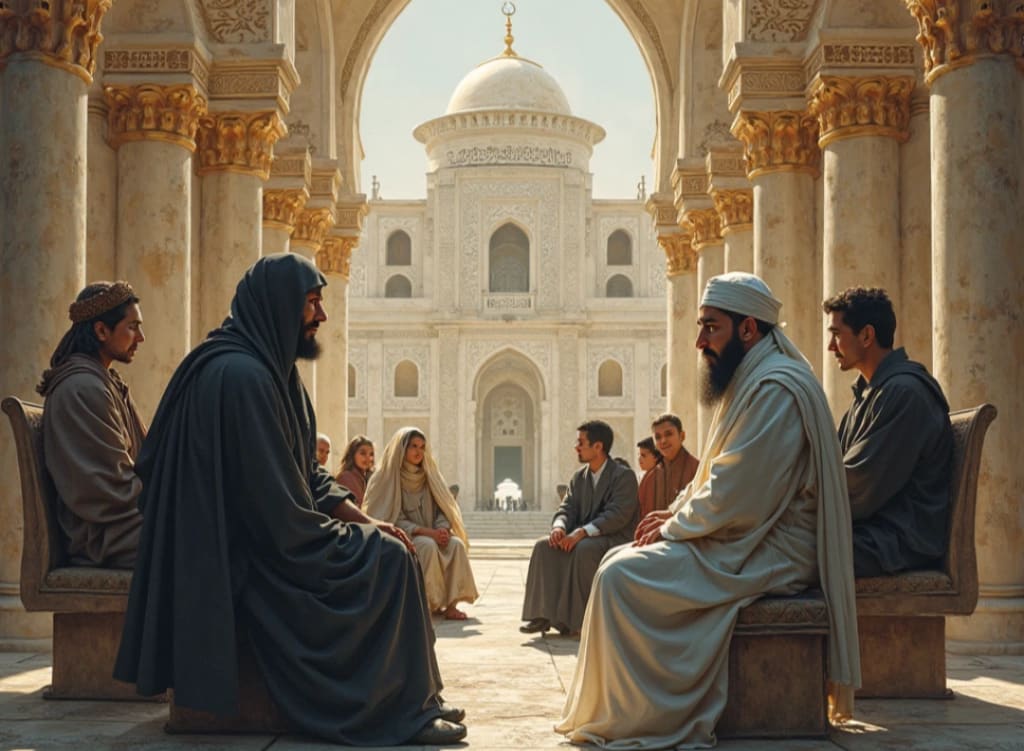
“Islam and Democracy: Conflict, Coexistence or Alternative?”
A profound question returns again and again in the court of history today—Can Islam coexist with democracy? Or is Islam itself a complete system of government that is an alternative to democracy? The Western world uses this question to establish a ‘political exception’ against Islam. But even in the Muslim world, many thinkers and intellectuals are divided on this question—for some, democracy and Islam are complementary, while for others, they are opposed to each other. In today’s discussion, we will go to the root of this debate—in the context of history, ideology, structure, and reality.
First, we need to know what the word “democracy” means. Democracy is a system of government in which the source of power is the people, they elect representatives, enact laws based on majority opinion, and determine state policies in the light of human reason and social contract. It is originally a product of Greek philosophy, and has taken its modern form through the European Renaissance and Enlightenment. Its main basis is man-made law, majority rule, and secularism.
On the other hand, Islam is a system of government where the supreme authority is Allah. Man does not make laws; rather, he governs according to the laws given by Allah. Sharia means divine law, which is based on justice, mercy, and morality. Islam has a system of ‘shura’ or consultation, but it does not override Allah’s law. Therefore, in an Islamic state, although the opinion of the people is important, it is not final; the final is the guidance of the Quran and Sunnah.
At this point, the contradiction becomes clear. Democracy claims that people can make laws, and even decide which morality to accept or reject by majority vote. But in Islam, this power is not in the hands of people. Allah’s law is immutable. Consequently, if same-sex marriage is legal in a democratic state by majority vote, then it is completely forbidden from the Islamic point of view—even if public opinion supports it. Here lies the first and most fundamental contradiction.
However, many Muslim thinkers—such as Rashid Rida, Abul Ala Maududi, Yusuf al-Qaradawi, and others—have tried to bring democracy and Islam closer together. They say that Islam's 'shura' system believes in representative elections, just like democracy, and that the Muslim consultative system is largely consistent with democratic thought. However, they also say that this shura cannot go beyond the boundaries of the Quran. This means that the structure of democracy may be Islamic, but its spirit will remain bound by the laws of Allah.
But the question is—how is democracy working in today's world? Democracy in the Western world has become a sham in many respects. Powerful lobbies, the influence of the media, and the pressure of the corporate economy—as a result of all this, the people's vote often becomes a tool for a specific agenda. In a so-called democratic country like America, no one can make truly pro-people decisions outside the military industry or the pro-Israel lobby. So is democracy really the rule of the people, or is it a disguise for the powerful?
Democracy in the Muslim world is often a tragedy. While Islamic parties gain popularity through democratic processes, the results are never acceptable if they go against Western interests. Examples include the Ikhwan in Egypt, Hamas in Palestine, and the Islamic Salvation Front in Algeria. It has been seen every time—even after winning elections and coming to power, they are overthrown, sometimes in military coups, sometimes on charges of terrorism. In other words, the definition of Western democracy—you can win the vote, as long as you establish Islam!
The real question here is—isn’t Islam itself an alternative system of governance? History shows that the Islamic state system was transparent, just, and driven by faith and morality among the people. The rulers of the Caliphate stood in court like ordinary citizens, administering not from public buildings but from mosques. When Hazrat Omar (RA) was the ruler, even a Jewish citizen received justice from Islamic justice. Is this possible in today’s so-called democracy?
That is, Islam is not a democracy, but a different concept of governance—which is based on Shura, Justice, Taqwa, Ummah, and the Law of Allah. It is not a paper freedom like modern democracy; it is a complete exercise of moral responsibility. Here the people are not kings; rather, they are trustees. Here the leader is not authoritarian; rather, he is accountable.
So it can be said—there is a fundamental ideological difference between Islam and democracy. In an Islamic state, the people are important, but the ultimate authority is Allah. In a democracy, law is man-made, while in Islam, law is Allah-given. It would be wrong to call each other complementary; rather, Islam itself is a complete, pure, and just alternative system—which is superior to democracy.
About the Creator
Keep reading
More stories from Abdul Barik and writers in Writers and other communities.
European colonialism and the beginning of Western domination in the Muslim world: a silent war of conquest
There is a chapter in history where, not with the blood of the sword, but under the guise of agreements, trade, education and culture, a terrible war of conquest is going on. The name of this war is colonialism. And the most silent victim of this war was the Muslim world. When Europe began to dominate the economy, technology and trade through the Industrial Revolution, the Muslim world gradually lost its political unity, weakened its military power, and most terribly, began to be defeated psychologically. This discussion is a picture of that long, suffocating history.
By Abdul Barik9 months ago in Writers
How to Hire a Virtual Assistant for Personal Organisation and Scheduling
If your calendar feels like a battlefield back-to-back meetings, personal errands, rescheduling, missed reminders you’re not alone. In 2025–2026, more professionals and founders are hiring a virtual assistant (VA) not for “extra help,” but to build a system that keeps life and work running smoothly.
By Michael Coplin6 days ago in Writers



Comments
There are no comments for this story
Be the first to respond and start the conversation.