
India-Pakistan Tensions Escalate: Military Strikes, Strategic Risks, and Global Ramifications
Operation Sindoor stokes a regional crisis amid concerns about nuclear weapons and uncertainty about the global economy.
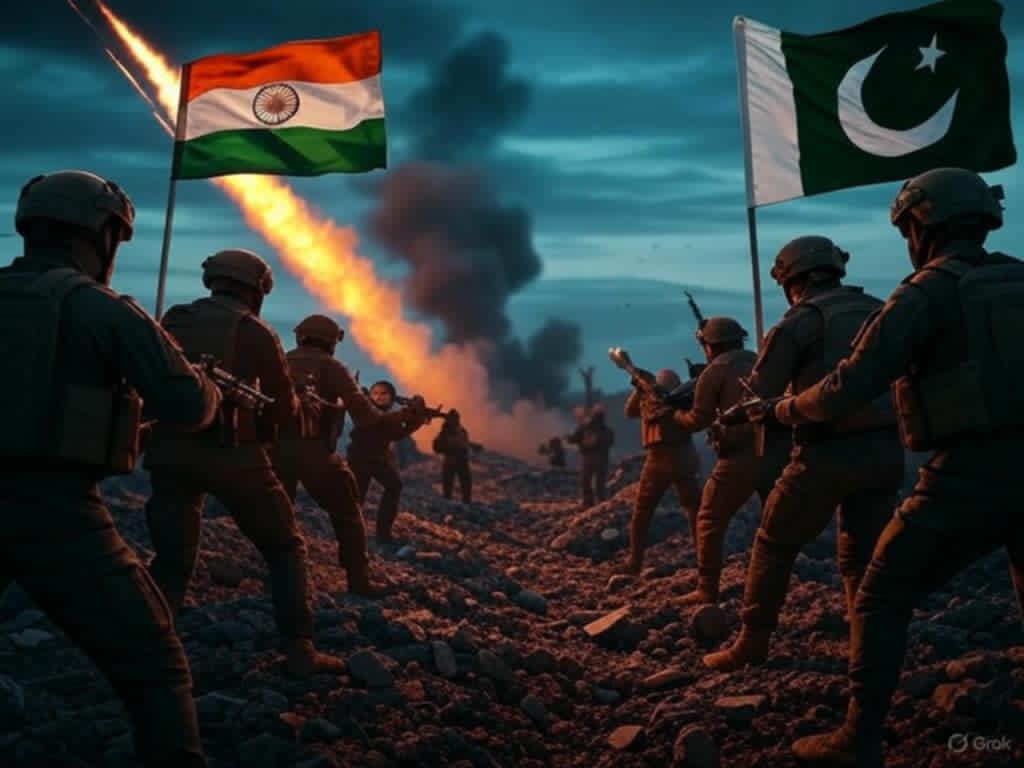
I. The Situation: An Upcoming Border Conflict In the early hours of May 6, India launched Operation Sindoor, a coordinated military campaign against nine locations in Pakistan and Pakistan-administered Kashmir. Indian officials stated the operation aimed to destroy infrastructure belonging to militant outfits Jaish-e-Mohammed (JeM) and Lashkar-e-Taiba (LeT), allegedly responsible for recent attacks in Jammu and Kashmir.
Pakistan's claim that it had shot down five Indian fighter jets and captured personnel and called the strike an "act of war" was India's swift denial. The region is at a crossroads with cross-border shelling, increased military presence, and heightened diplomatic rhetoric. II. Strategic Risks and Escalation Pathways
Full-Scale War
As military postures become more rigid, South Asia is facing its greatest security crisis in decades. A full-scale war is still a real possibility if either side crosses perceived red lines. Tensions last reached this level during the standoff in 2001–2002. Analysts warn that this time around, escalation could be faster and more dangerous due to the speed of modern warfare and the absence of sustained backchannel communication. Nuclear Brinkmanship
India and Pakistan both maintain nuclear arsenals, with differing doctrines — Pakistan's first-use policy and India’s no-first-use stance — though strategic ambiguity persists. With heightened troop movements and warplanes on alert, the margin for misjudgment is dangerously thin. Even a tactical nuclear exchange would have devastating regional and global repercussions, potentially disrupting the global economy and setting a perilous precedent.
The Kashmir Flashpoint
Kashmir remains the heart of the dispute. Local alienation is likely to deepen as a result of the latest strikes, potentially fueling militant recruitment and unrest. Human rights groups report communication blackouts and displacement in several areas, intensifying global concern over the humanitarian situation in the valley.
III. Pakistan’s Likely Responses
Pakistan’s response strategy blends diplomatic, military, and symbolic measures to counter India while avoiding full-scale escalation.
Political Pressure Pakistan rapidly moved to internationalize the crisis, appealing to the UN Security Council and engaging allies such as China, Turkey, and members of the OIC. While some countries expressed concern, most global powers — including the U.S. and the European Union — have so far maintained cautious neutrality, urging restraint but avoiding direct involvement.
Calibrated Military Response
Pakistan’s military remains on high alert. It is still possible to launch limited retaliatory strikes, such as artillery exchanges, cross-border commando operations, or cyber intrusions. These moves aim to serve as deterrents while stopping short of open war, though they carry the risk of rapid escalation if misread.
Water Politics
Reports suggest India has used the Indus Waters Treaty (IWT) to limit Chenab River flows in a calculated move. Pakistan views any tampering with water as a direct threat. Islamabad's response could open a new front in the resource control conflict by mobilizing legal mechanisms and contacting international environmental and human rights bodies. IV. Global Economic Ramifications
Shipping and energy disruption Major maritime trade routes pass close to the Indian subcontinent. As tensions mount, oil prices have surged, and global markets are jittery about supply chain security — especially for routes linking the Middle East to East and Southeast Asia. Any escalation that threatens chokepoints like the Strait of Hormuz or slows down cargo traffic in the Arabian Sea could trigger a broader energy crisis.
Market and Investment Shockwaves
Stock markets in Mumbai and Karachi dropped sharply following Operation Sindoor. As investors reevaluate regional risk, portfolio inflows and foreign direct investment (FDI) may decrease. This poses a particularly acute challenge for Pakistan, already grappling with economic instability, high inflation, and dependence on an IMF loan program.
Humanitarian Fallout
Humanitarian organizations warn that hundreds of thousands of civilians near the Line of Control could be displaced. In Azad Kashmir and northern India, preparations are being made for relief camps. A prolonged conflict could overwhelm national and international aid systems, already under strain from crises in Gaza, Sudan, and Ukraine.
V. Regional and International Responses
Major Powers and the United Nations
The UN Secretary-General has urged both nations to prioritize dialogue. Due to geopolitical calculations, however, such as India's growing influence in the Global South and its ties to Washington, open condemnation is unlikely. China has called for moderation but avoided direct criticism of India. It is balancing strategic interests: strong economic ties with India and a close defense relationship with Pakistan.
The United States is concerned about escalation but is unlikely to intervene directly unless its core interests — like maritime freedom or nuclear security — are threatened.
Gulf and Asian Responses
Saudi Arabia, the UAE, and Qatar, all key members of the Gulf Cooperation Council (GCC), are deeply concerned about the impact on oil exports and their expatriate labor populations. While publicly calling for calm, they are reportedly pursuing quiet diplomacy to ease tensions.
Southeast Asian countries such as Singapore and Malaysia, heavily reliant on maritime trade, are closely watching developments and have emphasized the need for peace without taking sides.
VI. Potential Scenarios
Escalation Followed by Diplomacy
A likely near-term outcome is limited escalation, followed by external diplomatic pressure prompting a cooling-off period. Backchannels may be used by both sides to engage, possibly through neutral states like Switzerland or the United Arab Emirates, while making symbolic military gestures to show their resolve. Prolonged Standoff
Alternatively, both sides may enter a prolonged military standoff absent a decisive conflict, marked by sporadic skirmishes and heated rhetoric. This scenario would drain economic resources and perpetuate instability in border communities.
Revitalized Peace Initiatives (Low Probability) While improbable in the immediate future, the crisis could revive calls for a new peace framework — including talks on Kashmir, cross-border trade, and military deconfliction mechanisms. However, significant progress would necessitate diplomatic concessions, domestic consensus, and a strong political will, all of which currently appear out of reach. VII. Why the World Must Pay Attention
The effects of a prolonged conflict between India and Pakistan go far beyond South Asia: Security around the world: Nuclear weapons make conventional warfare a real threat. Instability in the economy: A disruption to oil supplies and trade routes could have an effect on global markets. Humanitarian crises: A major conflict could spark a refugee crisis and overwhelm international aid efforts.
Geopolitical realignments: The conflict could reshape alliances in Asia and the Middle East if external powers are brought in. Conclusion: A Call for De-escalation and Diplomacy
One of the world's most dangerous flashpoints is the conflict that India and Pakistan are in right now. The scale of Operation Sindoor, combined with Pakistan’s intense diplomatic and military response, has brought the subcontinent perilously close to a major conflict.
De-escalation must be prioritized by the international community, which includes the United States, China, the United Nations, and key regional actors. Diplomatic channels must remain open, and both nations must restore military-to-military communication lines and reinforce existing ceasefire agreements to prevent further bloodshed.
Only through sustained dialogue, respect for humanitarian norms, and renewed political engagement can South Asia step back from the brink and chart a path toward long-term stability and peace.
About the Creator
Keep reading
More stories from writers in Writers and other communities.
Onyx Storm
Onyx Storm Chapter One: The Black Storm On a moonless night, the city of Azora was struck by a strange storm. It wasn’t ordinary wind, but a whirlwind of black onyx stones swirling in the sky, whispering ancient voices. People fled in terror, but Liara, the girl with silver eyes, felt the storm calling her by name.
By Alhouci boumizziabout 10 hours ago in Writers


Comments
There are no comments for this story
Be the first to respond and start the conversation.