
Imran Khan: From Cricket Legend to Political Icon
A Journey of Leadership, Resilience, and National Impact

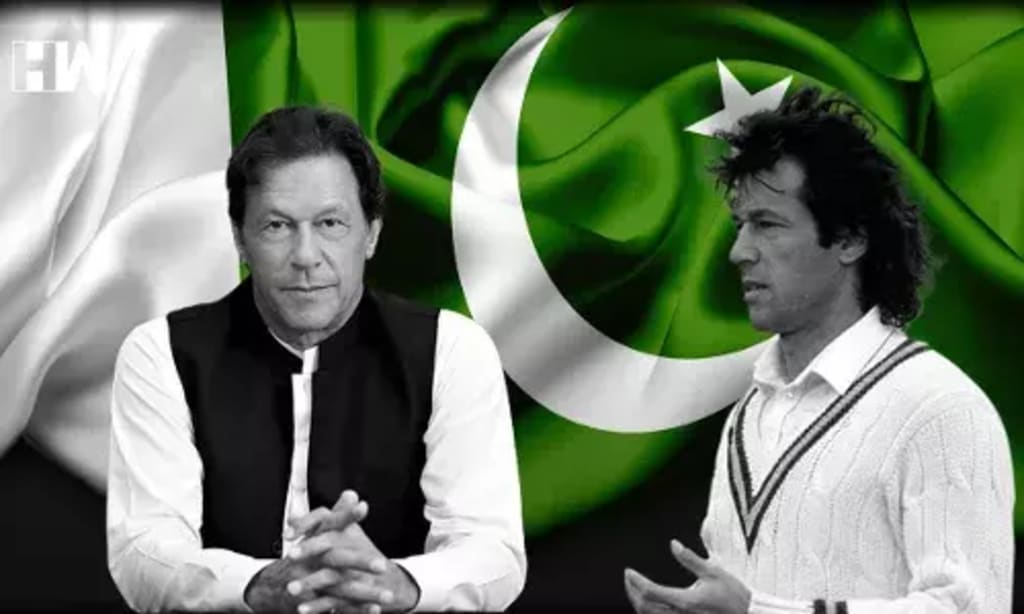
Imran Khan stands as one of the most dynamic and influential figures in Pakistan’s modern history. His journey from cricket stardom to political leadership is both inspiring and complex, marked by triumphs, controversies, and unwavering resilience. As a sportsman-turned-statesman, Khan has transformed public life in Pakistan and remains a central figure in the nation’s political discussion.
The Cricketing Legend
Imran Khan first rose to prominence as a world-class cricketer. Born on October 5, 1952, in Lahore, Pakistan, he attended prestigious institutions like Aitchison College and later the University of Oxford. His cricketing career began in the early 1970s, and he quickly established himself as one of the game's most formidable all-rounders.
Khan's crowning achievement came in 1992 when he led the Pakistan national team to its first and only Cricket World Cup victory. His leadership, charisma, and determination on the field made him a national hero and earned him international admiration. His famous rallying cry during the tournament, encouraging his team to fight like "cornered tigers," became symbolic of his approach to challenges both on and off the field.
Entry into Politics
After retiring from cricket in 1992, Imran Khan entered a new arena—politics. Driven by a desire to combat corruption and bring justice to the masses, he founded the Pakistan Tehreek-e-Insaf (PTI) party in 1996. In the beginning, PTI struggled to gain traction in Pakistan’s deeply entrenched political system. For over a decade, Khan remained on the political sidelines, often ridiculed and underestimated by his opponents.
However, his persistence paid off. Gradually, his message began to resonate, especially with the youth and urban middle class. By the 2013 general elections, PTI had emerged as a significant political force. In 2018, Imran Khan achieved a historic victory and was sworn in as the 22nd Prime Minister of Pakistan.
His Premiership and Political Impact
As Prime Minister, Khan promised a "Naya Pakistan" (New Pakistan), vowing to eliminate corruption, improve governance, and uplift the poor. His government focused on initiatives such as the Ehsaas Program for poverty alleviation, health cards for universal healthcare, and various housing schemes for the underprivileged.
Khan also attempted to reform foreign policy, balancing relations with China, the United States, and neighboring countries. His speeches at international forums, including the United Nations, were often applauded for their boldness and clarity, especially on issues like Islamophobia and the Kashmir conflict.
However, his tenure was not without challenges. Pakistan faced economic struggles, rising inflation, and growing dissatisfaction from political opponents and segments of the public. In April 2022, Khan was ousted from office through a no-confidence motion in the National Assembly—a dramatic chapter in Pakistan’s political history.
Imran Khan Today: A Symbol of Resistance
Since his removal, Imran Khan’s political journey has taken a turbulent turn. Facing multiple legal cases and mounting pressure from the establishment, Khan has continued to rally massive support across the country. He has survived an assassination attempt and continues to be a powerful voice against the status quo.
Despite being imprisoned in 2023 and barred from elections, Khan’s popularity remains strong. For many Pakistanis, especially the youth, he symbolizes hope, resistance, and the dream of a more just and transparent system. His political movement has evolved beyond traditional politics—becoming a struggle for civil rights, democracy, and national identity.
Conclusion
Imran Khan’s story is a rare blend of sportsmanship, idealism, and grit. From lifting the World Cup to lifting the spirits of a politically disillusioned nation, he has left an indelible mark on Pakistan’s history. While his political journey continues amid immense challenges, one thing is certain—Imran Khan is not just a cricketer or a politician; he is a symbol of change, courage, and unwavering belief in the power of the people. His legacy, still in the making, will be remembered as one of the most impactful in the region’s political and cultural narrative.
About the Creator
Keep reading
More stories from writers in Writers and other communities.
It's Winter
Anne Bernays and Pamela Painter — What If? Writing Exercise for Fiction Writers prompts The Exercise —Write a scene involving two characters. Have the point-of-view character presume something entirely different about the situation from what the other character's overt behavior seems to imply. For example, a landlord comes to visit, and the tenant suspects that it isn't a visit but an inspection. Make up several situations in which one character can fantasize or project or suspect or even fear what another character is thinking. The Objective - To show how your characters can use their imaginations to interpret the behavior and dialogue of other characters.
By Denise E Lindquistabout a month ago in Writers


Comments (1)
Good job really amazing story