
I Wrote the First Draft of My Historical Fiction Novel in 25 Days
And I have the screenshots to prove it.


My friends were not happy with me. It had been weeks and I had barely made an appearance for dinner, drinks, or anything else. I was fielding text messages multiple times in a day. "Where are you? What's going on?"
The truth? I'd been MIA because I'd been writing a novel.
For those who have climbed this mountain, you know what an impossible task this can be. Going from a blank page to "the end" is no small feat.
Writing a book can feel a lot medieval like battle at times. It starts with a brave charge into the unknown, you're filled with hope and pride in what you do. A few hours or days later, you sit weakly in front of a glowing scream. Your hands hurt. Your arms are screaming and the self-doubt is thundering in your brain.
For those who have written a novel, or tried to write a novel, it comes as no shock that only 30 out of 1000 people who start writing a book ever finish it. The process is not for the weak, and not for those who lack focus or conviction.
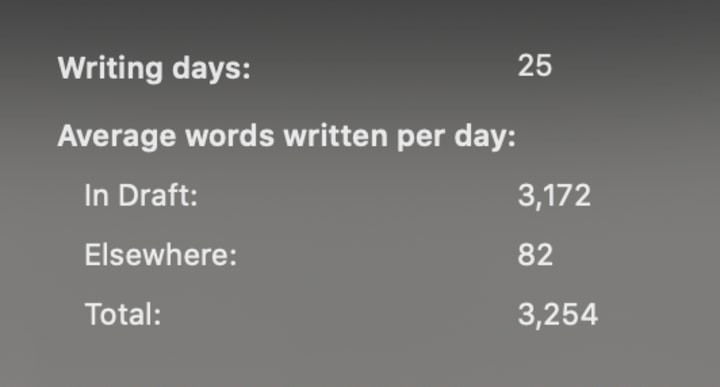
So imagine my surprise when, after only 25 days of writing, I finished the first draft of a historical fiction novel. What? It's true (see below). I went from concept to first draft in less than a month, and I did it all while juggling a full-time job and my side hustles as a writer and a content creator.
What happened? How did I do that? More importantly…can you? I believe you can, but you're going to need to get creative about your approach.
From Nothing to Novel in 25 Days: The Why
Before we get into the how you should probably understand the "why". That's because there will be people who have been groaning since seeing the title of this story. A novel in less than a month? That can't be right. Novels take time! Time = greatness! Right? Wrong.
Sure taking your time to write a "perfect" novel is a romantic idea, but it's unrealistic. First, who has that kind of time? Not the writers who want to make a career out of their passions. The industry moves fast and readers move faster. If you want to get your books out there, you have to write them at the right moment.
There are 3 major motivating factors behind writing your first draft as quickly as possible:
- Trends move fast: We live in a world where trends (and time) move fast. The concept you have for your book may be a fit for the market now, but not in a year or two. You need to work fast if you're serious about capitalizing on current trends.
- Feeding the monster: Sometimes, you can't help but take a while writing your book. These things do take time. The reality, though, is that the longer you take the more space you give self-doubt to trickle. You feed your imposter syndrome when you drag out the drive to finish.
- Getting on with it: Already have the idea for your next book? You need to see your first book through if you're serious about getting somewhere with your writing. Don't let yourself wander off into a dozen half-finished projects. Finish what you've started so you can get on with your life and your creative ideas.
Facts are the facts. The longer you draw out the writing of your first draft, the less likely you are to finish. Life gets in the way. Obligations pile up. Before you know it you have a dusty folder buried on your desktop filled with characters you barely remember and scenes you can't believe you wrote. Trends move on. The story may not even be viable anymore.
I realized that I was a writer falling into this loop. I dreamed of seeing my book on the shelf in Barnes and Noble and Waterstones, but there wasn't enough urgency. Realizing the above changed that and helped me get my first draft done in just 25 days.
That urgency may help you too. Get the story done. Get it down on that page all in one so that you can piece together the most cohesive version of the story that's building your head. Don't let yourself be fooled. Greatness in writing doesn't come on the back of a ten-year masterpiece. Do you want your book done? Get it done now so you can move forward.
From Nothing to Novel in 25 Days: The How
Let's get into the main event. The reason that you're here. How did I do it? How did I go from a blank page to a 300+ page first draft of a historical fiction novel? It normally takes people years to get to that point. Is it even possible to get the skeleton of your novel on the page in less than a month? Yes, and I've got the screenshots to prove it.
1. Working to an outline
If you're a panster, be prepared to be disappointed. It's hard, if not impossible, to complete an entire novel in any compressed amount of time if you're not working on an outline. They keep you on track.
An outline is like a map of your final destination. It shows you where you've started and keeps you focused on where you want to finish. Sure, there are lots of pitstops and coffee breaks along the way, but it helps you keep the boat going in the right direction while your story develops.
My novel is focused on 3 different points of view. For me to keep those characters moving forward, I had to make sure I had an outline of what they were doing, what their motivations were, and where they were ultimately going to end up. These outlines started as a couple of hand-written sketches before settling finally with something like this:

Having a digital outline allowed me to move swiftly between scenes and chapters. It allowed me to quickly crosscheck information and reference previous dramatics so that I could create cohesive storylines that maintained form across the narrative.
The outline details the overall story, as well as the individual scenes that are split between individual characters. Each subsection lays out the action, the setting, related characters, and section notes that relate to previous scenes or to research and action in the related scene.
2. Drafting the first scenes
The usual column of writing advice encourages writers to get into character or world design after an initial outline. It's the best way to get into the flow of the story, we're told. That's not the case for me. In my process, I get my hands dirty right away.
As I'm developing the story outline, dramatic scenes start to bloom for me. I see the characters making choices, creating alliances, establishing momentum, fighting for their dreams, all of it. Pieces of the story play in my head like a movie. I use the moment to capture those images like lightning in a bottle.

Before I get deep into figuring out who my characters are, I draft a couple of the most powerful scenes in my mind's eye. These can include descriptions of important places, moments of awe, conflict, resolution, and moments of hopes and dreams.
By hacking into the dramatics of these scenes, the psychology of the characters I'm working with is revealed. I start to see more of their motivations, what they want, and what they fear, when I draft these early moments of dialogue or import. Do I have to go back and change them? Sure, but that's what editing is.
I like to get a peek beneath the hood of my characters before I try and presume to write backstories on them.
3. Sketching characters
If you think I forgo character sketching in totality, you're wrong. Character sketches are deadly important to anyone writing a novel. Especially if you think you're going to go from concept to first draft in less than a month.
A character sketch helps you to see the humanity of your characters more fully. You see them as they are and can paint a more realistic and relatable picture of them for your readers.
Once I've completed an outline and have drafted a couple of scenes, I sit down to take a deeper look at the people I'm working with. All of my character sketches include:
- Name and age
- Where they live
- Role in the story
- Related occupations
- Habits and mannerisms
- Personality traits
- Background or history
- External conflicts
- Internal Conflicts
After I've drafted the dialogue for a couple of rough scene ideas, I'm able to breathe life into my characters in a quicker, more realistic way. I've popped into the story and seen their psychology. I've gotten a sense of what's under their skin and can see more of their personality, hangups, habits, and mannerisms.
I'll also sketch or generate images of the characters that I can use throughout the manuscript for inspiration (never for cover art or promotion). It's amazing how the story changes when you can look your protagonists and your antagonists in the eye.
4. Making marks every day
Getting down to the meat-and-bones of my 25-day process, it's time to get real. This first draft didn't happen by accident or by itself. It didn't magically grow overnight because I planted an outline seed. I had to sit down at the computer every single day and write. Was every day a great day? No. But I made a mark on the page every day, like a mountain climber scaling to the top an inch at a time.
If you're serious about writing a book and getting it done, then you need to put something on the page every single day, even if it is absolute crap.
There were days I stayed up until 4 AM, writing after the house was asleep and well into my much-needed rest. I wrote during my lunch breaks. I wrote in bed. I wrote on the couch. I wrote in my office. I wrote on the floor. I wrote first thing in the morning while my dog wandered around bleary-eyed through the back garden.
To get this draft done in 25 days, I wrote during every spare second that I could. Some days looked like this:

Other days looked like this:

No matter what, though, I kept writing. I opened up the project every single day, and if I couldn't find the words to give my characters - I researched. I read other books. I kept moving the arrow forward in some small way. That's how I ended up with this:

A screenshot of my final word count tally for the first draft (6 Mar)That's what you have to do if you want to get that first draft done. Put something on the page every day. Stop making excuses and become one of the 30 people who have the power to see their vision to completion.
BONUS: Drawing a line in the sand
This last piece of advice is specifically for those who write historical fiction. It's not so much advice as it is a warning of sorts. A cautionary tale.
You see, the issue a lot of historical fiction writers have is details.
More often than not, historical fiction writers are people with a fanatical passion for the history they write about. Since childhood, many of them have been fascinated with the characters they bring back to life and the stories that surround them. They (like me) have spent decades researching, for love, the subjects they write about.
That comes at a cost…
There is a thing as too much detail, and when you cross that line in your historical fiction novels, you ruin your pacing and pull your readers out of the world you're building.
Take it from me. Six years ago, I wrote a novel about Anne Boleyn. The manuscript (after edits) came in at a whopping 145K words. It was too much. And though I got some positive feedback from several agents, they all ultimately said the same thing. Too much detail. It reads like a textbook.
If you're writing historical fiction, you have to draw the line in the detail and realism you're including in your story at some point. Balance is necessary. There is a thing as too much, and the more you lean into precise historical details the more you pull away from the fiction aspect of the project.
Don't go too far with research. Make sure you're not spending too much time making sure you have the "perfect" name for a person or a thing. All those things can be rewritten in edits. Don't go too deep with historical fiction because you get too tied up in the details and making sure you "get it right". That's not the point of a dramatized story. The emotion is. The humanity is. The theatrics of those important moments are the point.
---
Let's recap. You have an idea for a novel and you want to get it all down on the page. You're not looking forward to months and months of sitting in front of a blank page, though. You want to get it done now.
So, you sit down at the computer every day and you get something on the page - even if it stinks. You get an outline done, you get yourself emotionally invested in the characters by sketching out a couple of early scenes. You begin to see your story take shape in your head and spend time detailing your characters and making them more and more tangible every day.
If you can focus, if you can commit, then you can have a first draft in 25 days too. Nothing that I did is miraculous or special. I wasn't funded by a trust, and I didn't have any kind of magical support. I made it happen by sitting down and writing. I stopped making excuses and got out of my way, and you can too.
Only if you have the conviction of a good story. Only if you can overcome the fear of your imposter syndrome. Are you one of those 30 writers who make it across the finish line? Are you one of the 6 who sees their stories published and brought to life for all the world to see?
You'll never know until you write the story. Now is your moment to get started.
About the Creator
E.B. Johnson
I like to write about the things that interest me.
Keep reading
More stories from E.B. Johnson and writers in Writers and other communities.
Medium.com Has Failed Its Writers...It's New CEO Is At Probably Fault.
When I joined Medium in 2019, it was a lifechanging experience. I was about two years out from my mother's death and going through a sort of personal revolution. I was in therapy and looking for a way to use my experiences to help other people. As I hit publish on my first post, I didn't realize I was starting on a path that would lead to a full-time career and a personal brand.
By E.B. Johnson 2 years ago in Writers
The Role of Community Behaviour in Crypto Market Movements
Crypto markets are unpredictable, loud, and full of people convinced they have tomorrow figured out. Beginners often mistake chaos for meaning. But most of the time the noise is just that. The community behind a coin drives a huge amount of market motion. That means anyone trying to read prices without reading people is flying half blind.
By Abbasi Publisher6 days ago in Writers



Comments
There are no comments for this story
Be the first to respond and start the conversation.