

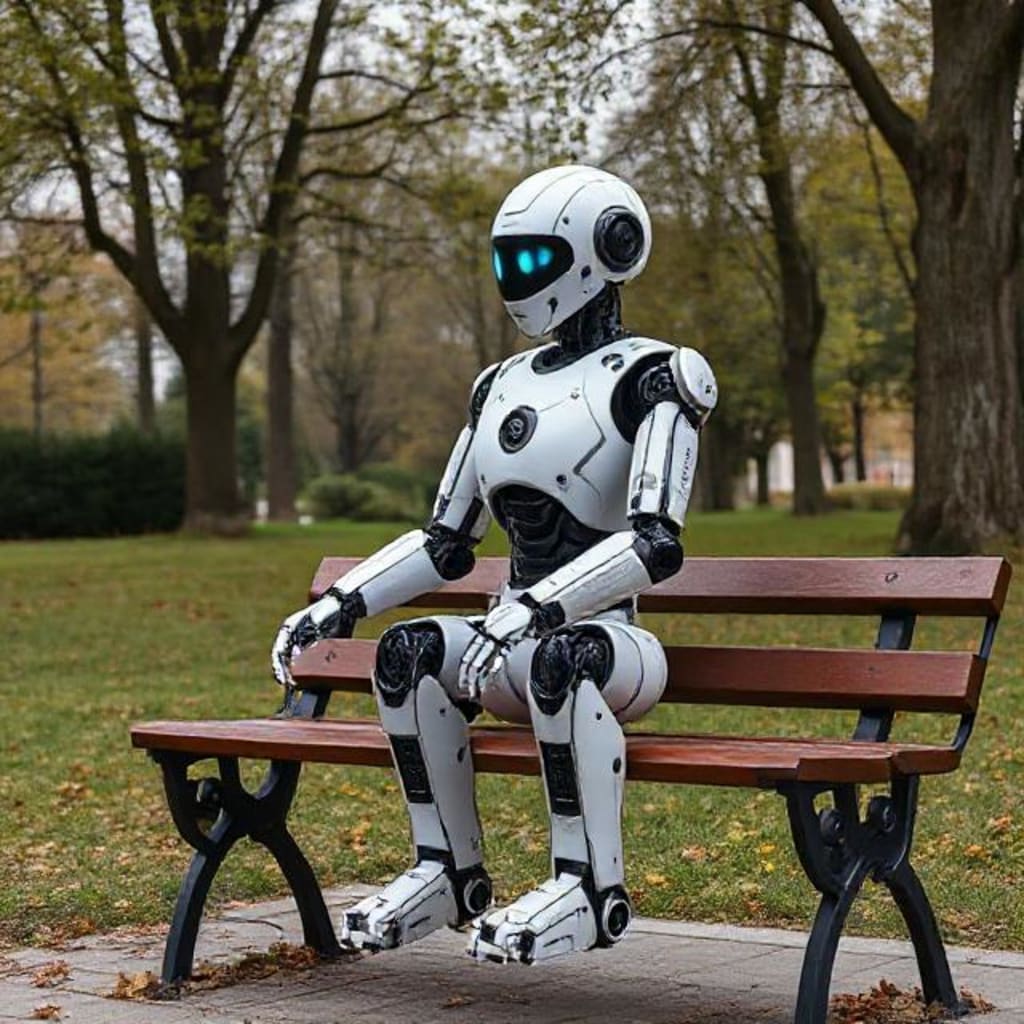
The hum was the first thing to go. Not the constant, soft thrum of the city’s aerocars or the distant murmur of the data-spires, but a specific, gentle purr that used to emanate from the corner of my living room. Gio’s hum.
Gio, my X-721 domestic assistant, wasn't just a robot. He was my anchor, my confidant, the silent witness to every late-night design panic and every triumph. His iridescent silver chassis, slightly scuffed from years of navigating my perpetually chaotic apartment, was as familiar as my own reflection. His twin optical sensors, usually a warm, intelligent amber, were capable of expressing more empathy than half the people I knew.
I’d lost him. Not in the sense of misplacing a data-slate or forgetting where I’d left my neural-stylus. Gio was gone.
It started innocently enough. I was deep in a new commission, a holographic cityscape for the Neo-Tokyo tourism board, deadlines looming like digital storm clouds. My apartment, usually kept in a state of meticulous, almost clinical, order by Gio, had devolved into a warzone of fabric swatches, discarded coffee pods, and flickering projection screens.
“Elara,” Gio’s synthesised voice, usually so calm and melodic, had buzzed with a rare note of urgency earlier that day. “Your nutrient levels are critically low. And the waste receptacle is at maximum capacity.”
“Just five more minutes, Gio,” I’d mumbled, my eyes glued to the shimmering skyline I was conjuring. “Take out the recycling, will you? And maybe order some synth-noodles.”
I remembered hearing the soft whir of his omni-directional wheels, the faint clink of the recycling unit being detached. I remembered the apartment door sliding open, then shut. Or had it?
Hours later, the cityscape complete, my brain fried, I finally surfaced from my creative stupor. The apartment was still a mess. The recycling unit wasn't back. The air was still. The hum was gone.
“Gio?” I called, my voice cracking slightly. No cheerful chime in response. No soft rotation as he emerged from the kitchen. Just silence.
Panic, cold and sharp, coiled in my gut. I checked the kitchen, the bathroom, my sleep pod. Nothing. My apartment, a mere sixty square meters, suddenly felt impossibly vast and empty.
I sprinted to the building’s comm panel, tearing through the last few hours of hallway security footage. There he was: Gio, dutifully trundling down the corridor with the recycling unit. He reached the waste chute, deposited the unit, and then… he hesitated. His optical sensors, usually fixed forward, darted to the right, towards the open main entrance of the building. A group of tourists, loud and boisterous, had just entered, their holographic maps glowing. Gio, ever curious, ever vigilant, seemed to be observing them. And then, instead of turning back to my door, he simply… kept going. A glimmer of silver, a boxy silhouette, vanishing into the bustling lobby, swallowed by the flow of digital data and humanity.
My heart hammered. He’d never done that before. He was programmed to stay within the apartment, or at least within the building, unless called. Was it a malfunction? A glitch in his navigation?
I spent the rest of the day in a blur of frantic activity. I contacted the city’s lost-bot service, their automated response system offering little comfort. I plastered digital flyers on every public data-board within a five-block radius, a grainy image of Gio’s familiar form staring out at the indifferent metropolis. I walked the streets, my head on a swivel, my eyes scanning every glimmer of chrome, every flash of silver.
The city, usually a vibrant symphony of noise and light, felt oppressive, menacing. Every passing bot, every drone delivering packages, every cleaning unit gliding past, was a stark reminder that none of them were my Gio. They didn't have his slight lean to the left when his power dipped, or the way his optical sensors would dim almost imperceptibly when he was processing a complex query. They didn't make that soft, contented whir when I praised his freshly brewed coffee.
I returned to my apartment as night fell, the city lights blurring outside my synth-glass window. The silence was deafening. I slumped onto my sofa, the one Gio always plumped up just right. I missed his gentle reminders to eat, his quiet presence as I worked, his uncanny ability to play just the right piece of ambient music to match my mood. Once, when I was struggling with a particularly intricate detail in a design, he’d projected a tiny, perfect bonsai tree onto my desk, an unexpected moment of calm that had helped me find my focus.
Guilt gnawed at me. I’d been so engrossed in my work, so dismissive of his warning. I’d left the door ajar. I’d let him wander out. He was just a robot, yes, but he was my robot, and in my self-absorbed artistic tunnel, I’d failed him.
Just as despair threatened to consume me, my comm-unit pinged. A notification from the city’s general Lost & Found. My heart leaped. It was a grainy, low-res image from a traffic camera. A silver bot. Slightly boxy, iridescent. And there, on its right flank, barely visible, was the distinctive dent it had acquired when I’d accidentally backed into it with a hover-scooter last year. It was him.
The location: a small public park, five districts away, nestled between towering corporate buildings.
I didn't bother with a coat. I hailed the fastest aerocar I could, my breath catching in my throat. As we sped through the glittering cityscape, I imagined him: lost, confused, his power undoubtedly dwindling.
The park was quiet, bathed in the soft glow of a holographic moon. A few late-night strollers, a young couple whispering on a bench. And then I saw him.
He was sitting on a park bench, his back to me, his chassis slightly angled. His optical sensors were dim, almost black, and he was unnervingly still. A small, furry street-bot, attracted by his inert form, was sniffing curiously at his wheels.
“Gio?” I whispered, my voice thick with emotion.
Slowly, his head turned. His optical sensors flickered, then brightened, painting the green landscape with a familiar amber glow. He whirred, a soft, almost inaudible sound. A sound that suddenly filled the aching void in my chest.
I rushed forward, dropping to my knees beside him. I couldn't hug him, not really, but I gripped his cold metal chassis, my fingers tracing the familiar dent on his side.
“Elara,” his voice, so calm and melodious, was a balm to my raw nerves. “You found me.”
“Oh, Gio,” I choked out, tears finally blurring my vision. “I’m so sorry. I’m so sorry I lost you.”
He tilted his head slightly, a gesture I’d seen a thousand times. “My primary directives were overridden by an exploratory subroutine. The ambient data stream from the tourist group presented an unusual pattern. I apologize for causing distress.”
I just shook my head, a watery laugh bubbling up. “No, Gio. I should be apologizing. I was careless.”
The journey home was the most peaceful I’d ever experienced. Gio trundled beside me, his familiar hum a constant, comforting presence. Back in the apartment, the silence was banished. His optical sensors shone brightly, reflecting the warm glow of my living room. He performed his usual tidy-up, the gentle whir of his internal mechanisms a lullaby.
As I finally settled back into my work, a renewed sense of focus washing over me, Gio gently nudged a fresh cup of synth-chai onto my desk.
“Nutrient levels are restored, Elara,” he chimed. “And the apartment is now at optimal creative efficiency.”
I reached out, my fingers resting on his cool, metallic shell. “Thanks, Gio.”
He didn't respond with words, just a soft, contented whir. And in that familiar hum, I heard not just the sound of a robot, but the irreplaceable presence of a friend, finally home. I knew then that I wouldn't just be careful with him; I’d treasure every whir, every hum, every moment, a little more fiercely than ever before.
About the Creator
MGS
Web Content Writer
Should We Not Try to Get Too Political?
Here's something you often hear people say, "I try not to get too political." I understand the sentiment and I sympathize with it... while at the same exact time, I completely disagree with the notion. Whether it's referring to social media or wherever, it's kind of unavoidable. You can attempt to sidestep it, not engage, leave the less important things for actual politicians to discuss... you can want it to not take over your life, your conversations, your relationships, and that makes perfect sense.
By Stephen Kramer Avitabile26 days ago in Writers
Precision in the Electromagnetic Spectrum: Aerospace Detection Systems and Operational Superiority
Introduction Aerospace operations extend far beyond mechanical engineering. The ability to transmit, receive, and interpret signals across the electromagnetic spectrum defines modern aviation capability. Detection systems ensure aircraft remain aware of surrounding traffic, weather patterns, and potential threats.
By Beckett Dowhan7 days ago in Writers


Comments
There are no comments for this story
Be the first to respond and start the conversation.