
How To Find Yourself
With Writing


Finding Yourself as a Writer: A Personal Odyssey
Writing is an art, a craft, and, for many, a way of life. Yet, for those embarking on this journey, the process of finding ourselves as a writer can feel difficult to find-elusive so-to-say. What does it mean to “find yourself”? For us, as writers, it means understanding your voice, discovering your purpose, and embracing the unique perspective you bring to your words. This can be in a novel, poem, or article on a platform such as this one. This process is neither straightforward nor quick; it is a path of self-discovery, trial and error, and continuous growth that can get frustrating and make anyone discouraged. But keep at it. It’ll come.

The Search for Voice
A writer’s voice is their fingerprint on the page. It is a combination of tone, style, and perspective that makes their work their own, and easily recognizable. Finding your voice as a writer often begins with exploration. When I first started writing, I mimicked the styles of authors I admired — Hemingway’s brevity, Morrison’s lush descriptions, and Angelou’s rhythmic prose. Over time, these influences blended with my personal experiences and worldview, giving rise to something uniquely my own. This was no easy task. Trying to write as these legends (or anyone else for that matter) made me feel like I’d never be good enough. This was when I decided that I would write how I wanted to write. That’s when my voice began to show.
Discovering your voice requires vulnerability. Writing authentically means laying bare your thoughts and emotions, even when they feel raw or imperfect. Journaling, freewriting, or storytelling can be invaluable tools for tapping into this authenticity. With practice, your voice emerges naturally, reflecting not just what you write about but how you write it.

Understanding Your Purpose
Why do we write? This question is central to finding yourself as a writer. For some, writing is a way to process emotions or make sense of the world. For others, it is about telling stories, advocating for change, or leaving a legacy. For me, writing has always been a means of connection. Whether through fiction, essays, or poetry, I aim to bridge the gap between my experiences and those of others, as well as touching even one reader as some authors did me. Making just one reader say wow, or giving hope where there is very little.
Understanding your purpose helps to guide your writing. When you know why you write, it becomes easier to choose what to write about and how to approach it. Purpose is not static; it evolves as you grow. The stories I wanted to tell as a teenager — centered on identity and belonging — have shifted over time, but the underlying desire to connect remains unchanged.
The Role of Experimentation
Writing is as much about experimentation as it is about discipline. Trying different genres, formats, and styles can help you uncover what resonates with you. Early in my writing journey, I dabbled in short stories, poetry, and even journalism. Some experiments felt like failures, but each one taught me something valuable about my interests and strengths.
Experimentation also means embracing failure. Not every piece will succeed, and not every idea will come to fruition. However, each attempt contributes to your growth. One failed story taught me to refine my dialogue; another taught me the importance of pacing. These lessons, though hard-won, became building blocks for future success.

The Importance of Community
Writing can be an isolating pursuit, but finding a community of fellow writers can be transformative. Early in my career, I joined a local writing group, and the feedback and camaraderie (aka trusted community and friendship) I found there were invaluable. Other writers can offer fresh perspectives, constructive criticism, and, perhaps most importantly, encouragement during moments of doubt.
Community also exposes you to diverse voices and styles. In sharing and critiquing others’ work, you learn to see your own writing more clearly. Collaboration and dialogue challenge you to grow, while mutual support helps you persevere.
Growth Through Reflection
Finding yourself as a writer is an ongoing process. With every new piece, you learn something about yourself — your habits, your preferences, your blind spots. Periodically revisiting old work can be illuminating. Early drafts that once seemed flawed may reveal insights or ideas worth revisiting.
Reflection also helps you track your evolution. When I look back at my early writing, I see not only how far I’ve come but also the seeds of what would become my style. Growth as a writer is not linear; it is a series of steps forward, back, and sideways.

Conclusion
Finding yourself as a writer is a lifelong journey of exploration, self-expression, and growth. It is about uncovering your voice, defining your purpose, and embracing the challenges and triumphs of the creative process. Whether you are just starting out or have been writing for years, the path is always open for further discovery.
Writing is not just about creating; it is about becoming. Through words, we come to know ourselves — and in sharing those words, we invite others to know us, too.
About the Creator
Kristen Bansfield -Pen Name K.R.Fields
Self-taught inspiring writer. This lady wants to be part of the story in the process of writing stories. She never chose writing, Writing chose her.
Find other stories on Medium/poetizer etc by user name-K.R.Fields
Keep reading
More stories from Kristen Bansfield -Pen Name K.R.Fields and writers in Writers and other communities.
"How To Find The Time To Write"
I have always wanted to be a writer. Since I was a little girl and got my first journal from my dad at Barnes and Nobles. We were out for the day, (I couldn't have been more then eleven) and we stopped into the bookstore. This was my very first time in this store and let me tell you. The feeling was magical to me, and to this day it still is. It was my father's birthday, and something had made me want to check that store out.
By Kristen Bansfield -Pen Name K.R.Fields2 years ago in Writers
Analyse this!
Wanna know how to improve your writing? There is a simple, quick, tried and tested method. Tried and tested by who? By me, as it happens, and I can guarantee that it will work for you. I know what I am talking about. Not always, of course, but certainly in this case.
By Raymond G. Taylor22 days ago in Writers
Mark Twain: The Man Who Lived, Laughed, and Witnessed America’s Transformations
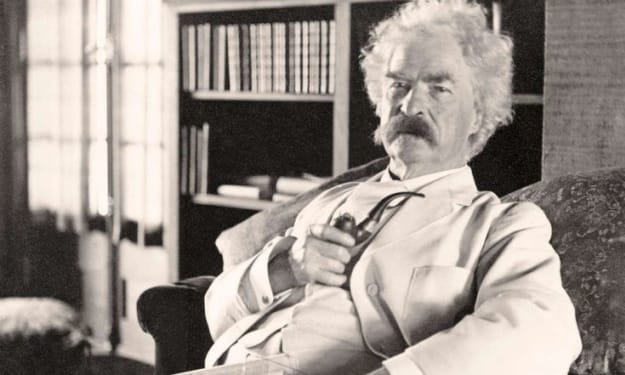
Have you ever wondered what it was like to grow up along the Mississippi River during a time when America was transforming faster than anyone could imagine? Meet Samuel Clemens, better known as Mark Twain—a boy from a small Missouri town who rose from modest beginnings to become one of the greatest storytellers the world has ever known. Twain didn’t just write stories; he captured the soul of a nation, observing both its humor and its heartbreak with a sharp, unforgettable voice.
By Haroon Pasha4 days ago in Writers


Comments
There are no comments for this story
Be the first to respond and start the conversation.